


 Innovation & Entrepreneurship
 Strategy & Leadership

- Elite mentorship replaces informal advice with rigorous accountability.
- The “coliseum” format concentrates expertise to rapidly challenge assumptions.
- Mentors help founders focus on priorities and systematically de-risk their ventures.
- Smart questioning and active listening reveal both strategic and human dimensions entrepreneurship.
- Strong mentoring ecosystems also generate community, trust, and long-term support
networks. - The strongest mentor commitment includes investor-level conviction.
Building a deep tech startup is notoriously isolating. Founders must navigate scientific development, fundraising, strategy, and industrialization at once, often with little margin for error. For ventures working on systemic challenges such as climate change, the journey from laboratory breakthrough to market-ready company demands more than goodwill or generic advice.
What makes the difference is a highly structured form of mentorship: one designed to test assumptions, sharpen priorities, and accelerate execution. In this model, mentorship becomes an engineered system of support, combining intellectual pressure, strategic discipline, and real-world validation.
The “coliseum” model: collective intelligence under pressure
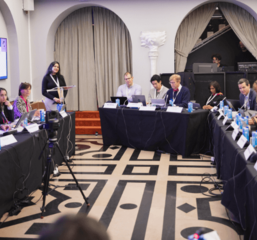
One of the defining characteristics of great deep tech mentorship is its format. Rather than relying on informal one-to-one conversations, some programs, such as Creative Destruction Lab (CDL), organize mentoring as a collective exercise where founders present their venture to a room of experienced entrepreneurs, investors, and scientists.
We can describe this approach as a “coliseum” model: a structured arena where a dense concentration of expertise challenges a startup’s assumptions, priorities, and strategy in real time. Each participant contributes a different perspective, scientific, operational, financial, or market-oriented, creating a multidimensional evaluation of the venture.
The value of this format lies in the collective pattern recognition it produces. When multiple experienced operators confront a founder’s strategy simultaneously, weak assumptions surface quickly and critical priorities become clearer. Instead of receiving fragmented advice over months, founders benefit from a concentrated burst of feedback that accelerates learning.
This environment also creates radical accountability. Because discussions take place in front of a group of experts, founders must articulate their decisions clearly and defend their strategic logic. Over time, repeated exposure to this scrutiny sharpens their thinking and helps translate technical ambition into concrete milestones.
At the same time, this approach gradually builds something equally valuable: a strong sense of community and trust. Over time, the mentor-founder relationship evolves into a durable support network. As Phil De Luna, CTO at Cura (CDL Climate), puts it: “The community and the lifelong friends I made through Creative Destruction Lab gave me the confidence and the ability to do what I’m doing now. I returned as a founder, so it’s a full-circle moment.”
Focus is a strategic discipline
One of the recurring challenges for deep tech founders is overextension. Scientific ambition can easily lead teams to pursue too many objectives at once, especially when the technology appears to open multiple possibilities. High-performance mentors counter this by enforcing radical focus, helping founders narrow the path and identify what is mission-critical.
This strategic focusing is closely tied to risk reduction. Because deep tech ventures often require substantial capital to move from prototype to manufacturing, founders must demonstrate that they can remove uncertainty step by step. Instead of scaling too fast or raising capital against an unproven concept, they are encouraged to follow a sequential trajectory.
Michael Hyatt captures this logic in what he calls the “crawl, walk, run” approach: the objective is not simply to grow, but to de-risk the venture in a way that makes growth investable. Here is what he tells entrepreneurs: “Your only job is to de-risk the deal for investors. And the more you can do, the less risk, the more risk you can take off the table, the higher your valuation.”
A rigorous environment to accelerate decisions
The most effective deep tech mentorship does not operate as a loose advisory network. It works through structure, intensity, and repetition. Founders are placed in a demanding environment where experienced mentors challenge their vision, question their assumptions, and push them toward measurable progress. This approach relies on procedural rigor: strict cycles, often compressed into intensive week-long sprints, create momentum and force decisions that might otherwise take months.
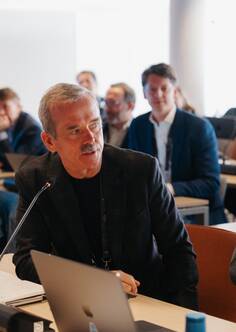
As Michael Hyatt, Founding Partner at Creative Destruction Lab, puts it, the program offers entrepreneurs "the fastest path to an outcome: to potentially have a great company, to build something massive." This speed, however, is not the product of unstructured creativity, it depends on a rigorous process. As mentor Olga Zorgati, Board Member at Ubisoft, explains: "To be very innovative, you need a lot of process. [...] Putting this in a very harsh environment, where you need to stop at all times, is very important."
Clearly defined milestones, regularly evaluating what works, and a demanding framework push founders to continually test their assumptions, pause to assess outcomes, and refine their strategic direction. Learning, in the process, to distinguish between merely "doing things" and making concrete progress.
Smart questions matter more than ready-made answers
The most effective mentors do not position themselves as all-knowing technical authorities. Their value lies elsewhere: in listening closely, understanding the founders’ real obstacles, and asking the questions that expose weak points in the company’s logic. This is a maieutic form of mentorship. Rather than prescribing every answer, mentors help founders surface the answers themselves through disciplined inquiry and accountability.
Olga Zorgati describes that posture this way: “My number one rule is try to listen first and listen not only with the mental but also with all of who you are to see what founders are trying to achieve...” CDL Climate Mentor Renaud Visage reinforces the same principle: “We’re here to ask smart questions. [...] Founders aren’t looking for scientific experts, they want people who help them overcome obstacles.”
This method creates a high standard of accountability. It pushes founders to ground ambition in facts, anticipate investor concerns, and develop what mentors repeatedly identify as a decisive signal of readiness: clarity of thought.
Deep tech needs both science and business fluency
Deep tech companies rarely succeed on scientific excellence alone. Their complexity demands a multidisciplinary environment in which technical expertise is complemented by market understanding, operational discipline, and strategic execution.
High-performance mentorship therefore works best when it bridges science and business. Scientific founders benefit from working alongside people who bring commercial frameworks, investor expectations, and organizational thinking into the room.
This kind of environment also enforces humility. Expertise is constantly relativized by the presence of others who understand adjacent fields more deeply. Michael Hyatt captures this dynamic in a striking phrase: “I always tell people: you’re the smartest person in the room for about 15 minutes. After that, someone sitting right next to you will know far more than you do about quantum computing or whatever comes next.”
That density of expertise is what allows founders to test their technology against the realities of company-building rather than against scientific standards alone.
The ultimate validation is capital commitment
Deep tech mentorship ultimately proves its value when ventures withstand market scrutiny and attract genuine commitment. That is why the strongest mentorship environments are connected to investment judgment. At the highest level, mentors are evaluating whether they themselves would back the company. Michael Hyatt states that expectation directly: “I don't believe in this process you should be putting up your hand if you're not willing to write a check. Will you invest in this company? That's the ultimate question.” When experts are willing to align their capital with their advice, mentorship reaches its clearest form of validation. Founders receive proof that their venture has crossed from promising idea to credible opportunity.
Mentorship, then, is not simply about helping deep tech founders think better, but also about building an environment where focus, accountability, and multidisciplinary challenges turn scientific potential into market-ready ambition. And for ventures tackling the world’s hardest problems, that architecture may be one of the most important scaling tools they have.
 Find out more



 Sustainability & Society