
 Innovation & Entrepreneurship


Founded in 2024, Pigmentoco is a clean tech startup co-founded by Amal Chebbi and Ayoub Lassoued in Tunisia. The company develops a waterless textile dyeing technology using supercritical CO₂, adapted to work on natural fibres such as cotton.
By eliminating water and chemical discharge from the dyeing process, Pigmentoco’s ambition is to address one of the most resource-intensive steps of the textile value chain. How? By offering industrial dyeing facilities a clean, closed-loop alternative that reduces both environmental impact and long-term operational costs.
The Problem
Textile dyeing is one of the most polluting stages of the fashion industry. It consumes around 1.9 trillion liters of water every year, most of which is discharged into the environment, contaminated with toxic chemicals. This pollution disproportionately affects countries in the Global South, including Asia and North Africa, where textile production is concentrated and where water scarcity is already a critical issue.
Beyond environmental damage, conventional dyeing creates structural inefficiencies for manufacturers: costly wastewater treatment, energy-intensive processes, and unresolved issues around toxic sludge disposal. As Amal Chebbi explains, discovering the scale of this impact was “shocking” and became the starting point for Pigmentoco’s mission.

The Solution
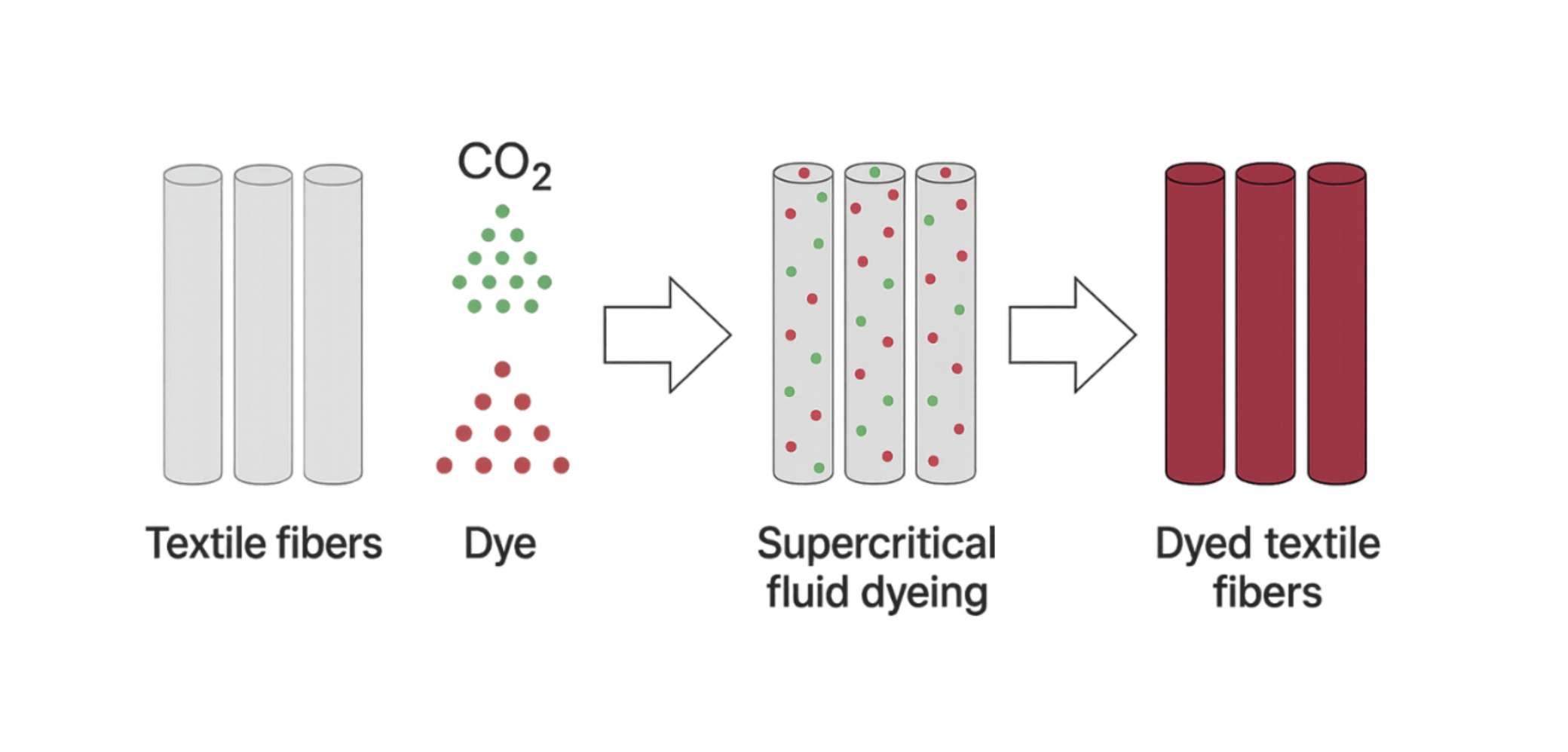
Pigmentoco uses supercritical CO₂ dyeing, a technology that replaces water with CO₂ in a closed-loop system. In this process, CO₂ is brought into a supercritical state, allowing it to transport dyes directly into textile fibers.
Pigmentoco’s key contribution lies in adapting this technology, historically limited to synthetic fibers, to natural fibers, beginning with cotton. Unlike other approaches, Pigmentoco integrates the dyeing process within the scCO2 closed system, eliminating conventional wet pre-treatment steps.
What makes Pigmentoco distinctive:
- A 100% water-free dyeing process, with no chemical discharge
- 96% CO₂ recycling within the system
- Reuse of excess dyes in subsequent dyeing batches
- No fixatives or auxiliary chemicals required
The startup is currently transitioning from a laboratory prototype to a semi-industrial scale and is actively seeking pilot projects.
Key Figures
- 0 water and 0 liquid discharge
- 40% less environmental impact compared to conventional aqueous dyeing (Life Cycle Assessment)
- 30% less dye consumption thanks to colorant recycling
- 1 ton of auxiliary chemicals reduced, improving worker safety by eliminating exposure to harmful substances
- Economic performance improves with scale and energy optimization
How They Did It
Pigmentoco started working through a partnership with a Tunisian research laboratory that had been working on supercritical CO₂ technology for over seven years, giving the startup immediate access to deep technical know-how and industry connections that the founders alone could not have built so quickly.
The founding duo brings complementary strengths: Amal Chebbi leads business strategy and market development, while Ayoub Lassoued, a physicist with a PhD, heads scientific and technical development as CTO. Beyond skills, Amal also stresses the importance of building the right team from the start, one defined by strong chemistry and complementary expertise.
Pigmentoco also benefited from structured support through the WomenEntrepreneursforGood (WE4G) program operated by HEC Paris, described by Amal Chebbi as “one of the most structured and personalized programs I have experienced.” The program played a decisive role in meeting their first development milestones and structuring their strategic expansion into France and Europe.
What’s next
Pigmentoco is currently focused on industrial validation through pilot projects with textile manufacturers. Priority targets are industrial players that already operate supercritical dyeing equipment, enabling faster market entry.
The startup plans to first commercialize its technology through the licensing of its process and formulations, enabling industrial players to integrate the solution into existing CO₂ dyeing systems. Once the process is validated at scale and sufficient resources are secured, the company intends to expand into manufacturing and supplying its own dyeing machines.
In parallel, Pigmentoco provides tailored sustainability services to textile manufacturers around coloration and decoloration processes, helping them reduce water usage, chemical impact, and overall environmental footprint, in line with its mission to detoxify and optimize resource use across the textile value chain.



 Strategy & Leadership