


 Sustainability & Society

- Vulnerability is multidimensional — economic, relational, systemic — and often invisible.
- Efficiency-driven cultures can unintentionally reinforce exclusion and mistrust.
- Trust and psychological safety are essential for employees to thrive.
- Inclusive governance means giving vulnerable voices real power, not symbolic participation.
- Partnerships with civil society and government are crucial to addressing systemic roots.
Leadership Beyond Efficiency
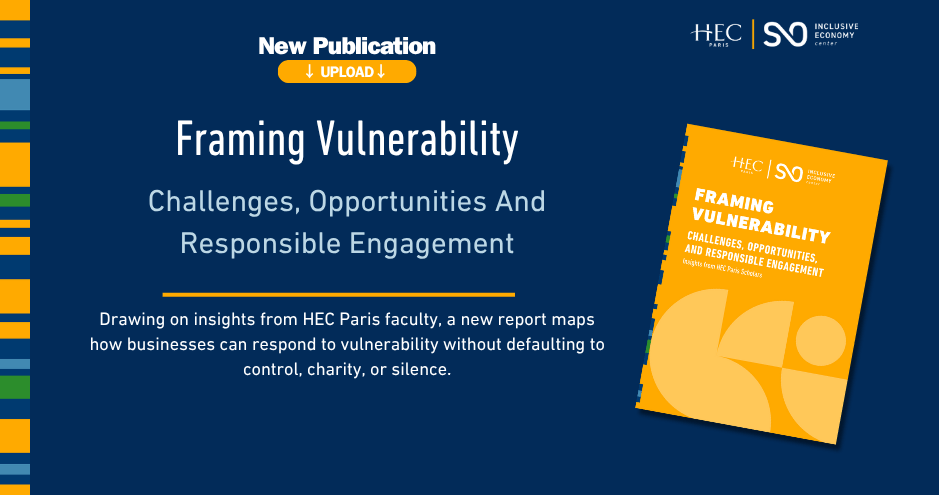
Vulnerability isn’t just an issue “out there” in society. It exists inside every team, every boardroom, and every strategic decision. In a new report “Framing Vulnerability: challenges, opportunities, and responsible engagement” published by the HEC Paris Inclusive Economy Center, postdoctoral researcher Octavio De Barros shows how organizational mindsets built on control and efficiency often clash with the lived experience of vulnerable individuals — whether employees, customers, suppliers, or communities.
Drawing on interviews with ten HEC Paris faculty members across economics, strategy, accounting, and organizational behavior, the study reveals that while companies cannot solve systemic problems alone, their choices matter. Ignoring vulnerability can exacerbate exclusion and mistrust, particularly harming already vulnerable groups. In contrast, by acknowledging it, firms can foster resilience and inclusion, which are key drivers of long-term, sustainable performance.
Why Businesses Must Reframe Vulnerability
Organizations have long been conditioned to view vulnerability as a risk to be mitigated — something external and manageable, often quantified in terms of exposure to harm. This framing makes sense for setting corporate strategy, but it falls short of the lived reality.
As HEC Professor of Management Control, Finia Kuhlmann explains, risk-based approaches offer the illusion of control: “When organizations talk about vulnerability in terms of risks, it means they can mitigate, they can make a plan. Whereas vulnerability in this much more existential, unavoidable way is just scary”.
True leadership means reframing vulnerability not as risk or as a weakness that can be readily adjusted, but as a shared human condition that influences decision-making, agency, and organizational life.
When Good Intentions Reinforce Structural Harm
Many firms adopt “care” or “provision” mindsets, offering support programs or aid. Yet, as several HEC scholars caution, well-meaning initiatives can inadvertently worsen vulnerabilities.
Charles Autheman, HEC lecturer in Human Rights points out that organizations often act without a clear planning: “Trying to act mildly on all sorts of vulnerabilities might end up producing nothing if not more vulnerability”.
The danger lies in failing to listen to the needs of vulnerable individuals and, consequentially, setting the wrong priorities: when managers define who is “vulnerable” and impose solutions from above, they risk reinforcing dependency rather than fostering agency. As Professor Nathalie Riond, Director the HEC Paris Stand Up program, argues, vulnerable groups must not be treated as passive beneficiaries but as partners in designing solutions.
From Metrics to Meaning: Rethinking How We Measure Well-Being
Organizational systems thrive on metrics — productivity rates, engagement scores, ESG rankings. Yet, these numbers rarely capture what it feels like to be vulnerable.
Professor of Economics, Yann Algan stresses that standard indicators like income or inequality “do not explain attitudes. What really has an impact is when you ask people if there’s anyone they can count on in times of trouble. This is real vulnerability”.
Measurement itself can distort behavior, pushing individuals to prioritize what is counted rather than what they value. To avoid this trap, organizations should combine quantitative analyses with qualitative insights — focus groups, trust surveys, open dialogue — to capture the complexity of human experience.
Toward Trust-Based Cultures and Inclusive Governance
At the heart of responsible engagement is trust. As Professor of Human Resources Audrey Holm explains, psychological safety is essential: “If you want your people to work at their best, they need to feel safe that they can tell you what they’re going through”.
Building this culture requires shifting from a “provider” mentality to inclusive governance. Professor of Strategy, Bénédicte Faivre-Tavignot outlines a progression: include vulnerable voices, empower them to make decisions, and incentivize openness within teams. Vulnerability, once acknowledged, can become a source of collective strength.
Professor of Accounting Daniel Martinez adds: “Firms need to listen more, to be supportive, good allies and learn from their stakeholders’ experiences. They don’t have to be the leaders all the time”.
The Road Ahead: Actionable Paths, Not One-Size-Fits-All Solutions
The report offers six guiding principles for organizations committed to engaging with vulnerability responsibly:
- Abandon the “generous provider” mindset — focus on learning and humility.
- Recognize literacy gaps — seek guidance from nonprofits, governments, and academia.
- Foster trust and empowerment — build psychologically safe workplaces.
- Rethink measurement systems — balance metrics with lived experience.
- Embed inclusive governance — give vulnerable groups a seat at the table.
- Leverage partnerships — align with actors better equipped to tackle systemic issues.
No single organization can fix structural vulnerabilities such as poverty or discrimination. But businesses can avoid making them worse — and, when acting with humility and openness, they can become part of the collective effort to create more inclusive societies.
Far from being a liability, vulnerability is an inherent part of the human experience – and recognizing it can be a powerful leadership asset. When leaders acknowledge vulnerability in themselves and others, they cultivate empathy, build trust, and promote collective growth.
As Barros concludes, “Acknowledging vulnerabilities can serve as a pathway to becoming stronger and more resilient”. For organizations navigating an era of crises, this may be one of the most strategic lessons of all.
Find out more: watch the conference of the vulnerability replay (in French)


 Innovation & Entrepreneurship


 Economics & Finance