
Leading Through Disruption: How Lex Mundi is Shaping the Future of Legal Leadership in an AI-Powered World
As the world’s largest network of independent law firms, Lex Mundi connects 125 jurisdictions through a shared commitment to excellence. Its role, says President & CEO Helena Samaha, is not only to link firms together but to give them the tools to remain competitive — especially as the business of law is redefined by global crises and generative AI.
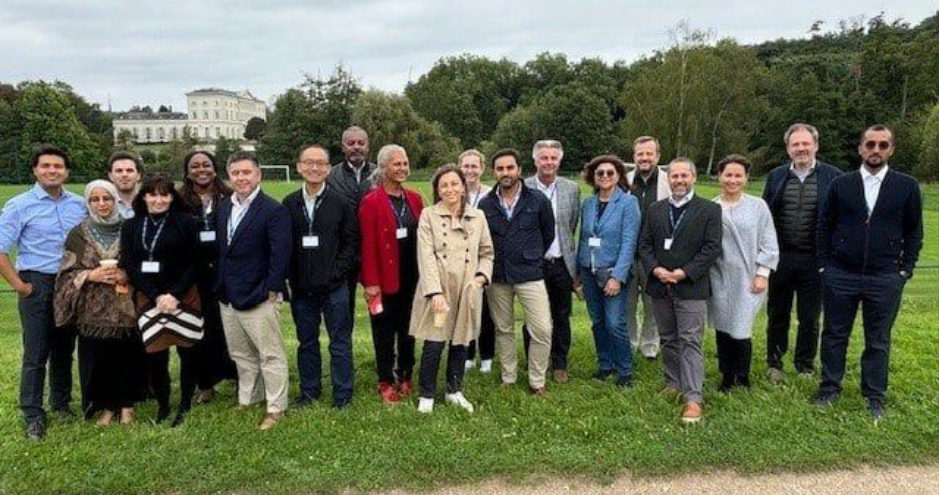
Participants at HEC Paris le Château
In recent years, surging regulatory complexity, geopolitical fragmentation, and the meteoric rise of generative AI have converged to redefine what it means to advise clients at the top end of the legal market. Visiting firms on-site, Helena Samaha has observed both common ambition and uneven readiness: partners everywhere want to remain market leaders and to innovate, but many lack the strategic and technological muscle to keep up with the pace. To ensure its value proposition and nurture its network of managing partners, Lex Mundi decided to launch a development program in partnership with HEC Paris Executive Education.
A sector at an inflection point worldwide
According to Helena Samaha, President & CEO of Lex Mundi:
“Law school doesn't really teach you business skills. If you're a lawyer, you have to learn those along the way or do a special business course.”
Leadership programs aren’t new at Lex Mundi. Half of Lex Mundi’s own team got upskilled to remain relevant in their practice, while the Lex Mundi Institute has been offering leadership training and workshops to members for 21 years. However, COVID-19 and what followed after (the Ukrainian war, global inflation crisis, Middle East war, etc.) have shown that most business leaders including law firm leaders had not anticipated the rapid cumulation of these crises.
At the same time, law firms were facing another key challenge: Artificial Intelligence (AI). “Priorities now differ by region, as AI regulation unfolds at varying speeds,” she notes. Younger lawyers also expect purpose-driven leadership— and they want to benefit from new technologies to fast-track their careers. This directly challenges the traditional apprenticeship model. Yet, the culture of knowledge retention remains deeply rooted within law firms.
However, the culture typically found in Lex Mundi firms is different and offers an inherent advantage as Vice-President David Sanders explains: “Inside Lex Mundi, everybody’s open. Whether you’re a big firm or a small one, you hear what the cutting edge is, and how to replicate it cost-effectively thanks to members’ willingness to share. That ability to learn from others is incredibly powerful and Lex Mundi plays a critical role in facilitating those exchanges”. In the past, Lex Mundi has already produced comparative guides on AI, GDPR, and antitrust, and brought that global knowledge back into the membership. "Nonetheless, we came to realize that our leadership training needed to be adapted to today's environment, focussing on converting the challenge of transformation into an opportunity," Helena Samaha observed.
To harness that openness and upskill the network, the Lex Mundi leadership team raised a fundamental question: “If it isn't traditional leadership training, what should it be?” This is how three pillars that they believe to be essential for leadership training today emerged:
- Resilience to lead through continuous disruption,
- Embracing an entrepreneurial mindset,
- Leading and strategizing for innovation.
These requirements would serve as the foundations for a structured, high-impact development program focused on disruption, strategy, and personal leadership.
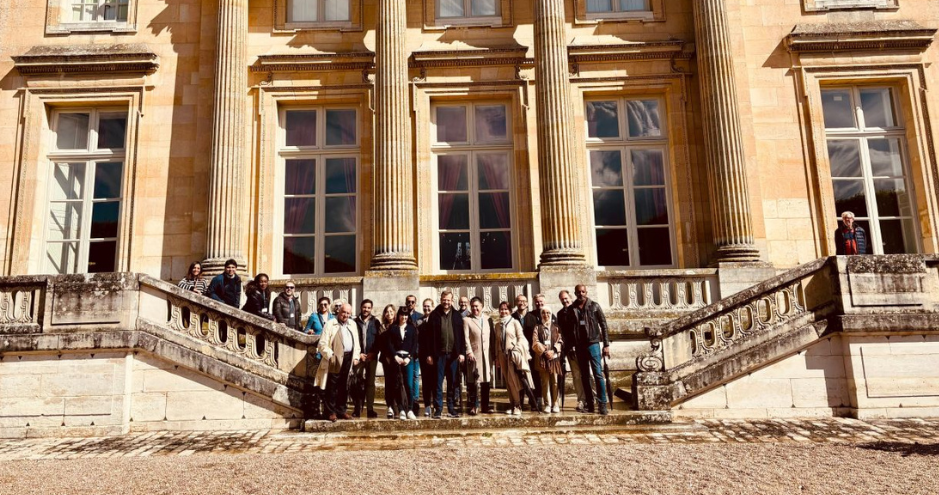
Participants in front of Le Petit Trianon at Versailles
Co-creating HEC Paris’s signature-based learning journey
Following a competitive Call For Tender, Lex Mundi selected HEC Paris for its blend of business acumen and legal-industry insight. Co-design workshops with HEC Paris faculty, Helena Samaha’s leadership team and the Lex Mundi Institute produced the Executive Business Program for Law-Firm Leaders: a residential, cohort-based experience hosted at HEC Paris Le Château and the Paris innovation hub Station F, preceded by a Hogan psychometrics leadership assessment and a one-to-one coaching session.
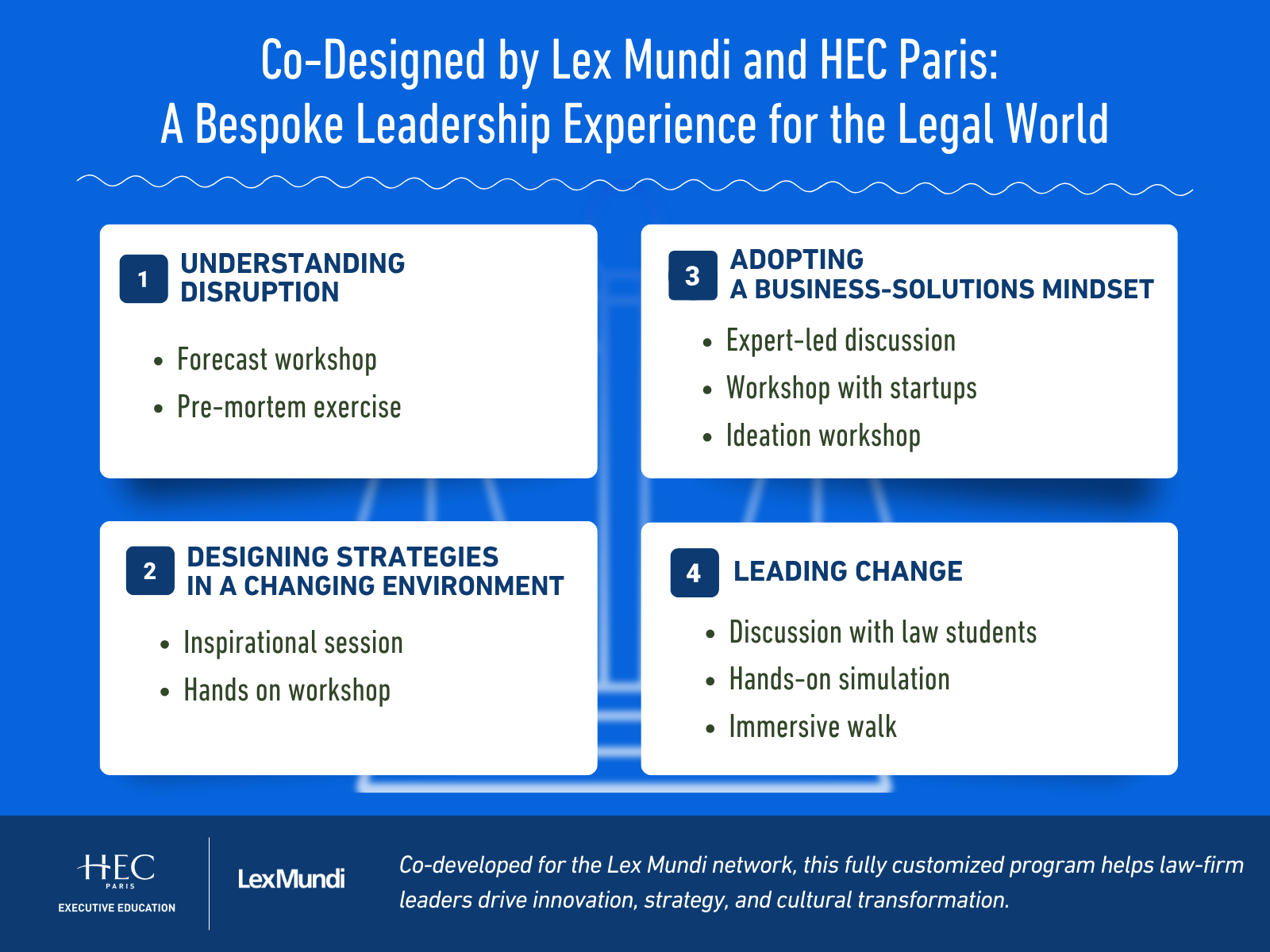
4 days. 4 learning pillars. 100% co-designed for Lex Mundi
The inaugural session, led under the supervision of David Restrepo, Academic Director and HEC Paris Associate Professor in Data Law & AI, focused on four learning pillars—all representative of HEC Paris’ faculty signature methods:
Pillar 1: Understanding disruption
This first day, aimed at strengthening the participants' own vision of the future, kicks off with a forecast session “The Future Is Now”, led by Professor Jeremy Ghez, and followed by a pre-mortem exercise where managing partners are facing an unexpectedly disrupted legal market with free competition.
Pillar 2: Designing strategies in a changing environment
Through a hands-on workshop on how to ‘Think strategically and innovatively’, participants are invited to rethink business models of law firms, and explore innovative value creation based on the original and stimulating Odyssey 3.14©, developed by Professor Laurence Lehmann-Ortega. To get even further in their innovative strategic thinking, the cohort actively participates in an insightful workshop, facilitated by Professor David Restrepo, on the disruptive potential of AI, and its integration into legal practice to turn it into strategic leadership.
This is exactly what Maria Zoupa, Partner at Zepos & Yannopoulos, did upon completing the program. “I actively engaged the executive committee in a discussion on legal LLMs (Large Language Models) and how the firm should address them.” Similarly, Megan Deleon, affirms the program gave her a solid foundation for understanding AI composition and outputs. “This knowledge enabled me to engage in credible client discussions on integrating AI to strengthen the attorney–client relationship and improve efficiency, while also anticipating issues before they escalate into conflict”, she explains.
Pillar 3: Adopting a business-solutions mindset
During a session guided by John Mawdsley, participants explore client-centric business opportunities and fortify their relationship-building acumen through strategic conversations. What is more important: identifying new needs from existing clients or gaining new clients? How and when leverage client relationships when a client is attached to several partners? After answering these questions, participants immerse themselves in the dynamic environment of Station F, where they engage in open, thought-provoking exchanges with innovative legal tech startups. Drawing on both experiences, they are challenged to generate new value propositions for the legal industry during an ideation workshop.
Pillar 4: Leading change
Anchored in a business simulation delivered by Professor Mathis Schulte, legal leaders are stretched in their understanding and approach to change. They also engage in an in-depth discussion with legal students on their career prospects before enjoying an immersive walk at the Château de Vaux-le-Vicomte to cultivate self-awareness, and reflect on their personal and group learning journey.
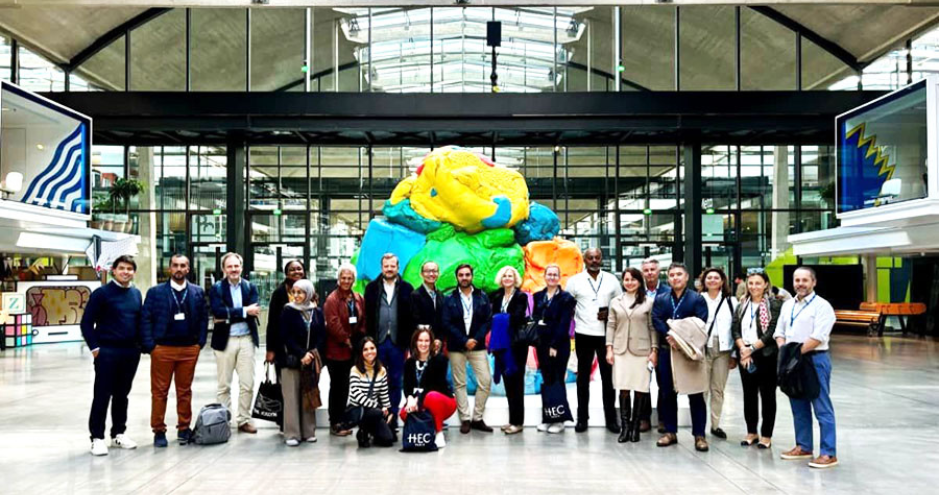
Participants at Europe’s biggest startup campus Station F
Instant impact, lifetime outcomes
4.87/5
Overall satisfaction from 18 participants
From Individual Insight to Collective Leadership
Impact does take many forms in this particular program. For Helena Samaha and David Sanders, who experienced it first-hand, as well as the legal firm leaders, the learning journey allows a perfect continuity between individual development and group immersion, fostering a whole new approach to things.
David Sanders, Vice-President of Lex Mundi, explains:
"For me, it was truly impactful—almost life-changing in how I approach work—because although I always saw myself as resilient and set in my ways, the program, especially Laurence Lehmann-Ortega’s session, really pushed me to be more open and willing to consider new perspectives– which is mind-blowing after so many years of practice."
Maria Zoupa experienced a similar realization and has since adopted a more reflective approach in meetings: “I listen more before speaking, seeking a consensus and synthesis rather than focusing on differences of opinion. In the past, I sometimes viewed certain situations as insurmountable,” she admits.
Aligning Management with Emerging Talent Needs
The faculty at HEC Paris knows this all too well: sometimes a gentle confrontation is exactly what opens our eyes. For the legal leaders, their conversation with young law students who had left law-firm life proved to be one of the program’s most enlightening moments. To the question: “Why are people like you, among the brightest students and graduates, leaving law firms?”, managing partners, who don't often have the opportunity to interact with the trainees coming in, got a chance to get an honest and quite brutal answer.
David Sanders recalls: “I've seen wellness presentations in law firms fall flat because they're aimed at senior corporate lawyers used to 60-hour weeks and multi-million dollar deals, but when you put them in front of young lawyers or entrepreneurs, it suddenly becomes clear there's another way, broadening everyone's perspective and creating something truly magical.”
For Maria Zoupa, this transformative dialogue led to immediate action: “Following the session, I discussed findings with our HR department and the executive committee, and we have been working since then to structure the career paths of younger generation, and integrate them into our succession plans.”
Leadership in Action: Strategic Alignment and Cultural Shift
Strategy, organization and culture will never be the same for the participants of the program.
Megan Deleon confirms that the program has further supported internal strategic discussions and alignment within her organization: “I now have the ability to synthesize broader strategic initiatives surrounding AI with the tactical aspects of development and implementation.” She also feels that her training and education at HEC Paris have enabled her to be “full circle” in her day-to-day leadership and management roles.
Maria Zoupa, on her side, now recognizes the need to delegate more in order to free time for strategic thinking. She set a concrete target of increasing delegation by 50%, a goal she has already achieved. “Stepping back from day-to-day production has allowed me to empower my experienced partners to take the lead and consult me when needed, while I focus more on business development and planning.” She is now actively participating in the executive committee meetings, as well as reassessing the firm’s organization with a renewed perspective gained from the session.
It didn’t stop there. Maria Zoupa also initiated a series of meetings between her practice and other firm practices, encouraging participants to exchange business development opportunities for mutual benefit, rather than focusing solely on their own practice’s gains. To turn this into action, she set specific goals, she set specific targets: “I established a goal to conduct client visits with an organized team and a clear, unified message. I regularly monitor progress and goal achievement.”
Helena Samaha can also attest to the mindset shift among participants, as law firms are now discussing the possibility of investing in startups—a relatively new development in the sector. “I do think we underestimate the world of startups and their impact. And interestingly, the topic comes up in conversation with our law firms: who's investing in startups, why, etc.?”
Finally, who would have expected that the ‘blue sky thinking’ session in the gardens of Versailles would turn out to be one of the most unexpected — yet powerful — experiences? The session received a perfect 5/5 rating from every attendee. Why? Because it provided the ideal space for participants to absorb their learning and envision how to implement new ideas back at work.

Immersive walk at Le Petit Trianon
Holger Alfes, a participant from Noerr, reflected on the unique perspectives shared throughout the program: “The diversity in personalities and the resulting views on the structuring of change processes was astonishing...I [now] look much more optimistically into the years to come in such transformative times.”
Other participants’ own words testify to the powerful impact the program had on them:
“A truly excellent and differentiated leadership training. First-class trainers and a fresh take on skills for leaders, such as the garden walk.”
“It went beyond my expectations by incorporating current challenges in the strategy training and alternative ways of learning, like the walk in Versailles and interactions with entrepreneurs. A top experience for me!”
“Fantastic program. We should continue combining history, culture, and future-facing content like tech and innovation.”
This custom program is a reminder for all leaders within the network and beyond that the starting point is you and your personal development, because working on yourself is the most powerful lever to lead others with purpose and credibility.