
Family Offices & Private Equity: An Increasingly Close and Active Relationship
Cross Perspectives on the Transmission and Investment Issues Facing Family Businesses
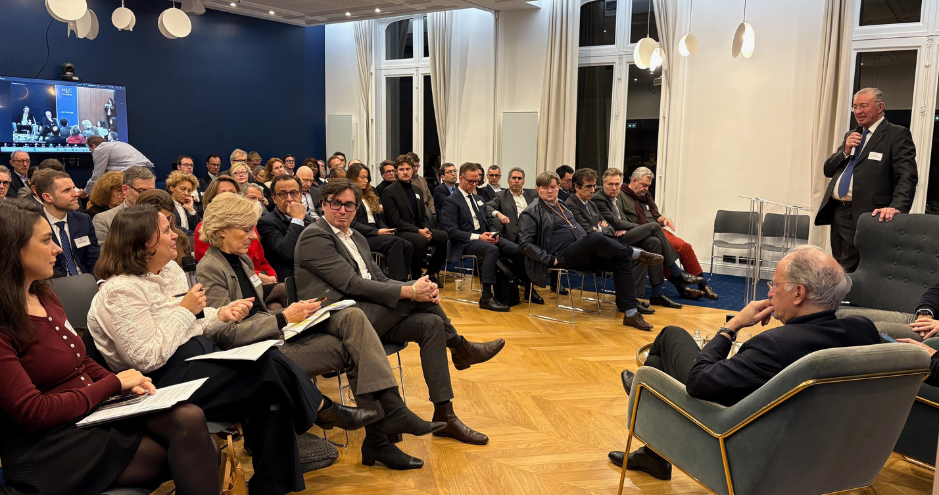
On February 2, 2026, the HEC Alumni – HEC BACI (Investment Banking & Private Equity Group) hosted a conference dedicated to the evolving relationship between Family Offices and Private Equity. The event brought together nearly 180 participants, both in person and online, including private capital professionals, Family Office representatives, and experts in family businesses. The conference was moderated by Patrick Lissague (H.78), Founder and Honorary Chairman of the HEC BACI group, who guided the discussions around the major developments shaping the dialogue between Family Offices, Private Equity, and family-owned businesses.
The discussions brought together several leading figures from the ecosystem, including:
- Christel Bapt, Founder of Cedrus & Partners and Chairman of the Private Assets Commission at Association Française du Family Office (AFFO),
- Frédéric Crot, former Chairman of the Association Française du Family Office (AFFO) and current President of the International Forum of Family Offices (IFFO),
- François-Xavier Mauron, Co-Managing Partner at Andera Partners and President of the HEC BACI group,
- Sophie Wigniolle, Partner at Eric Salmon & Partners,
- Diane Laure Zipper de Fabiani, Head of the HEC Alumni Family Business Club,
- Grégoire Loustalet, Partner at LWM, PhD in Law and Taxation,
- as well as Cécile de Lisle, Executive Director of the HEC Paris – Dieter Schwarz Center for Family Business.
Family Offices: Increasingly Institutional Long-Term Investors
Discussions highlighted the growing prominence of Family Offices as major players in private markets. Long perceived as atypical investors, they are now adopting increasingly structured practices, including formal investment committees, rigorous selection processes, diversified strategies, and a rising use of co-investments alongside Private Equity funds.
While moving closer to institutional standards, Family Offices retain distinctive characteristics: an intergenerational vision, the ability to operate with a long-term horizon, and a strong focus on alignment of interests, values, and governance.
Business transfer: a clearly established order of priorities
In her remarks, Cécile de Lisle highlighted a structuring principle for family businesses engaged in a transmission process:
“When considering succession, the primary question remains the transmission of the business itself. The Family Office comes next.”
This perspective underscores that, for many families, issues of governance, management succession, and business continuity take precedence over wealth structuring. In this context, the Family Office and Private Equity serve as tools supporting transmission pathways rather than as ends in themselves.
Private equity and family businesses: a changing partnership
Discussions also highlighted the growing role of Private Equity in the trajectories of family businesses—particularly as a partner in first-time capital openings, a driver of growth, and an intermediate solution between strictly family ownership and public listing. At a time when a significant share of European family businesses is expected to undergo generational transfer over the next fifteen years, the relationship between Family Offices, Private Equity funds, and family-owned companies appears more strategic than ever. It is grounded in strengthened dialogue, a nuanced understanding of both human and wealth-related challenges, and the ability to support long-term transformation.