
Governance: A Key Driver of Family Business Longevity
The HEC Paris Family Business Center had the pleasure of introducing the roundtable organized by the HEC Alumni Governance Club on the theme: “Governance: The Key to Ensuring the Longevity of Family Businesses.” This introduction provided an opportunity to present the newly created Center and to highlight the growing importance of family businesses within the HEC ecosystem, before giving the floor to the insightful discussion between Caroline Bois (Andromède / Rémy Cointreau) and Éric la Bonnardière (Tarkett / Evaneos), expertly moderated by Laurent Allard (Family & Co).
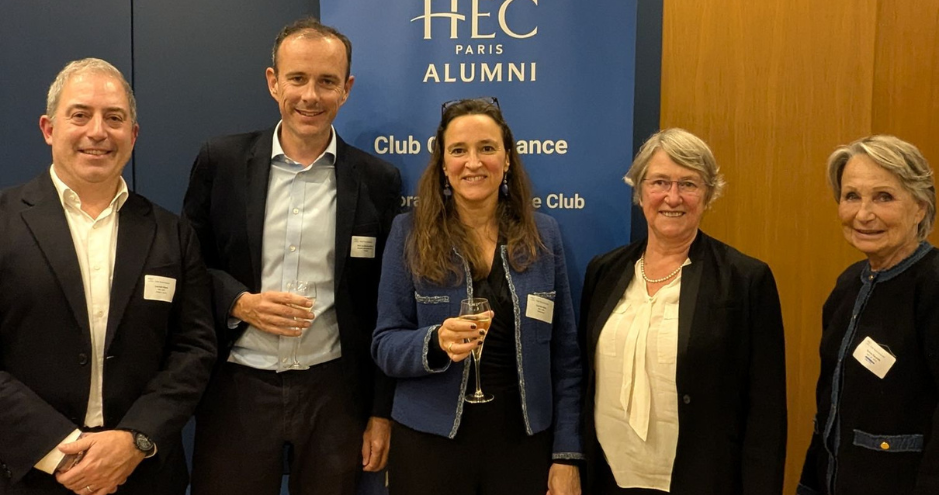
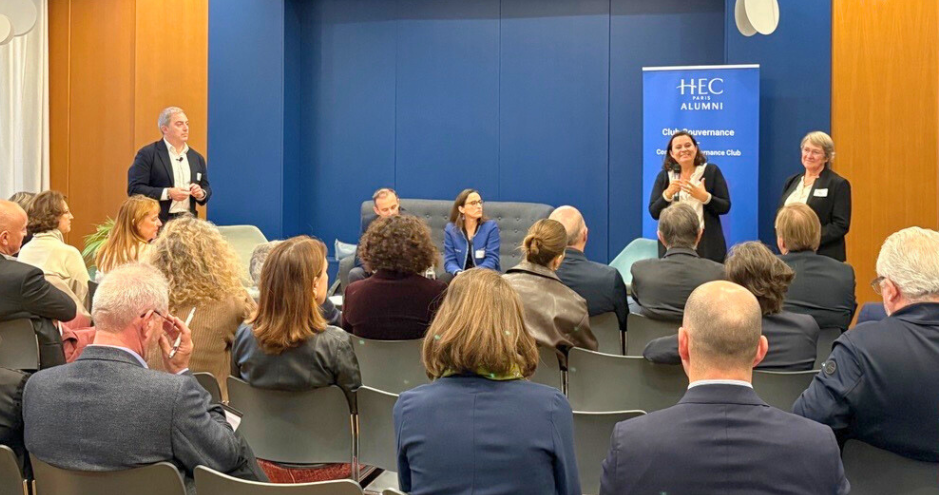
Moderated by Laurent Allard (H.01), the roundtable gathered a full room at the HEC Alumni Association in Paris. Two leaders from emblematic entrepreneurial families shared their experience:
- Caroline Bois (H.97), Executive Director of the family-owned Andromède Group and Vice-Chair of the Board of Rémy Cointreau;
- Éric la Bonnardière (M.06), Chair of the Supervisory Board of Tarkett Group and Founder of Evaneos.
From Transmission to Co-Construction
The speakers emphasized that family governance is built over the long term—well before the formal transfer of leadership. In both families, succession was prepared gradually over more than a decade: cross-generational discussions, support from independent board members, and clarification of the shared purpose.
“Governance is only a tool serving a collective project,” stresses Caroline Bois. “We first worked on defining our identity as active shareholders, then designed the governance bodies to support it.”
When “Hard Law” Meets “Soft Law”
Formal mechanisms—bylaws, shareholder agreements, age limits—provide clarity. But “soft law”—family charters, governance committees, mediation processes—creates trust.
At Andromède, a governance committee was established to objectify decisions and anticipate transitions.
At Tarkett, a family council ensures alignment between shareholders and leadership, and appoints members to the Executive Board and Supervisory Board of the holding company.
Uniting and Educating Shareholders
Both families place great emphasis on shareholder education and cohesion: extended general assemblies, seminars, factory visits and internal newsletters strengthen a sense of belonging.
“We have created many rituals so that family members feel involved in the strategic project and its impact,” says Éric la Bonnardière.
“The family must be able to speak with one voice, particularly in its relationship with the executive leadership,” adds Caroline Bois.
These rituals nurture a living form of governance—one where every family member feels legitimate, informed and heard.
Anticipating Tensions, Fostering Trust
Both speakers highlighted the importance of dialogue and transparency to avoid friction.
Éric la Bonnardière reflected on the tensions faced by the previous generation, which led his own cohort to introduce more listening, conviviality and structured discussion. Today, trust between the family, the chair of the board and the executive team is seen as a major lever for long-term continuity.
A Governance That Extends Beyond the Business
The families also discussed the philanthropic dimension of their governance: endowment funds and collective initiatives serve as learning platforms for younger generations and reinforce the social contribution of entrepreneurial families.
In conclusion
This roundtable demonstrated that family governance is far more than a set of rules: it is a long-term culture built on trust, dialogue and transmission. More than ever, it remains the cornerstone of family business longevity and a pillar of the human-scaled economy that HEC Paris seeks to understand, support and advance.
Learn more about the Family Business Center