


 Brands & Behaviors
 Strategy & Leadership


- Compensation linked to experience peaks at 3.4 years for salespeople and 6.4 for sales managers
- Sales managers are rarely promoted from sales roles — most are hired from other functions
- Pay increases early in careers but follow a sharp inverted-U curve, creating opportunity costs for long-tenured staff
- Sales experience is valued more than firm or industry experience — and more than sales experience in managerial roles
In sales, sticking around too long may actually cost you. Our research analyzing 25,000 sales and sales management careers finds that pay growth linked to experience peaks at just 3.4 years for salespeople and 6.4 for managers. Beyond that, salaries stagnate — and opportunity costs rise. These findings reshape how firms should think about mobility, compensation, and career progression in sales-intensive organizations.
Experience as a proxy for quality
It's clear that work experience is a valuable metric for employers. When other markers of quality (in terms of job performance) are absent from a candidate’s credentials, hiring managers look to an applicant’s level of experience and whether they have industry-specific experience to help them select the right person.
We wanted to understand how experience translates into compensation value, and whether different kinds of experience – in an occupation, a firm, or an industry – were valued differently. To do that, we looked at the paycheck data of around 25,000 sales employees working in France between 1994 and 2015.
One sector, two career paths
A few trends quickly emerged. We found that sales managers and salespeople have quite different career paths and compensation levels across their professional lifetimes.
You might think that salespeople would be the obvious candidates for sales management roles, but in fact the opposite is true. A sales manager is not typically promoted from a sale position. They are much more likely to be drafted in from another function within the same firm. And the longer a person works in sales, the less likely they are to become a sales manager.
Three times out of four, employers employ sales managers from within their firm. And two times out of three, they are recruited from other managerial functions. This makes sense, given that an internal hire is a known quantity, and their skills and organizational fit are verifiable.
However, many new sales managers have zero sales experience. Their managerial experience is apparently what counts.
Time to move on?
Another striking pattern is the speed with which experience ‘decays’ in sales and sales management. The amount of compensation that results from an individual’s experience describes an inverted U shape, rising at first before plateauing off and then going into decline as a person’s experience increases.
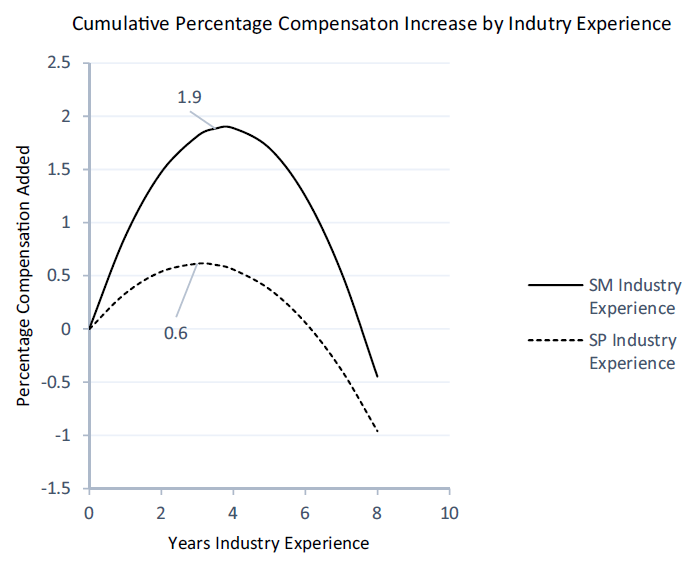
n the graphic: Industry experience and compensation. Note: A salesperson on the dashed curve has 0 years of industry experience at the start of his/her career. After 6 years, his/her compensation has increased by 0.06% as the result of his/her cumulated industry occupation experience.
This trend is the same across all three types of experience we measured. It also holds true for salespeople and sales managers, although the time it takes to plateau, and decline is different for the two groups.
Although the pay-packet does not literally decrease in size after the plateau phase, it is less than the individual could earn in another job, role or industry, so the ‘loss’ is in the form of an opportunity cost.
Fascinatingly, our data showed us precisely how far into their employment the average sales professional would get before it made financial sense for them to leave.
For sales managers and salespeople alike, experience-related compensation climbs for around 3 years before levelling off. The figures are 2.9 years on average for salespeople, 3.4 years on average for sales managers. During that time, pay increases at 1.1% per year for salespeople and 3% for sales managers.
Salespeople’s career moves are mostly within an industry, according to our data. The compensation value related to industry experience peaks at around 3.1 years for salespeople and 3.6 years for sales managers. As before, the increase is greater for sales managers, at 1.9% per year, compared to just 0.6% for salespeople.
Occupation experience
Occupation is where the different values attached to experience for salespeople and sales managers really comes into focus. For salespeople, the peak in experience-related pay comes at 3.4 years. For sales managers the figure is almost double – 6.4 years. What’s more, during the ascending phase of the experience arc, sales managers’ pay increases by 13.8% each year. For salespeople, the increase is a more modest 3.25% per year.
For salespeople, sales experience is more valuable than firm or industry experience. In sales management roles, logically enough, prior experience in a managerial role is valued highly, despite that previous role not being sales specific. For both groups, it seems that value is placed on their role-specific transferrable skills – who you work for, and in what industry, matters less.
Why does experience change in value?
Our research supports a few hypotheses about why experience is valued differently over time. It may be that at first, payment increases in line with the acquisition of valuable skills and knowledge. Longer-term, an individual’s appetite to keep growing their abilities levels off as there are fewer opportunities to learn, and they become more preoccupied with professional obligations such as paperwork. Technological advancement could also play a role, as older employees are less inclined to learn and use new tools and systems, placing them at a disadvantage compared to younger colleagues.
The way remuneration relates to experience encourages salespeople to adopt a ‘sales identity’, where occupation is more consistent than firm or industry. It is occupational experience that employers seem to value most highly, suggesting that hiring a skilled salesperson is more important than finding one with industry or firm-specific experience.
We ran a comparative analysis with two other professions – accounting and HR – where skills are highly transferrable between companies and industries. We found that these ‘boundary spanner’ functions show similar patterns in how experience is valued by employers across firm, industry and occupation parameters.
Applications for salespeople and sales managers
Salespeople and sales managers have limited time during which financial rewards will increase. For salespeople, on average this is 3.4 years in sales occupations, though of course it will vary from person to person. Typically, it will make sense for a sales manager to stay in their role for 6.4 years before moving on.
For a salesperson wishing to transition to sales management, counterintuitively it may make sense for them to move first into a non-sales management role, and then sidestep into sales management, rather than to apply directly as a salesperson. Employers value management experience over sales experience in these roles.
We found that for new sales managers moving in from other job functions, there is more risk when they switch firms, industries or occupations if they have no sales experience at all. Leaders in sales can help offset this tendency by providing good quality support and training in sales-specific skills.
Implications for firms
Given high levels of employee mobility, firms should consider hiring sales employees with more experience. Salespeople may well leave, and firms will be financially better off hiring people with a few years of experience, as these are associated with lower payouts over the complete employment period. Overall, our findings reveal that firms should consider whole-career trajectories when designing compensation plans for sales employees, whether sales managers or salespeople, especially given their impact on a firm’s all-important bottom line.
Methodology
We used data from a large-scale administrative database (the Annual Declaration of Salaries, accessed 2022) based on mandatory employers' reports of each employee's gross earnings subject to payroll taxes from 1994 through 2015 in France. We combined this data with occupation codes that correspond to sales manager and salesperson roles, and eliminated all but those who had worked full time for at least 3 months.
Watch the RESKILL Masterclass
{"preview_thumbnail":"/sites/default/files/styles/video_embed_wysiwyg_preview/public/video_thumbnails/INQ-3po6zgQ.jpg?itok=JBiWhEQ2","video_url":"https://www.youtube.com/watch?v=INQ-3po6zgQ","settings":{"responsive":1,"width":"42","height":"42","autoplay":0},"settings_summary":["Embedded Video (Responsive)."]}
Find out more on ActionCo (in French): Commerciaux : combien de temps rester en poste pour maximiser ses revenus ?
Sources
Based on an interview with Professor Dominique Rouziès and her paper, ‘How do firms value sales career paths?’, co-authored with Ali Reza Keshavarz, Francis Kramarz, Bertrand Quelin and Michael Segalla, published in the Journal of the Academy of Marketing Science, May 2023.



 Geopolitics & Public Affairs


 Innovation & Entrepreneurship