


 Strategy & Leadership
 Tech & AI
- Leadership legitimacy rests on the ability to make technological innovation - and the use of AI - socially acceptable and widely accessible.
- The biggest risk of automation is breaking the transmission of knowledge and triggering a “silent fracture.”
- In the AI era, competitive advantage depends on learning velocity, as well as ethics and the quality of moral judgment.
- Europe can turn regulation into a strategic edge by building trustworthy AI grounded in fairness, traceability, auditability, and confidentiality.
The Big Turning Point in Human Cognition
Artificial intelligence is not “just another” tech revolution; it marks a profound shift in human cognition itself. Like the printing press, electricity, or the internal combustion engine, AI is radically reshaping how we analyze, decide, and transmit knowledge. This is not simply about optimizing performance, it is a rewrite of our relationship with work.
That shift has hit with the force of a systemic shock. As Bloomberg recently reported, some consultants have started training their own models to automate their tasks, with the explicit aim of limiting hiring and bypassing traditional career paths.
This substitution mindset may promise immediate profitability, but it threatens to break the human value chain. In this new reality, a leader’s legitimacy rests less on technical mastery than on the ability to turn innovation into progress that is socially acceptable, and accessible to all.
The Easy Path of Automation or the Responsible One
Every technological rupture offers a tempting shortcut that eventually becomes a trap for an organization’s long-term viability. Today’s leaders face a civilizational choice: hollow out the organization through automation, or build resilience through people.
Choosing the “easy path”—replacing younger employees with algorithms—is a major risk factor. By depriving a generation of learning and on-the-ground experience, the organization destroys its own capacity to renew itself. Without transmission, there is no next generation—and without a next generation, the company compromises its ability to project itself into the future.
Preventing the “Silent Fracture”: Work as a Social Institution
Work is not merely a financial transaction. It is a foundational social institution, and a cornerstone of citizenship. Reducing employees to a cost that AI could erase means eroding the very foundations of our society.
The most insidious threat is the “silent fracture.” When we exclude the youngest workers from learning processes through excessive reliance on machines, we push them to invent “native,” agile, distributed organizations outside traditional structures. In those parallel models, knowledge will circulate frictionlessly, but also without “stewardship,” depriving incumbent firms of vitality and know-how. The imperative, then, is to adopt the strategy of the world’s best universities: don’t fight AI, learn to work with it. The goal is that any employee who leaves the organization does so equipped with augmented skills, rather than excluded by “progress.”
Ethics and Discernment: The Pillars of Leadership in the Age of AI
In an era of automation, leadership is defined by ethical legitimacy and the ability to exercise discernment. Since no human intelligence can rival the machine’s computational speed, the challenge shifts to the organization’s learning velocity—and the quality of moral judgment.
- Curiosity as a management principle. Leaders must institutionalize continuous exploration so that AI remains a tool for discovery—not a rigid automatism that freezes processes.
- Collective reflection. This is the organization’s vital defense mechanism. The goal is to turn data into shared intelligence—both to capitalize on knowledge and, crucially, to identify and correct excesses or biases in algorithmic models.
- Judgment. This is the ultimate frontier. Machines compute; only humans decide in the political and moral sense. Leadership is taking responsibility for consequences—where the machine offers only probabilities.
AI accelerates every knowledge cycle; human organizations must therefore learn at an equally sustained pace. The point is not to slow the machine down, but to ensure humanity stays ahead through discernment.
Europe’s Advantage: Regulation as a Strategic Edge
In the global race for power, Europe occupies a unique position, between the pursuit of performance and the demand for trust. Its tradition of law and restraint is not a handicap; it is a decisive strategic advantage.
The European framework (the AI Act) defines the anatomy of trust required for mass adoption: fairness, traceability, auditability, and confidentiality. For leaders, the challenge is to strike the right balance between raw performance and explainability. By demonstrating that fair, transparent AI can outperform opaque systems, Europe can propose a model of controlled progress, where technology serves a human purpose. Regulation then becomes the foundation of durable effectiveness, as opposed to productivity without resilience.
From Reflection to Action: The Mission of the HEC–Deloitte Chair
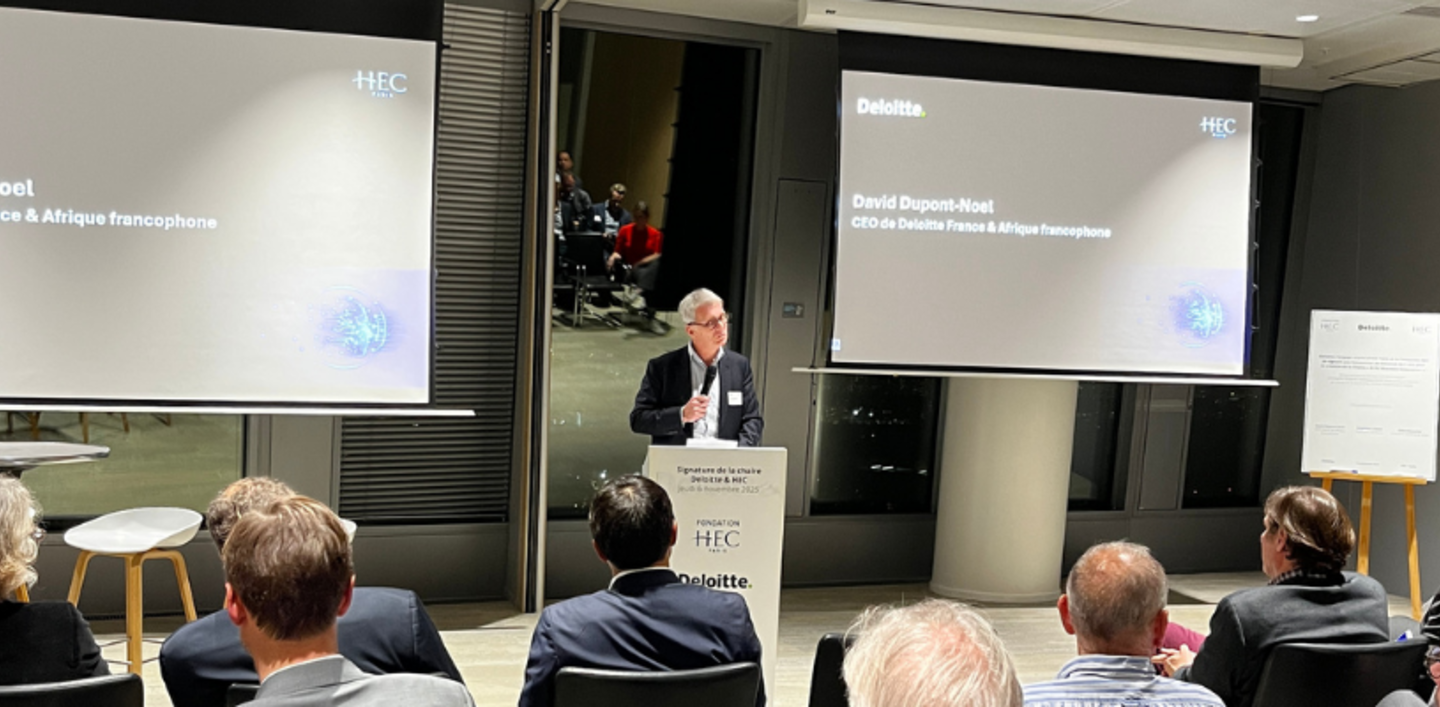
The ambition of the HEC–Deloitte “AI for Business Innovation” Chair is to turn these strategic reflections into operational levers for French companies. We are moving from experimentation to responsible implementation.
The Chair’s mission is structured around three concrete objectives:
- Producing useful research: documenting AI’s real impacts on decision-making structures and on performance/explainability trade-offs.
- Experimenting with frameworks and tools: developing transferable methodologies, tested with pilot companies ready to shape tomorrow’s standards.
- Scaling knowledge dissemination: supporting transformations through training and the sharing of real-world business cases from the field.
In the spirit of HEC’s motto, “Apprendre à oser” (“Learning to dare”), we urge leaders to choose the path of responsible boldness. AI will not replace leaders—but it will test their legitimacy. The future of work, and the very meaning of leadership, depend on our ability to invest—starting now—in transmission and human judgment.


 Innovation & Entrepreneurship


 Sustainability & Society