


 Strategy & Leadership

- Pirates agreed in advance on rules for dividing spoils, enforcing discipline and compensating injury, which helped prevent conflict at sea.
- Separating the roles of captain and quartermaster created counterweights and reduced the risk of leadership drifting into abuse.
- The people making decisions were also the ones who directly benefited from the gains.
- Captains could be removed by the crew, which gave them a reason to treat their men well and make sound decisions.
- The collective aim was clear and shared, which made coordination easier.
At first glance, pirates look like the opposite of a structured organisation: violent, undisciplined, bound by no rules at all. Yet research in economic history and governance points to something far more ordered. Georg Wernicke, a strategy professor on HEC Paris’s Strategy in the C-Suite certificate, puts it like this: “Imagine a crew of 50 to 100 men, from different backgrounds, from different countries, often armed, sometimes highly violent. They all have to live and work in an extremely confined space, on a ship that may stay at sea for weeks or even months. There is no outside authority to impose discipline or arbitrate conflicts.”
How do you organise a group like that? How do you set rules, divide responsibilities and keep cooperation intact? Pirate crews gradually developed governance mechanisms and collective rules that allowed them to function in highly unstable conditions. Far from the usual popular image, their organisation still speaks to some very current questions about governance.
Lesson 1: Rules need to be set before the crisis
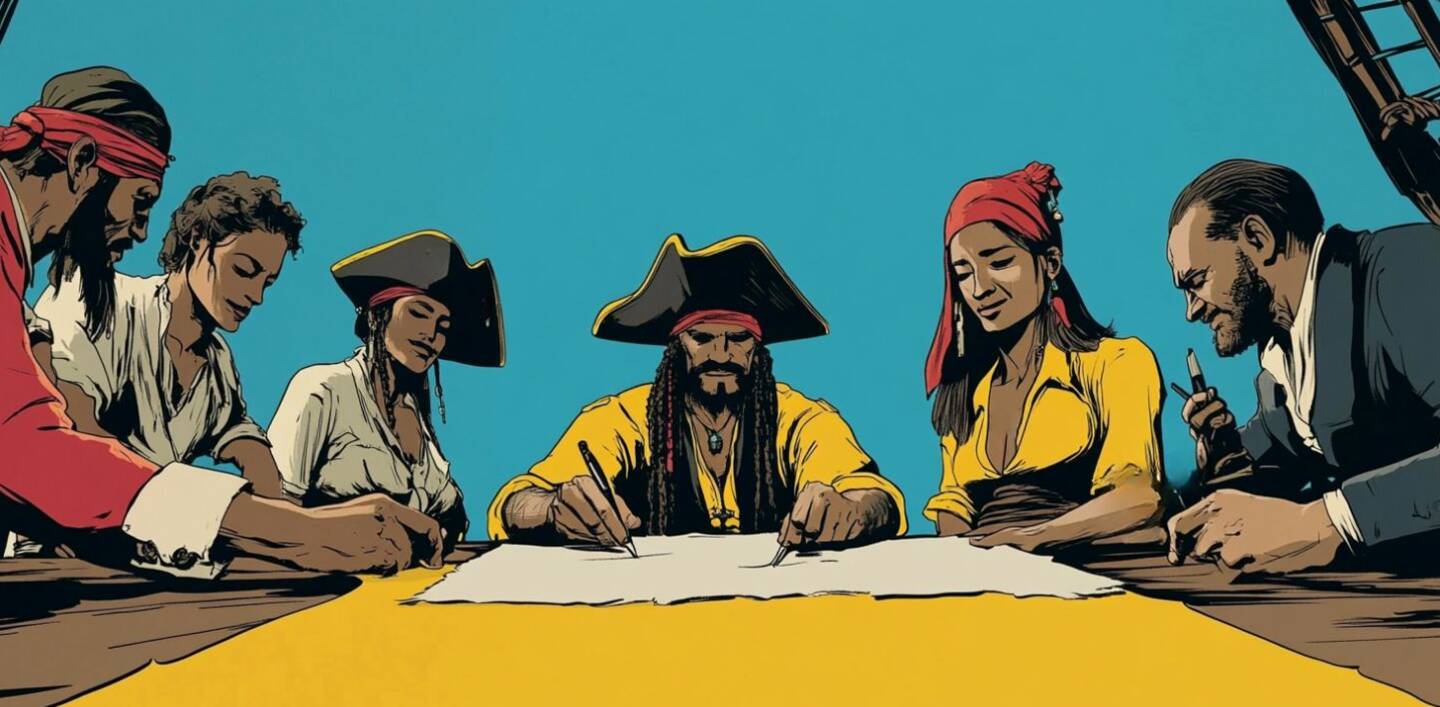
Before setting sail, pirate crews adopted what historians call “articles of agreement” — the famous pirate codes. These texts provided a common framework and set out the rules each crew member agreed to follow. “It was the equivalent of a constitution for us today,” says Georg Wernicke.
The agreements specified how loot would be divided by role, with a larger share for the captain and quartermaster and fixed shares for the rest of the crew. They also laid down penalties for misconduct in order to maintain discipline. They even addressed the risks of life at sea, setting compensation in advance for injuries such as the loss of an arm, a leg or a finger.
The crews were trying to deal with conflict and perceived unfairness before either could take hold. The lesson is simple enough: set the framework before the action starts, and you are less likely to make the most sensitive decisions under the pressure of conflict.
Lesson 2: Power works better when it is shared
Among pirates, power was not always concentrated in the hands of a single individual. On many ships, the roles of captain and quartermaster were distinct. The captain led operations at sea, especially in battle or during manoeuvres. The quartermaster represented the crew’s interests, oversaw the division of spoils and could act as a check on the captain’s decisions. That split answered a practical need: how to coordinate a potentially fractious group without allowing power to slide into arbitrariness.
The same principle can be found in many organisations today, where the role of CEO — responsible for running the company day to day — is often separated from that of the chair, who oversees and scrutinises the chief executive. That separation is not universal. In the United States, for example, about 30 per cent of large companies still practise what researchers call CEO duality, with one person holding both positions.
Pirates had already identified the risks that came with that concentration of power. Some historians even argue that discipline on pirate ships could be more stable than it was in the Royal Navy of the time, where concentrated authority sometimes went hand in hand with brutal treatment of sailors.
Lesson 3: Incentives are stronger when decision-makers share the risk
Another striking feature of pirate organisation lay in the relationship between those making decisions and those benefiting from the outcome. On a pirate ship, that distinction was almost non-existent: the people leading the expedition were also the ones sharing in the gains. The crew divided the spoils according to rules set in advance. “There wasn’t someone sitting in a bay in the Caribbean saying: go plunder and bring me something back,” Georg Wernicke says, with a laugh.
That arrangement reduced the principal-agent problem that concerned economists such as Adam Smith. “It appears when the person who owns the asset is not the one who controls it,” Wernicke explains. In the conventional maritime world, for instance, a merchant owns the ship but hands its management over to a captain.
Once the ship is at sea, the owner can no longer really control what the captain does: he may slow down, mistreat the crew or siphon off part of the gains.
The same logic applies in business, where shareholders own the company but do not run it. Executives act on behalf of the owners, and that can create diverging interests. The lesson for leaders today is not to erase the distinction between shareholders and management, but to design incentives that bring those making decisions as close as possible to those bearing the consequences. Performance-related pay, stock options and equity stakes are all meant to do just that.
Georg Wernicke is quick to point out the limits of the pirate model. A system in which all members are both operators and beneficiaries works well in small, closed organisations. “If you want to scale an organisation and attract outside capital, that model becomes much more complicated,” he says.
Lesson 4: A leader who can be removed remains accountable
On pirate ships, a captain’s authority was never secured once and for all. The crew voted to appoint its captain, but it could also decide to replace him. “The captain knew he had to treat his crew well,” says Georg Wernicke. “If he mistreated them, they could vote to replace him.” The possibility of removal created a form of immediate accountability. In some cases, the sanctions could be drastic: a captain judged incompetent or unfair might be stripped of his office, reduced to an ordinary crew member, or even set adrift at sea in a small boat.
The captain was also judged on the quality of his decisions. If the crew felt that a strategic choice ran against its interests — refusing to attack a ship out of fear, or following the wrong route, for example — it could challenge his leadership. Since every member stood to benefit directly from the gains of the expedition, each had a direct stake in the captain’s performance.
Executives can still be replaced today when results disappoint. The mechanisms are a great deal more complex. Replacing a CEO usually involves the board, formal procedures and a series of trade-offs among different stakeholders.
The lesson still holds. Concentrated power needs credible counterweights.
Boards, votes and other forms of checks and balances remain among the surest ways of keeping leadership accountable.
Lesson 5: Purpose has no value unless it is genuinely shared
At first glance, it may seem odd to talk about purpose in relation to pirates. Their purpose is difficult to defend morally: raiding ships and enriching themselves. Even so, Georg Wernicke thinks there is something to learn here. “Pirates had a clear goal,” he says. “They knew exactly what they wanted to achieve and used that goal to organise a group of around a hundred people around it.” In a violent, uncertain environment with no outside rules, that common aim served as a compass for collective action. Governance rules, the division of gains and disciplinary mechanisms all took their meaning from the pursuit of that shared objective.
The lesson is not about the nature of the goal itself. It lies in the organizational force of a clear, shared purpose that runs through the whole group. In business, purpose has become a staple term, yet it often remains confined to speeches, slide decks and annual reports. It does not always carry through into day-to-day decisions or actual behavior. “Even when a purpose is clearly formulated, that does not mean it is genuinely lived within the organisation,” Wernicke says. When that aim is not deeply built into decision-making mechanisms and incentives, it gradually loses force. “In that case, purpose ends up losing its purpose.”
For leaders, the implication is clear enough: a collective aim only has value if the people in the organisation understand it, share it and see it built into the rules that shape everyday decisions.

 Executive Education
Five questions leaders should ask themselves
Pirates are obviously not a model of governance to copy. They do, though, offer a few clues about how a collective can function in uncertain conditions.
For leaders, that means asking five practical questions:
- Are the rules of the game clear to everyone from the start?
- Are there counterweights that stop authority from pooling in too few hands?
- Do the people making decisions also share in the risks and the results?
- Can a leader be challenged if his or her decisions harm the organisation?
- Does our purpose really guide decisions, or does it remain mostly rhetorical?
That may be the real modernity of pirate governance: they understood that a power structure should be judged not only by how efficiently it works today, but by whether it can still be corrected tomorrow. A governance model that suits the moment can easily become a trap — especially once power has accumulated to the point where it can no longer be challenged. Once cemented, a flawed structure tends to last. Pirates, at least, had that clarity: it is better to set the rules before crisis strikes than to realize too late that no one is left to keep the captain in check.





 Innovation & Entrepreneurship