


 Sustainability & Society
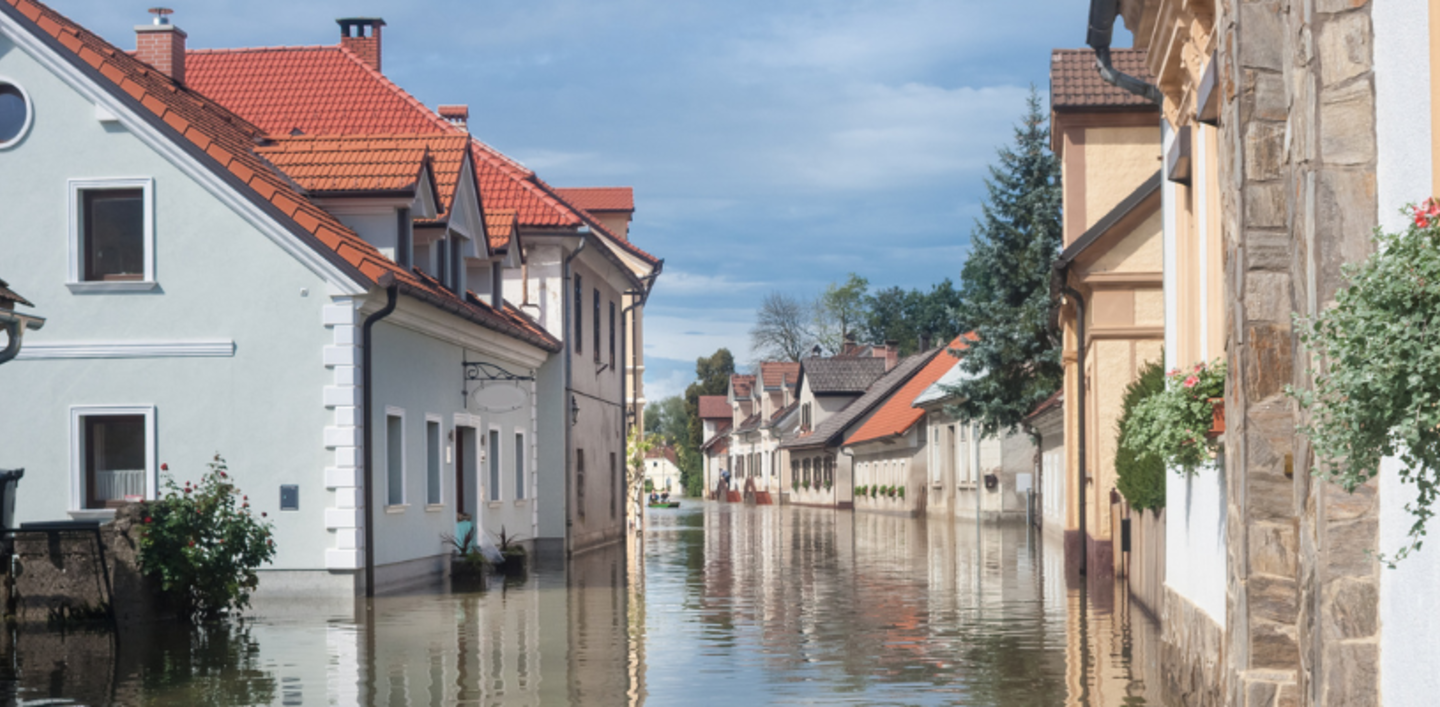

Submerged for weeks this winter, dozens of French departments experienced what were described as “widespread” floods, while they are still referred to as “exceptional events.” Drawing on François Gemenne’s column in Les Echos, Crues : l'adaptation au changement climatique, un enjeu de sécurité, and the France Culture Radio program of February 16, 2026, “Crues « Extraordinaires » : Pourquoi tout déborde ?", we revisit here the debate between Françoise Vimeux, François Gemenne, and Jean-Baptiste Fressoz. For them, these floods reflect less a meteorological inevitability than a long-standing political choice: prioritizing minimal adaptation and denial of risk over a profound transformation of our ways of living and civil protection systems.
“The exceptional is becoming the norm”: a climate defined by its impacts
For climatologist Françoise Vimeux, Research Director at the Institute of Research for Development (IRD), the current situation is far from a mere outburst of nature: weeks of low-pressure systems, “heavy and abundant” rainfall, saturated soils—each additional drop becomes a major flood risk. Climate change does not necessarily make storms more frequent or more violent in themselves, she emphasizes, but it amplifies their consequences: torrential rains “boosted by about 10%” by a warmer climate, sea levels already around 23 cm higher than at the beginning of the 20th century, and flooding that reaches further inland and blocks river outflows.
In this context, continuing to speak of “exceptional events” borders on blindness. “It’s not just an impression, it’s a reality: the exceptional has become the norm,” insists François Gemenne, Professor at HEC Paris and Academic Director of the Master in Sustainability and Social Innovation, who sees this vocabulary as a collective trap. Terms like “unprecedented,” “record,” or “climate crisis” suggest a temporary disruption, a rough patch before a return to normal; “in reality, there will be no return to normal, because the normal lies ahead of us, not behind us,” he stresses.

Living in a flood zone without knowing it: an organized risk
“One in four people in France now lives in a flood-prone area—nearly 20 million people,” recalls Françoise Vimeux, citing figures. And it is not just a matter of rural villages: the Maison de la Radio, France Télévisions, many ministries, the Louvre, and the Musée d’Orsay are all located in floodplains—these large flat areas corresponding to river overflow zones.
Yet, far from reducing this exposure, France continues to build in at-risk areas. In his column, François Gemenne points out that “a quarter of the French population lives in flood zones, and this figure keeps increasing, when it should be decreasing.” “All over the country, exemptions are still regularly granted, even in the most exposed areas,” he laments, noting that the level of risk remains poorly understood by both elected officials and residents, despite growing awareness of vulnerability. Vimeux asks bluntly: “Why are building permits still being issued today in areas that are now flood-prone?” For Gemenne, the answer lies both in short-term economic interests and in a psychological bias: “we tell ourselves we’ll fall on the right side of the statistics—that it will affect others, not us.”
From “living with climate change” to the dead end of low-cost adaptation
Jean Baptiste Fressoz, a French historian of science, technology, and the environment at the CNRS, reminds us that the idea of “adaptation” is nothing new: “As early as 1976, a conference in the United States was titled ‘Living with climate change’: the change will happen, we will have to adapt to it.” This discourse quickly took hold in Western countries in the 1980s: at a meeting organized by Margaret Thatcher in 1989, “each minister explained that not much could be done without losing competitiveness, and that the best option was to adapt and hope it wouldn’t be too severe.”
This history challenges a comforting narrative, according to Fressoz: “We are often told that we tried to transition, that we attempted to decarbonize, and that since we are failing, we now need to adapt. In reality, over the long term, adaptation was Plan A. The transition was never really taken seriously.” Moving an entire world away from carbon requires a strong state, massive public investment, and a strategy—all things rejected by the neoliberal wave of the 1980s; by contrast, adaptation “fits very well with a vision in which everyone is responsible for themselves, each person fends for themselves.”
Even today, adaptation remains “structurally underfunded,” notes Gemenne: it is treated as just another environmental policy, whereas “it is a true policy for protecting people and property, on par with defense or justice.” The decline in civil protection resources is, in his view, the most worrying symptom.

Civil protection and insurance: a matter of national security
As floods become more frequent, François Gemenne argues that “adaptation is a sovereign responsibility.” He identifies two national priorities: first, halting construction in at-risk areas; second, massively strengthening emergency and prevention services. The figures he cites are striking: volunteer firefighters make up about four-fifths of the country’s roughly 250,000 firefighters, yet recruitment is becoming increasingly difficult amid lack of recognition, administrative burdens, and interventions that are “increasingly frequent and thankless.” The situation sometimes borders on the absurd: “fire trucks and ambulances have to pay highway tolls,” and the central public purchasing agency “overcharges for the red paint” of emergency vehicles, he points out.
On the insurance front, Gemenne sees another battleground of adaptation. “The number of people exposed to climate risk keeps increasing, notably because we continue to build in flood-prone areas,” he explains; for insurers, the cost of climate-related claims “doubles every five years.” The French model, based on national risk pooling, is under strain: “Will it still be possible to insure everything? Will we be able to keep pooling risks at the national level? Can you explain to someone in Clermont-Ferrand that their home insurance premium triples because of coastal flooding risks?” Abroad, particularly in the United States, some major insurers are already withdrawing from entire regions, leaving families uninsured.
Fressoz, for his part, emphasizes the fundamentally political nature of these decisions: who should be compensated, to what extent, and according to what criteria, when homes were knowingly built in risk-prone areas? “These are major debates about social inequality, democratic choices—not technical issues,” he warns.

Limits of adaptation, technological illusions: what floods force us to decide
Beyond the immediate urgency of floods, the three speakers agree on one point: we will not be able to adapt to just any climate. “Adaptation has a hard physical limit,” recalls Françoise Vimeux: beyond about 2°C of global warming, it becomes “complex or even impossible” in certain sectors and regions. France’s current adaptation trajectory is based on a scenario of around +3°C by 2050 and +4°C by the end of the century in mainland France: “4°C means extremely difficult adaptation, involving choices: what do we keep, what do we sacrifice?” she warns.
For Jean-Baptiste Fressoz, we must grasp “the enormity of what is happening”: to find a planet as rich in CO₂ as ours, we must go back about 3 million years; “what we are experiencing is not an environmental crisis, it is a change in geological era.” In this context, he warns against the “technological illusion” that we will be able to decarbonize everything and then remove CO₂ from the atmosphere using still largely nonexistent technologies. Even with unlimited funding, “once electricity and cars are decarbonized, the rest becomes much more complicated”: aviation, maritime transport, and above all the global food system—about one-third of emissions—for which there is no magic solution.
Faced with this reality, Gemenne calls for moving beyond the sterile opposition between emissions reduction and adaptation. “We must stop seeing adaptation as surrender,” he argues, noting that some policies—such as building retrofits—“allow us to do both,” reducing emissions while better protecting against heatwaves. “We are dealing with a gradual problem where each additional fraction of a degree implies enormous impacts,” he stresses, and it is still possible to influence the trajectory, even as the Paris Agreement becomes increasingly difficult to achieve.
Vimeux also emphasizes reasons for action: without the Paris Agreement and the policy frameworks put in place since 2015, we would be on an even higher warming trajectory today. “Even if it’s not fast enough or strong enough, it still works,” she says: our collective choices are already bending the curve. But the current sequence of floods shows that the question is no longer whether we will “live with climate change”; it is how we choose to protect ourselves—and whom we are willing to leave behind in the floodwaters.
Translation made by LLM
