

 Sustainability & Society


Loneliness is usually treated as a private experience, a matter of mental health or individual well-being. Yet across many societies, social disconnection is becoming more widespread, more persistent, and more unequal. As trust erodes and people retreat into smaller social circles, a deeper question emerges: could the weakening of our social bonds be quietly reshaping our economies and our democracies?
- Loneliness and social disconnection are structural phenomena, not isolated personal experiences, and disproportionately affect young people and low-income groups.
- Eroding trust deepens inequality and limits economic mobility, by restricting access to diverse networks and opportunities.
- Weak social ties generate economic and democratic costs, including lower productivity, reduced civic participation, and rising polarization.
- Trust can be rebuilt, but only through sustained, evidence-based investment in social infrastructure and cross-group connection.
Why Are We So Connected, Yet So Alone?
In the age of hyper-connectivity, loneliness is paradoxically on the rise. Despite social media, remote work tools, and urban density, people across societies report feeling more isolated and mistrustful than ever. In addition to the mental health issues this raises, there are also economic, social, and democratic risks.
The research agenda report Bridging Social Capital and Trust: A Research Agenda by Marieke Huysentruyt, María de los Ángeles Gutiérrez M., and Yann Algan, published by the HEC Paris Sustainability & Organizations Institute, brings together a growing body of evidence showing that when trust erodes and social bonds fray, the consequences extend far beyond individual well-being. Educational outcomes suffer, productivity declines, civic engagement weakens, and economic growth slows. This raises a pressing question: could the loneliness crisis be one of the most underestimated challenges of our time?
 Find out more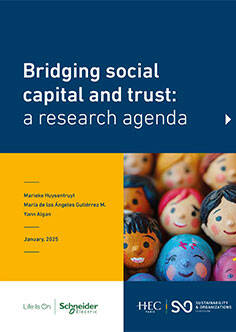
What Does the Research Tell Us About Loneliness and Inequality?
Loneliness is not evenly distributed across society. The report shows that social disconnection disproportionately affects young adults, low-income individuals, minorities, and people living in economically or geographically isolated areas. These groups face structural barriers to forming meaningful connections beyond their immediate social circles.
The research highlights the importance of connections that cross social, economic, and cultural boundaries, often referred to as bridging social capital. When these ties are absent, access to information, opportunity, and support networks shrinks. Over time, this lack of connection reinforces inequality and limits upward mobility, particularly for those already at a disadvantage.
Loneliness is also closely linked to health outcomes. Social isolation increases the risk of anxiety, depression, chronic illness, and premature mortality. These effects generate substantial costs for healthcare systems and reduce individuals’ capacity to participate fully in education, work, and civic life.
How Is Disconnection Shaping the Economy?
Disconnection does not remain confined to the social sphere; it gradually translates into economic underperformance. The report shows that when trust between individuals weakens, workplaces become less resilient and less productive. Employees who feel isolated or excluded are more likely to disengage, experience burnout, and withdraw from collective effort, reducing both individual performance and organizational effectiveness.
The research also highlights a strong link between trust and innovation. Environments characterized by low interpersonal trust tend to discourage cooperation, knowledge sharing, and risk-taking — all of which are essential for innovation and long-term growth. By contrast, societies and organizations with higher levels of trust are better equipped to adapt to shocks, coordinate action, and sustain economic dynamism.
At a macro level, the erosion of social ties undermines civic participation and confidence in institutions. The report underlines that declining trust weakens democratic engagement, reduces compliance with collective rules, and increases polarization, dynamics that ultimately raise the economic cost of governance. Taken together, these findings suggest that loneliness and disconnection act as silent economic drags, gradually eroding productivity, innovation capacity, and institutional effectiveness.
Can We Measure (and Rebuild) Social Trust?
One of the central challenges identified in the report is measurement. Trust, social ties, and feelings of belonging are rarely captured by conventional economic indicators, yet the research shows they are fundamental to long-term prosperity. Without reliable ways to observe social connection, policymakers and organizations systematically underestimate its importance and delay action.
The report points to a growing set of tools that make social connection more visible, including large-scale surveys, experimental methods, and network-based data. These approaches help measure not only trust in institutions, but also the extent to which individuals are connected across social and economic divides, a critical factor in reducing inequality and polarization.
Importantly, the research agenda demonstrates that trust can be rebuilt. Evidence from schools, cities, and workplaces shows that carefully designed interactions across difference can strengthen social ties, improve well-being, and foster cooperation. These interventions work by creating opportunities for repeated, meaningful contact rather than forcing consensus or uniformity.
The authors ultimately call for a shift in priorities. Measuring and nurturing trust should be treated as an investment in social infrastructure, alongside education, health, and physical capital. Without this shift, efforts to address inequality, democratic decline, or economic stagnation risk treating symptoms rather than root causes.
What Happens If We Do Nothing?
The report is clear that inaction carries significant risks. When loneliness and social disconnection persist, they gradually weaken the foundations that allow societies to function effectively. Trust in institutions declines, cooperation becomes harder to sustain, and collective responses to shared challenges lose legitimacy and effectiveness.
One of the most serious consequences highlighted by the authors is democratic fragility. Low levels of interpersonal and institutional trust are associated with lower civic participation, rising polarization, and reduced willingness to comply with collective rules. Over time, this erosion increases the cost of governance and makes democratic systems more vulnerable to disruption.
Economic consequences follow closely. Societies marked by fragmentation struggle to mobilize human capital, sustain productivity, and support inclusive growth. The report shows that without deliberate efforts to rebuild trust and social connection, inequality deepens and opportunities for upward mobility narrow, reinforcing long-term economic stagnation.
The research agenda ultimately reframes loneliness and disconnection not as marginal social issues, but as systemic risks. Addressing them requires sustained investment in social infrastructure and evidence-based policies that strengthen connection across difference. Without such action, societies risk drifting further apart, and losing the resilience needed to face future shocks.
Sources
This article is based on insights from the research agenda report Bridging Social Capital and Trust: A Research Agenda
by Marieke Huysentruyt, María de los Ángeles Gutiérrez M., and Yann Algan, published by the HEC Paris Sustainability & Organizations Institute.



 Geopolitics & Public Affairs