

 Geopolitics & Public Affairs


Executive Summary
People's daily experiences at work determine their support for radical parties far more than traditional factors like social class, income and education. These are the results of an unprecedented study of nearly 4,000 private-sector employees in France by a two HEC researchers and a student. Indeed, the workplace is a laboratory for trust. Relations with co-workers nourish trust or distrust, which in turn spills over into a more general outlook on others. These factors, in turn, express themselves in the ballot box: supporters of the Rassemblement National (RN) tend to be isolated in the workplace, even within their team, and suffer from a weak feeling of belonging. Their attitudes towards immigration and welfare tend to be “closed” culturally (they oppose immigration and redistribution policies). Supporters of La France Insoumise party (LFI) express solidarity with their peer group, but anger towards the “system.” Those who declare no political affiliation express no political convictions and are disengaged; they tend to abstain from voting. These insights suggest that social cohesion and quality workplace relations should be encouraged, because, beyond well-being or performance, this is a democratic issue.
Understanding radical votes in France
Ahead of France’s March 15 and March 22 municipal elections, three HEC professors examined the rise of the Rassemblement National (RN). The RN has not only gained ground in territories considered now leftist or centrist bastions, it has also become the first political force amongst private-sector workers in France (25.5%), followed by workers who declare no political affiliation (33%) and way ahead of other parties, even among executives. This is far removed from the stereotype of a party that is popular only among “losers” of the globalized economy. But how does the RN appeal to employees across such different classes? The authors' answer: “Tell me how you experience your working life, I will tell you who you vote for.” Indeed, the factors behind protest votes are not so much the pay slip, the social class or education, as once thought, but two more subjective factors: interpersonal trust and life satisfaction. And these two variables are shaped where we spend eight hours a day – in the workplace and its can of worms, or in the family atmosphere. So, by comparing how daily life at work is experienced not between social classes, but within a same class, the authors explain why two colleagues, in similar work positions and with similar earnings, may make very different choices at the ballot box.
Daily life at work and political fault lines: Key insights
1/ What differentiates electorates at work: social ties. Supporters of centrist and right-wing parties (particularly those of Emmanuel Macron’s Renaissance party) tend to have positive work experiences: they express trust in their company, its management, its strategy; and their co-workers.
The employee who supports the RN is the only ones who distrusts his/her colleagues. This “horizontal” distrust reflects feelings of not being heard, low belonging, lack of mutual help.
The profile of a worker who votes for LFI is almost the mirror opposite of the first one: his/her strong distrust is “vertically” against institutions – the company, management – but (s)he expresses strong trust towards her/his peers.
2/ Recognition, aspirations, frustrations: same anger, different objects. The frustration expressed by LFI voters takes an existential form: they are dissatisfied with the gap between their aspirations for socially useful, liberating work, that “changes the world”, and reality.
Conversely, the frustration expressed by RN supporters is material. It is focused on wages and career prospects, in a quest for recognition and social status.
3/ Non-affiliated workers form a category of their own: their frustration levels are low not because all is well – on the contrary, they are just as isolated in the workplace as their radical right peers – but because they have ceased to hope for change. They are “muted.”
4/ RN supporters are not a monolithic group. Looking closer at workers who support the RN, it appears that their experiences at work vary widely: 60% are “happy” and 40% “unhappy” - and it is not a matter of white collars vs blue collars. The former support the corporate world, the latter aspire to a form of welfare (incidentally, this does not make it a simple task for the RN to define its economic program). What unites RN supporters is their anti-immigration stance.
5/ Interpersonal trust predicts cultural openness. The most striking result of this study, according to the authors, is the following: what predicts cultural attitudes, and particularly attitudes towards immigration, is trust towards co-workers, and more broadly, relations to others. This applies to all social strata.

To renew faith in democracy, begin with the workplace
These findings have significant implications for any attempt to renew faith in democracy – beginning with work relations. Firstly, promoting recognition and socialization in the office, the workshop or the shop, will boost trust in the company.
But feelings of isolation amongst workers are a matter that goes well beyond performance: every open space in which an employee lunches alone, every team in which suggestions are ignored, every workshop without mutual help nurtures general distrust. That is why quality of life at work policies are crucial – they are a democratic issue. After all, one third of France's private-sector workforce identifies with no political party and is disengaged both from a professional and civic point of view. This trend can only be reversed by renewing cooperation and trust in work relations.
 Find out more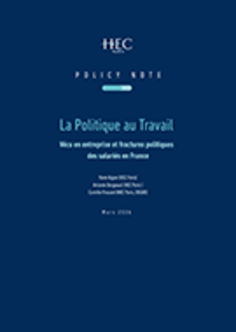
Conclusion: Companies are laboratories for social trust
The split in France's political identity cannot be reduced to questions of wages or education levels: it is rooted in the daily experience of quality social ties (or lack thereof) in the workplace.
Trust in colleagues predicts cultural attitudes and in particular, openness to immigration, across all social classes.
Workers who identify with the Radical Left are more worried about workplace transformations (including AI) but are in favor of remote work. RN supporters oppose remote work, which makes isolation worse.
One private-sector worker out of three declares no political affiliation – a “muted” profile, disengaged from the civic and professional worlds.
Work policies based on quality of life are no luxury; they are a democratic issue. Because they help strengthen bonds and they reduce general distrust.
Authors and methodology
Yann Algan and Antonin Bergeaud are professors at HEC business school, Camille Frouard is a student at HEC and ENSAE. The authors carried out their study in 2024 and 2025, in the wake of the European and French general elections. They studied a representative sample of 3,909 French salaried employees, supported by a grant from the Institut Bilendi. The research focused on daily life at work.



 Sustainability & Society