
What Every Business Leader Needs to Know About Decision-Making Under Uncertainty
HEC Professor Matt Mulford explains how leaders can avoid predictable mistakes, and build resilience in uncertain times.
In today’s boardrooms, you rarely decide with certainty. Markets shift overnight, competitors counter faster than expected, and technological shocks, from AI to synthetic biology, reshape industries before strategies even land.
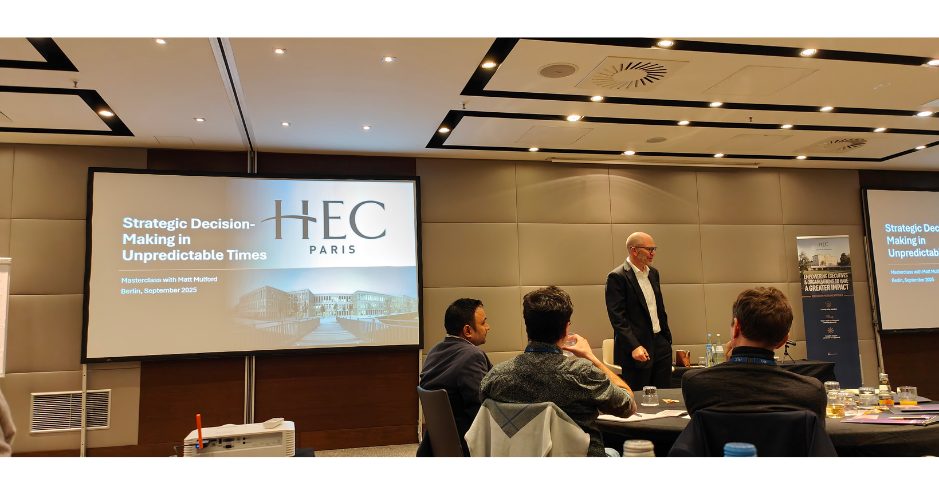
At a Berlin session with executives, HEC Paris Adjunct Professor Matt Mulford described a four-level framework, first developed at McKinsey,to categorise different levels of uncertainty. The original framing of each level represents a different kind of uncertainty, and requires a distinct leadership response. Think of it as a decision playbook: diagnose which level you are facing, then apply the right tool.
This session was part of HEC Paris Executive Education’s broader effort to help companies embed resilience through Custom Programs: tailored learning journeys that turn insight into organizational practice.
Key Findings
- Diagnose four levels of uncertainty — each needs a distinct playbook.
- Don’t trust averages alone: manage risk by reading distributions.
- Anticipate rivals’ moves with competitive stress-tests.
- Use scenarios to pre-build options, not to predict a single future.
- In radical uncertainty, adaptability beats strength: simplify and speed up.
Why Executives Misread Uncertainty
Geopolitical volatility, AI-driven disruption, and sustainability pressure make today’s environment feel anything but stable. Yet under this turbulence, many leaders still act as if they were facing simple risk: believing sharper forecasts or more data will eventually bring clarity.
The danger lies in misdiagnosis. Leaders often treat deep uncertainty as if it were risk, which leads them to rely on the wrong tools and make predictable mistakes. Cognitive traps amplify the problem. Mulford highlights the narrative fallacy:
An answer popped into your head… an automatic process that creates a story… and then we usually look for evidence to confirm what we believe to begin with.
This tendency to explain and confirm blinds executives to alternative realities.
Bottom line for leaders: the first error is not in the data, but in the way uncertainty is framed. Misreading the context leads to misapplied strategies. The rest of the framework shows how to diagnose correctly, and act accordingly.
To address this, Mulford offers a four-step framework for decision-making under uncertainty. Each step helps leaders avoid predictable mistakes by matching their choices to the type of uncertainty they face.
Level 1 Uncertainty: Managing Measurable Risk
Some decisions live in a world of risk, you can estimate probabilities, bound outcomes, and extend trends. This is familiar ground. But even here, managing to the mean misleads. For you, the practical shift is to manage the distribution.
As Mulford puts it, “If you only look at the average, you have no idea… it depends on what the distribution looks like in order for you to manage best.”
He illustrated this with a hospital case that highlights the stakes. Three intensive care units all reported the same average infection rate for central lines, a critical KPI. Yet their distributions told very different stories:
- Stable but consistently high rates suggested a process problem to be redesigned.
- Mostly low with occasional spikes pointed to a compliance issue linked to specific protocols or actors.
- Generally poor with rare bright spots indicated the need to study and scale good practices from exceptional weeks.
The managerial implication is universal: the right intervention depends on the pattern, not the average.
As Mulford urges, “Please look at something other than just the average… [to see] what kind of thing you’re dealing with.”
Tool for executives: add mean, median, and standard deviation to KPI packs and track them through time. A rising mean with shrinking variance signals system-wide lift; a rising mean with widening variance signals emerging stars but broader lag. In both cases, the average alone would have steered you wrong.
Level 2 Uncertainty: Anticipating Rival Moves
In many decisions, the core uncertainty is not your data, it’s the other side’s move. Outcomes depend on your action and your competitor’s response. If you don’t model that interaction, you invite avoidable surprises.
This is where you apply game-theory thinking. As Mulford explains: “You alone can’t create the outcome. It’s going to be a combination of your strategic decisions and your competitors’.”
A cautionary tale for anyone planning market entry: when Procter & Gamble targeted Clorox’s bleach quasi-monopoly, they ran the numbers on price, advertising, and margins. What they missed was the response. Clorox neutralized the test by delivering free bleach to every household, obliterating demand. Mulford’s verdict: “They did their analysis… but what they didn’t say is, okay, how is my competitor going to respond?” ("I Think of My Failures as a Gift")
What you can do now: run a Competitive Neglect Exercise. Assume your strategy leaked to a key rival. Design the rival’s best counter, then pre-plan your counter-counter. In an hour, you’ll expose vulnerabilities that the market would reveal at far higher cost. As Mulford notes, leaders often don’t know competitors as well as they think because they’re absorbed in their own strategy. Don’t be that team.
Level 3 Uncertainty: Scenario Planning Without Story Traps
Some futures are unknowable in detail yet still bounded by recognizable extremes. That’s when scenario planning becomes your best tool. As Mulford puts it, “We don’t know what’s going to happen… but we know boundary conditions.”
Your risk here isn’t a lack of imagination; it’s over-imagination.
“The more detail we put on some future scenario, the more likely we think it’s going to happen”, Mulford cautions.
Every added assumption makes the narrative feel convincing—even as it becomes statistically less probable.
How to use scenarios well: don’t chase a “most likely” story. Prepare countermeasures across plausible ranges :
- Define boundary conditions: best case, worst case, credible middle cases.
- Build triggered options and pre-approved responses you can activate when signals appear.
Your goal isn’t a beautiful story; it’s shorter reaction time when reality moves.
Level 4 Uncertainty: Building Speed to Survive
In true uncertainty, there are no reliable probabilities or stable boundaries. Here, your edge is adaptability, not size or current strength.
Mulford’s survival lesson is blunt: “Not all life died… The animals that survived were the quickest to adapt.” Organizations have an advantage that species don’t: you can change your DNA. “Companies can alter their DNA… create parts of themselves that are relatively simple and quick to adapt”, he notes. Complex matrices packed with veto players slow decisions, and in radical uncertainty, delay is defeat.
Actions you can take now:
- Create protected fast lanes that operate with fewer constraints.
- Simplify governance to reduce bottlenecks and push decision rights closer to the edge.
- Shorten concept-to-launch cycles so solutions hit the market before conditions shift again.
Mulford’s warning holds for every leadership team: “If your opponent can move twice for each move you make, you’re going to lose.” Your durable advantage is speed to adapt.
Architecting Better Choices
You’re not paid to predict the future; you’re paid to architect choices. Diagnose the uncertainty level first, then match the decision system:
- Risk: instrument dispersion; manage variance.
- Rival moves: pre-mortem the competitive game.
- Ranges: codify options with clear triggers.
- Radical: institutionalize speed and simplicity.
If you’re grappling with AI, sustainability, or market disruption, this is how to avoid predictable mistakes and keep your organization a step ahead. The challenge isn’t uncertainty itself; it’s your discipline in designing the processes that shape decisions under it.
But insight alone isn’t enough. Leaders who want to embed these practices need a structured environment to test, adapt, and scale them. That’s where HEC Paris Custom Programs come in: co-designed with global companies to translate cutting-edge research into applied capability, from decision-making resilience at the C-suite to digital transformation and sustainability embedded in core strategy. Whether your challenge is digital transformation, sustainability, or global strategy execution, our tailored programs equip leaders to anticipate risks, out-adapt competitors, and embed resilience at scale.
Start designing a Custom Program with HEC Paris to build the adaptive decision systems your executive team needs.
Source: Strategy under uncertainty, McKinsey