
Direct Air Capture (DAC): Turning Air into an Asset
In 2024, atmospheric CO₂ reached 421 ppm, far exceeding the critical 350 ppm threshold, as natural carbon sinks become saturated. With emission reduction strategies proving insufficient on their own, Direct Air Capture is now considered a required technology to achieve climate targets. The International Energy Agency (IEA) has set a goal of capturing 980 million tonnes of CO₂ per year via DAC by 2050. 1
This article is an exclusive tech foresight publication from the series "Deep Signals: Where Science Meets Business", co-created by XOTA, a group of Executive Master Alumni from École Polytechnique and HEC Paris. Authored by Livia Kalossaka (HEC Paris Deep Tech Center) and the XOTA group, it distils complex scientific breakthroughs into actionable insights for business leaders, investors, public policymakers and scientists.
1 W. Brown de Colstoun, Direct Air Capture, SOTA Report, École Polytechnique (2025)

What's Emerging: A Field of Contrasts
The DAC field is split. Mature technologies like solid sorbents (S-DAC) and liquid solvents (L-DAC) dominate installed capacity but face challenges. Simultaneously, a new wave of modular, electrified approaches is emerging (electrochemical, membrane-based). Most of these are at TRL ≤ 6. This technical push is reflected in market momentum: though there are only a handful of major operational plants today, more are in development across Europe, the Middle East, and the USA. The global DAC market, estimated at $100M in 2024, is projected to grow at 60% annually to surpass $1.7 billion by 20302.
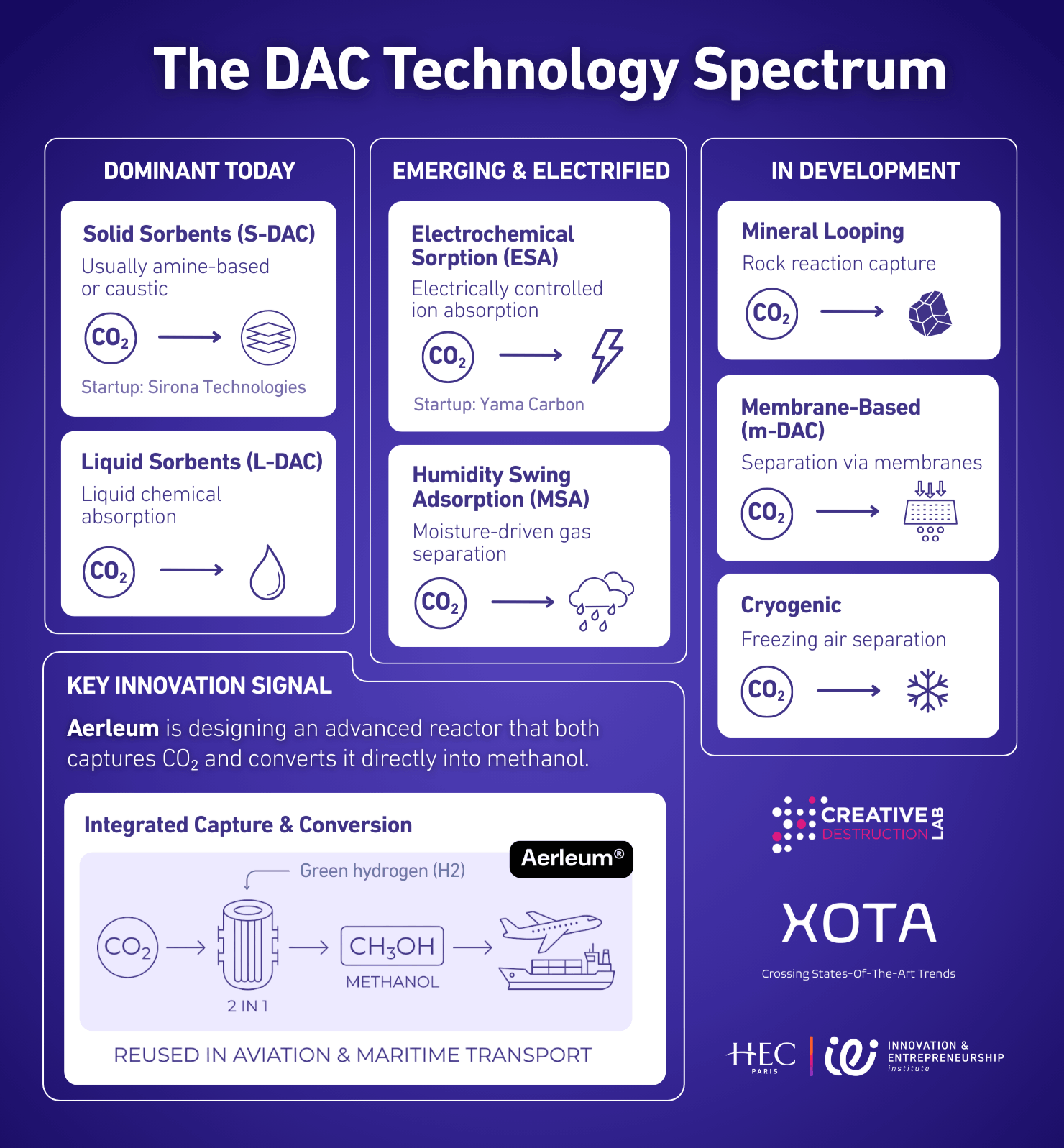
Promise vs. Performance: A DAC Reality Check
Theory and reality often diverge, and Climeworks' "Orca" plant provides a crucial lesson. While designed for 3,000 tonnes/year, its 2023 performance was 1,000 tonnes. This gap highlights the immense challenge of operating a first-of-a-kind plant. However, this is not a story of failure, but of learning; these hurdles are being overcome, and the solutions are being directly implemented into the next generation of plants. This underscores a critical industry need: more transparent sharing of operational data (successes and failures alike) to accelerate progress for everyone in this field3.
3 "The reality of deploying carbon removal via direct air capture in the field", climeworks
Overall Signal Level → 🟡 Moderate (advancing with significant hurdles)
Dimension | Strength | Explanation |
Scientific Validation | 🟢 Moderate | Capture proven; sorbent lifetime & degradation are key unsolved challenges. |
Commercial Readiness | 🟠 Weak–Moderate | A few at T-RL 8-9, most TRL 5–6. High water use & dependence on renewable energy/storage sites are major constraints. |
Societal & Policy Momentum | 🔵 Strong | Rapid growth in policy incentives & corporate demand for durable removal.
|
Business Implications & Key Hurdles
DAC offers unique advantages: geographic flexibility, the ability to remove "historic" CO₂, and no competition with agricultural land.
This creates opportunities for durable carbon credits and CO₂ feedstock. However, investors face significant hurdles.
- Cost: Currently high, ranging from $230 to $1,000 per tonne of CO₂.
- Energy Intensity: The low concentration of CO₂ in air makes capture energy-intensive. Projections suggest DAC could consume up to 12% of global electricity by 2100 if not optimized.
- Supply Chain: Sorbent and membrane production carries its own environmental and ethical risks that need management.
A Blueprint for Readiness: The Kenya Case
While much of the DAC world focuses on established hubs, Kenya is quietly emerging as a global blueprint for a successful carbon removal ecosystem. It's a compelling "watchout" case for three key reasons:
- A Diverse Portfolio: Kenya is testing multiple carbon removal approaches at commercial scale, from CDL alumni SironaTech to Octavia Carbon's geothermal-powered DAC as well as biochar and enhanced weathering projects. This diversification builds resilience and a broad knowledge base.
- Natural Advantages: The country's fundamentals are world-class: approximately 90% renewable grid powered by geothermal energy and volcanic geology in the Rift Valley that is ideal for permanent CO₂ storage 4.
- The Ecosystem Advantage: Beyond geology, Kenya offers a dense network of finance, logistics, UN agencies, and a strong pipeline of local talent centered in Nairobi.
The key takeaway: Kenya demonstrates that successful commercial readiness isn't just about perfecting a single technology, it's about building an entire ecosystem where technology, natural resources, and human capital work together.
4U.S. International Trade Administration — Kenya: Energy & Electrical Power Systems

The DAC Roadmap to 2050
Timescale | Strategic Goal |
Short-Term (2025–2030) | Industrialise pilot projects; prove technical and economic viability at scale. |
Mid-Term (2030–2040) | Drive down costs below $100/tonne; develop regional hubs for capture and storage. |
Long-Term (2040–2050) | Deploy at the gigatonne scale as a sustainable and equitable part of the global climate solution. |
DAC Business Models
Model | Revenue Sources | Key Customers | Example |
Carbon Credits/Offsets | Voluntary carbon markets | Corporates | Microsoft DAC deal |
Government Subsidies/Incentives | Tax credits, investment support | Developers | US 45Q, Canada ITC |
CO₂ Utilization (CCUS) | CO₂ sales for products, EOR, fuels | Industrial users | Climeworks, Project Concho |
Integrated Renewable Operations | Reduced energy costs, faster scale | Developers/utilities | Mammoth Facility (Iceland) |
About HEC Paris Deep Tech Center
Bridging Science and Entrepreneurship
At the heart of groundbreaking innovation, our Deep Tech Center connects scientific research with real-world impact. By supporting ventures rooted in advanced technologies (from AI to biotech), we help founders turn cutting-edge discoveries into scalable businesses.
About XOTA
XOTA is a group from École Polytechnique (called "l'X" in French) built to bring the bibliographic research and technological analyses of Executive Master graduates into the hands of decision-makers. It publishes concise, forward-looking strategic monitoring briefs, regularly featured in La Jaune et la Rouge (the École Polytechnique alumni magazine) and most recently in Futuribles, France's leading journal for foresight and futures studies.