


 Economics & Finance

- The ECB President should not be a “superhero” but a consensus-builder, balancing diverging national interests within the Governing Council.
- Institutional fragility in the Euro Area increases political pressure on the ECB, making leadership more visible — and more contested.
- Central bank decisions rely heavily on staff expertise and internal processes, limiting the influence of any single leader.
- Compared to the U.S. Federal Reserve, the ECB operates in a more politically charged environment, raising questions about independence and governance.
Christine Lagarde: An unusually scrutinized nomination
Christine Lagarde became the 4th President of the European Central Bank on 1 November 2019, for an 8-year term. It is striking how many comments her nomination has drawn on several topics, such as her unusual profile for the job, the politics of her nomination, and her first moves at the helm of the ECB.
Such publicity is relatively unusual for a central banker. The “Google Trends” tool allows us to visualize this quantitatively by comparing the number of searches for Ms Lagarde and her predecessors, especially around the time of their nominations. There were six times as many searches for “Christine Lagarde” around the time of her nomination this year as for “Mario Draghi” when he was appointed in 2011. In contrast, Mr. Trichet seems to have generated few searches during his tenure.
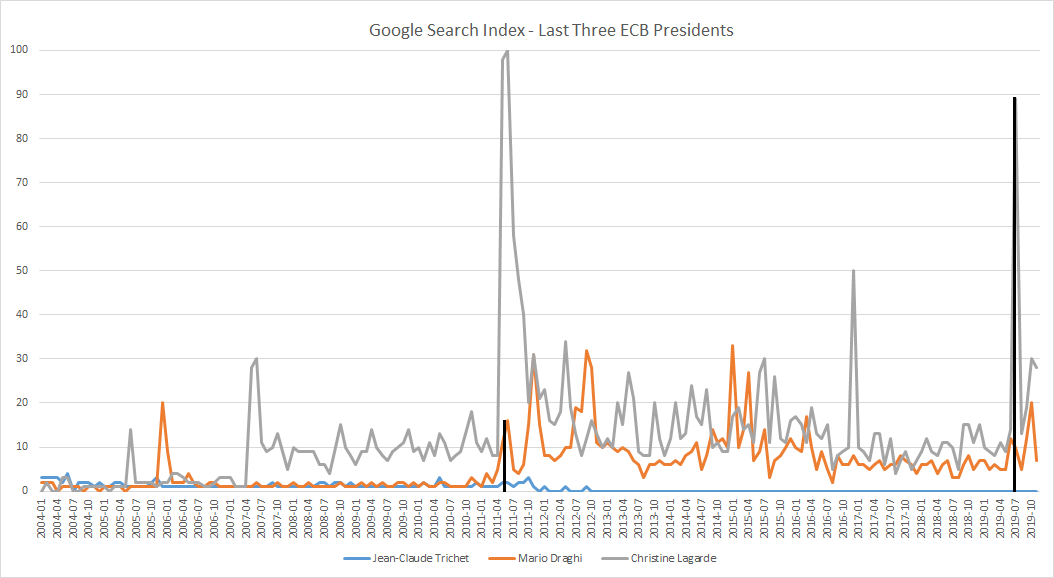
One should not of course draw too many conclusions from this crude analysis, but in my opinion, it reflects an important trend: the position of President of the ECB is much more prominent and thus gets much more media attention today than was the case ten years ago. This is in large part due to Mario Draghi, whose media treatment during the Euro area crisis created the perception that the President of the ECB was a sort of European superhero (“Super Mario”).
Interestingly, if one conducts the same exercise for the Federal Reserve, the opposite picture emerges: Ben Bernanke drew more attention in 2005 than Janet Yellen did in 2013, who in turn generated more searches than Jerome Powell in 2017.
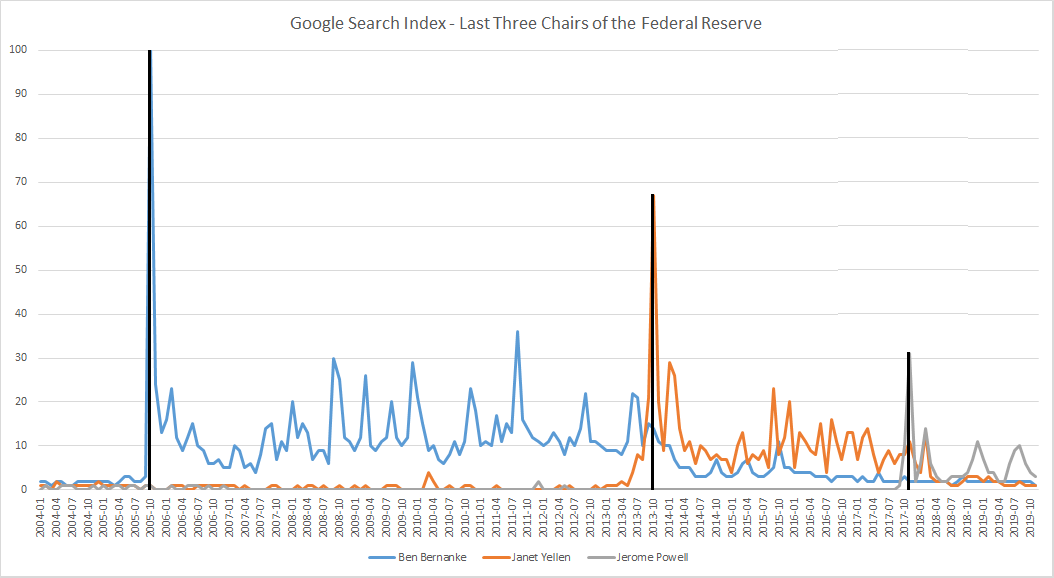
The hypothesis I develop here is that the trend observed for the ECB reflects not only differences in personalities across ECB presidents but also a certain institutional fragility of the ECB. This problem has to do with both its young age for a central bank (after all, the ECB was still a teenager two years ago), and with the institutional difficulties of the Euro area and the European Union.

What does a President of the ECB do?
When it comes to monetary policy decisions, in principle, the President of the ECB is only the chair of a committee, the ECB Governing Council, which is made of the six members of the Executive Board of the ECB and the governors of the 19 national central banks of the Euro Area (only 15 of them have voting rights in a given month). Due to this structure, it is unlikely that the President of the ECB can act as a monarch, regardless of any putative super-heroic abilities. Rather, the President has to be a dealmaker: the 19 national representatives are likely to be influenced by the situation of their own economy and to favor different policy decisions, especially when economic conditions diverge across the Euro area. A consensus – or at least a compromise - has to emerge from these different views, reflecting, to the extent possible, the “general interest” or the Euro area. An interesting empirical study by Hayo and Méon (2013) confirms this view: they show that the interest rate decisions of the ECB over 1999-2006 are best explained by a model in which national governors follow their national objectives and bargain over the interest rate decision, the bargaining power of each country being proportional to its GDP. The situation of crisis countries then gained more weight during the sovereign debt crisis (Bouvet and King, 2013).
Ardent Europeans might lament this situation, as in principle all members of the ECB Governing Council are supposed to care about the interests of the Euro Area as a whole, not only of their home countries. While this situation may reflect the incompleteness of the political union of the Euro Area, it is worth noting that the same behavior is observed in the voting members of the Federal Open Market Committee (FOMC), which plays a similar role as the ECB Governing Council and functions in much the same way: the presidents of at least some of the 12 Federal Reserve Banks display a systematic bias towards the macroeconomic conditions of their own district (Jung and Latsos, 2015).
The role of staff
Another reason not to overemphasize the importance of any individual central bank president is that central banks are organizations with a life of their own. There was much more continuity in policymaking between Ben Bernanke and Janet Yellen and then between Janet Yellen and Jerome Powell than had been expected ex ante. The reason is that all three had to rely on the same staff and on the same well-established processes: the Federal Reserve System is a large organization with 19,500 employees in the 12 Federal Reserve Banks and another 2,900 at the Board of Governors in Washington. While the Fed has many different missions, a considerable part of the workforce is devoted to collecting information and statistics, analyzing, forecasting, and ultimately giving as much information as possible to the board and providing policy recommendations. Romer and Romer (2008) show statistically that individual Federal Reserve Bank presidents do not have an informational edge over staff forecasts and that, when their monetary policy decisions differ from those implied by the forecasts, they are generally misguided.
While such an empirical study does not exist for the Euro area (due to lack of data), the European System of Central Banks relies similarly on the expertise of its staff, which is probably of similar quality and, if anything, more numerous (3,500 employees at the ECB, between 9,000 and 10,000 at both Bank of France and the Bundesbank, 6,700 at the Bank of Italy).1 As in the U.S., this staff produces an impressive quantity of data, reports, forecasts, and models to guide policy decisions, so that one would expect the results of Romer and Romer (2008) to hold in the Euro area as well. While the role of the central bank’s president is certainly important, monetary policy decisions are the output of an entire institution2.
Academic orientation of the Federal Reserve and the European System of Central Banks
There is, however, an interesting difference between the central banks of the U.S. and the Euro Area relative to the profiles of the governors, which may affect the way they incorporate the information produced by the staff. In the United States, the presidents of the 12 Federal Reserve Banks all have a very similar profile: seven of them have a Ph.D. in Economics, one has a Ph.D. in Engineering, and the rest have MBAs. Moreover, many presidents served as head of research in a Federal Reserve Bank and are established researchers. According to Google Scholar, all the Federal Reserve Bank presidents with a Ph.D. in Economics have at least one article with more than 1,000 citations (an extremely influential article), and several of them have more than 10,000 citations of their entire work.
Of course, this was also true of several chairpersons of the Federal Reserve in the past. In retrospect, it seems incredibly lucky that, two years before the financial crisis, George W. Bush happened to nominate Ben Bernanke, an expert on the U.S. Great Depression and one of the few macroeconomists at the time who had worked on macroeconomic models with crises induced by financial frictions. Janet Yellen is one of the leading figures in neo-Keynesian economics. To take one example, her paper “Can Small Deviations from Rationality Make Significant Differences to Economic Equilibria?” (AER 1985), joint with her Nobel-prize winning husband George Akerlof, is the one I always cite when I’m asked to name a microeconomics paper that gave me a real intellectual epiphany.
The presidents and governors in the European System of Central Banks have completely different profiles. Among the 19 national central bank governors, 7 have a PhD or a doctorate in economics, and few have published papers in international journals. Two exceptions are Pablo Hernandez de Cos (Bank of Spain), who has more than 2,000 citations, and Jens Weidmann (Bundesbank), who has an influential policy paper with more than 1,000 citations.
The Federal Reserve System thus seems to value the skills of research economists, whereas European countries appoint central bankers with different skillsets.3 There is, however, no clear gap in academic expertise between the two systems. Philip Lane, the current “chief economist” of the ECB, as well as Frank Smets, formerly advisor to Mario Draghi, are examples of very well-established researchers (with 27,225 and 21,113 citations, respectively), who can be compared with the most respected economists of the Federal Reserve System.
It may actually be perfectly sensible to appoint non-economists or non-research economists at the head of a central bank.4 The study of Romer and Romer (2008) would support this idea: the staff is in charge of explaining the different choices available, their economic consequences, and the trade-offs involved, and the governors select what they see as the best option, which may be a political rather than an economic decision. In line with this idea, many people seem to expect that Christine Lagarde will rely on the economic expertise of the two academic economists part of the ECB’s Executive Board, Philip Lane and Isabel Schnabel, and assume a more political role.
Economics and central bank independence
In addition to providing expertise, economists have another important function in central banks, which is to frame the decision process as essentially a scientific or technocratic matter. When monetary policy is debated by research economists, which policy to adopt is essentially an academic debate, in which politics play little role. In contrast, central banking in the Euro area is heavily politicized: does monetary policy imply a disguised subsidy to “deficit” countries? Does it weaken incentives for some governments to conduct reforms? Does it harm the banking system of some countries relative to others? Should it support green policies? In such a context, it is not surprising that the appointment of the ECB’s president is seen as a competition for influence between different member states rather than the search for the most competent person possible.
Although monetary policy decisions have political consequences, and thus are political decisions as well, we know from historical experience that central bank independence is important, and that political influence on the central bank is a recipe for instability and inflation. To simplify, the balance that was found in the last quarter of the 20th century5 was for the legislative power to give the central bank a certain mandate (e.g., keep inflation close but below 2%), and to agree ex ante to the redistributive consequences that the necessary policies would imply (e.g., indirectly hurting growth and increasing unemployment when necessary to fight inflationary pressures).
This separation between central banks and politics becomes more and more difficult to maintain with the growing importance of central banks in the economy, especially with quantitative easing: by buying large quantities of assets, the central bank is affecting not only the total level of money in the economy in a neutral way, but also affecting how capital is allocated, thus creating winners and losers. While the general trend towards more and more political interference in many countries is worrying,6 it is to some extent logical that the political sphere requires more control over central banks’ decisions when these decisions become more consequential than what had been expected ex ante. Perhaps what is needed is a new “contract” between the legislative branch and the central bank, one that reflects the realities of quantitative easing and other “non-standard” monetary policy tools.
Can the central bank be more mature than its monetary union?
Mario Draghi recently pointed out how much progress the Euro area had made since its still recent creation, and how its resilience during the financial crisis and its current stability defy the pessimistic odds the common currency faced at its inception.7 Christine Lagarde recently suggested that the ECB should take stock of its accomplishments, become more self-assured, and adopt a less defensive stance - for instance, by publishing dissenting opinions within its Governing Council.8
This is hopefully a signal that the ECB will move out of a permanent “crisis mode” and become a more mature institution. Ideally, in my opinion at least, this should mean becoming the benevolent, important, but relatively boring institution that a central bank should be: a place where technocrats decide marginal changes to policy rates so as to maintain stable inflation and maybe to some extent smoothen the business cycle. Perhaps this is too much to ask from the ECB at the moment, because the Euro area lacks the governance mechanisms and the fiscal tools that would allow monetary policy to be restricted to its core function. Christine Lagarde seems determined to use her position to push national governments to solve these issues.9 If this attempt is successful, her legacy could be to have contributed to creating a truly mature monetary union. If not, the outcome might be that the president of the ECB will become a minister of finance of the Euro area “by default”, which in the long run may not be compatible with the political independence of the ECB.
References
Akerlof, G. and J. Yellen (1985): “Can Small Deviations from Rationality Make Significant Differences to Economic Equilibria?”, American Economic Review, 75(4).
Borio, C. (2019): “Central Banking on Challenging Times”, SUERF Policy Note n° 114.
Bouvet, F. and S. King (2013): “Do National Economic Shocks Influence European Central Bank Interest Rate Decisions? The Impact of the Financial and Sovereign Debt Crises”, Journal of Common Market Studies, 51(2).
Hayo, B. and P.-G. Méon (2013): “Behind closed doors: Revealing the ECB’s decision rule”, Journal of International Money and Finance, 37.
Jung, A. and S. Latsos (2015): “Do federal reserve bank presidents have a regional bias?”, European Journal of Political Economy, 40.
Monnet, E. and D. Puy (2019): “Do Old Habits Die Hard? Central Banks and the Bretton Woods Gold Puzzle”, IMF Working Paper 19/161.
Romer, C. and D. Romer (2008): “The FOMC versus the Staff: Where Can Monetary Policymakers Add Value?”, American Economic Review Papers & Proceedings, 98(2).
Footnotes
[1] The numbers are not directly comparable with the Federal Reserve System as central banks do not have the same missions across countries.
[2] Monnet and Puy (2019) show empirically that a central bank’s monetary policy decisions (in the context of the Bretton Woods era) are explained both by the “institutional memory” of the central bank and by the personal experience of its president.
[3] This difference seems to affect the speed at which academic innovations are transmitted to policy, as noted in an interview by HEC professor Gaetano Gaballo.
[4] This does not mean that the reliance on more academic economists in the U.S. is a bad thing either. A unique quality of economists who are active in research is that their knowledge of economics is up to date and they can quickly take academic breakthroughs into account in their policy decisions. Conversely, consider a hypothetical 60-year old central banker at the start of the crisis in 2008, whose study of economic research stopped in his formative years. This person would have had to rely on conceptual tools from the 1970s. Worse, it is not unimaginable that our central banker may have studied economics only with non-research active professors, who themselves were relying on tools from the 1950s!
[5]Central bank independence in itself is a much older concept though. See in particular Eric Monnet, “L’indépendance des banques centrales a toujours été jugée nécessaire à leur crédibilité”, Le Monde (Online, in French), 25 October 2019, for a richer historical perspective.
[6] See Borio (2019).
[7] See “Interview: Mario Draghi declares victory in battle over the euro”, Financial Times Online, 30 September 2019.
[8] See “Christine Lagarde urges ECB to find ‘healthy’ way of tolerating dissent”, Financial Times Online, 2 December 2019.
[9] See “ECB’s Lagarde urges governments to boost public investment”, Financial Times Online, 22 November 2019.
