
 Geopolitics & Public Affairs
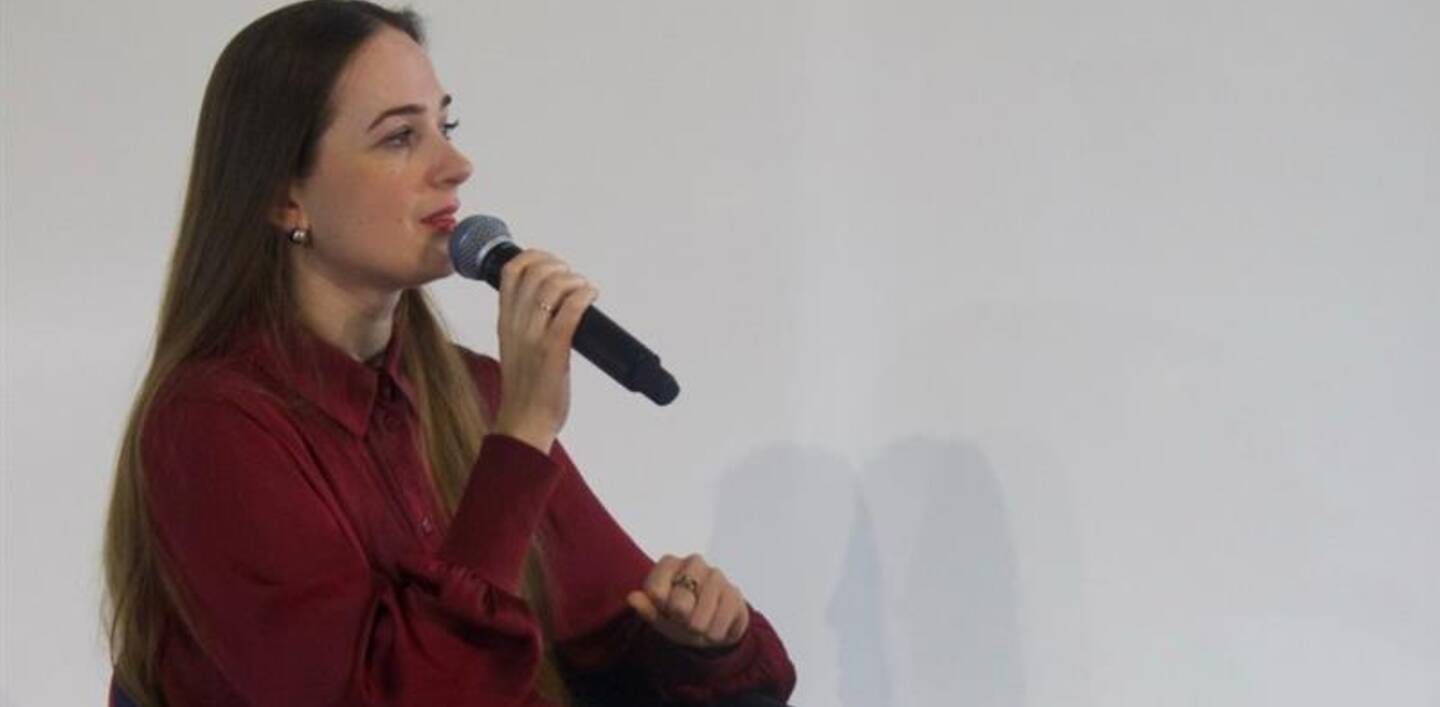
- Peace without justice is just another form of war. Oleksandra Matviichuk argues that any “peace plan” that locks in Russian occupation only guarantees the next war.
- Re-humanizing war in a “post-informational” world. She warns that AI-driven warfare is eroding any shared sense of reality.
- Ordinary people and businesses hold more power than they think. The 42-year-old insists that individuals and firms must decide whether they help sustain authoritarian violence or resist it.
As peace proposals and counterproposals over Ukraine’s future ping pong across the Atlantic, Oleksandra Matviichuk insisted that a ceasefire that leaves people to be tortured in basements or “disappeared” in filtration camps is not, she suggested, peace at all. It is, she believes, merely war in a quieter register, where suffering becomes invisible to outsiders.
A Nobel Laureate in a Week of Nobel Controversy
Two days after Oleksandra Matviichuk filled an HEC Paris lecture hall with stories of abducted children, underground torture chambers and drone “hunts” for civilians, the Nobel Peace Prize itself was plunged into controversy. This year’s laureate, Venezuelan opposition leader María Corina Machado, has openly praised Donald Trump and publicly dedicated the prize to him – a move that, critics say, blurs the line between non-violent human rights advocacy and the project of a strongman politician.
A debate that didn’t leave Matviichuk indifferent. “I think the Nobel Peace Committee awarded María Corina Machado in order to highlight her and other people’s struggle for a democratic Venezuela,” she said in an exclusive phone interview with HEC after the conference. “This is very important, because the Nobel Peace Prize can shine a light on the situation in one concrete country. And people in Venezuela, who for years have been suffering under an authoritarian regime, deserve this attention.”
The Ukrainian human rights lawyer, who shared the 2022 Nobel Peace Prize as head of the Center for Civil Liberties, spoke on the eve of Human Rights Day, which commemorates the adoption of the Universal Declaration of Human Rights in 1948. In a talk that ranged from Soviet dissidents to AI-enabled weapons, she argued that the international order built after 1945 is “collapsing before our eyes”. And she warned that Europe has still not grasped what that means.
Matviichuk argued that, for three decades, the international community chose convenience over accountability as Russian forces committed war crimes in Chechnya, Moldova, Georgia, Syria, Libya, Mali and now Ukraine. Each failure to prosecute, in her telling, created a “chain of wars” and a “chain of impunity”.
In that light, current diplomacy over Ukraine, she continued, is not just about borders, but about whether law has any meaning. Many Western capitals are now openly talking about “realistic” peace plans that would freeze the frontline more or less where it is, keeping large parts of Ukrainian territory under Russian occupation.
Matviichuk is pushing hard against that logic. “I’m not naïve,” she said in our post-conference interview. “Russia will never sign any peace agreement that contains real justice provisions. But there is another option: to establish justice as a parallel track. The key is that any peace agreement must not contain barriers to justice. This is crucial. Then let justice work on its own track.”
For this, the human rights lawyer hopes for backing from independent bodies: “The International Criminal Court doesn’t care about this 28-point plan. It will not stop its criminal proceedings. It will not withdraw arrest warrants. It will continue its work. That’s why we must, as quickly as possible, establish several other accountability mechanisms, including a special tribunal on the crime of aggression.” Politicians, she suggested, will always be tempted to trade away justice for short-term stability. Civil society’s job is to make that trade politically impossible.
Matviichuk went on to lambast the current peace plan: “We see an asymmetric reduction of the Ukrainian army, which is very strange, because it is not the Ukrainian army that attacked Russia, it is the Russian army that attacked Ukraine.” She sighed during our telephone exchange: “The US is suggesting the lifting of all sanctions against Russia. It is even being rewarded with territory it has not even occupied yet - territory the size of Luxembourg! There are no security guarantees at all for Ukraine. The whole logic is to weaken the victim and strengthen the aggressor.”
Humans at the Center of all Negotiations
For all the talk of tribunals and treaties, Matviichuk repeatedly dragged the conversation back to the human scale of war. At one point, she recalled a five-year-old girl who grabbed her hand and begged, “Please, make my mum come back.” As a lawyer, Matviichuk told the 100-strong audience, she could not fulfill that request.
Stories like these are her answer to what she calls the “geopolitical” framing of Ukraine. Too often, she argued, Europeans talk about minerals, sanctions, military budgets or even “Zelensky’s suit,” while ignoring deported children, prisoners of war and civilians in occupied territories. “The plan had zero words about people living under occupation,” she said.
“I’m sorry, but that is not acceptable. Russian occupation means enforced disappearances, torture, rape, denial of your identity, forcible adoption of your children, filtration camps and mass graves. We must try to provide these millions of people under occupation with some security and human rights guarantees. Without the human dimension, we will never find a path to peace.”
Selective Humanity?
Matviichuk’s human rights concerns are not confined to her homeland. At the hour long conference she listed countries facing daunting challenges in this field: “Syria, Sudan, Myanmar, Nicaragua, Venezuela… human rights questions there will define our common future because we are losing freedom in the world. 80% of people live in non-free or partially free societies.”
After the conference, she elaborated: “The right strategy for human rights defenders is to unite our efforts and do something with the international system of peace and security, because it does not work at all. This system must protect people against wars and authoritarian regimes regardless of where they live, and regardless of whether media or international organizations are interested in their fate. If we want to stop these human rights violations, we must unite.”
The Vice-President of the International Federation for Human Rights (FIDH) denounced the selectivity of some advocates: “I think it is a huge problem that we are not able to express our humanity to all victims of war - the victims of the horrible attacks on October 7 and the victims in Gaza of bombardment of densely populated areas. People use this war in the Middle East as an example of double standards. Unfortunately, we saw the same thing in other conflicts.”
She continued: “Look at Sudan: horrible things are happening there, but for a long time there were zero words in the main media about the war in Sudan. Or take Gaza again: South Africa submitted a case to the International Court of Justice based on international crimes committed there, but South Africa is ‘neutral’ when we speak about Russia’s war of aggression against Ukraine. It is the same with Brazil: the government is very vocal about crimes in Gaza, but neutral about the Russian war against Ukraine. So, the general problem is that our humanity is selective. Some countries highlight one situation; other countries highlight another.”
Dangers of a “Post-Informational” World
At the same time, Matviichuk is painfully aware of the growing challenges posed by a “post-informational world”. Digital platforms, state propaganda and algorithmic feeds, she warned, are destroying any shared sense of reality. When people can no longer agree on basic facts, even the most carefully documented atrocity can be dismissed as “fake”.
“In our digital reality, people literally lose the ability to distinguish between a lie and the truth.” She hammered out an alternative: “We must do something about the big tech companies who make a profit from disseminating lies, hate and disinformation. They have to change their algorithms, which spread these things. Scientists have shown that lies spread through social networks multiple times faster than the truth or even rational posts. This is a problem of the greediness of big tech companies, who put their own profits above the common good. They need to be regulated.”
Drones, AI and the Wars to Come
If the collapse of a shared reality is one side of the future, AI-driven warfare is the other. In Kherson, Matviichuk told the students, Russians have used “drone hunting” tactics against civilians. In one case she cited, a drone followed a two-year-old playing in a garden and later killed him while he was in his own home. For the Kyiv-based activist, this is not just a horror of the present - it is a window onto wars where robotic armies and AI will make killing ever more remote, and ever easier.
She reminded those in the amphitheater and online that Ukrainian cities have become live laboratories for new weapons and tactics. “If it is tested in Kherson today,” she suggested in substance, “it can be used in Paris tomorrow.” For a room full of future consultants, tech entrepreneurs and financiers, the message seemed clear: you will not just read about this in policy reports; you may help build or fund it.
From Maidan to Jouy-en-Josas: Ordinary People and Businesses
Matviichuk’s insistence on individual responsibility ran through her account of the 2013-14 Revolution of Dignity. Ukrainians, she told the audience, were not born with a democratic “chip”; they had to build it, through years of protests, court cases and daily acts of resistance. She recalled a small poster from the Maidan that simply read: “We are drops in the ocean.” A single drop dries quickly, but millions of drops become a force no army can ignore.
Her stories from the current war echoed that metaphor. Neighbors evacuating strangers from shelled villages, volunteers documenting crimes in real time, families hiding each other from deportation teams. These are what she called “ordinary people doing extraordinary things” that, in her words, “prove that freedom is stronger than fear”.
That logic applies to business too. Matviichuk did not name specific companies from the podium, but she was blunt about European firms that continue to operate in Russia: by paying taxes there, she argued, they help fund a state that now devotes an enormous share of its budget to war. “Chocolate is not bread,” she said in substance – people may enjoy certain brands, but no one will die if those brands leave a market.
For a school that trains future CEOs and investors, the implication was uncomfortable but unavoidable: business is not neutral. Decisions about where to invest, whom to supply and when to walk away are ethical choices, not just calculations about risk and return.
The EU’s Lack of Strategy
During our phone exchange, Matviichuk was unsparing with European leaders: “I want the European Union to have a strategy. They’ve replaced strategy with ‘non-escalation management’. They just react. And when you only react, when you have no initiative, no strategy, no vision, no goals - you will never succeed.” For the civil society leader, the EU is simply playing by Putin’s rules of the game: “That is why we are now at the point where Putin openly says he is ready for war with Europe. So first and foremost, the European Union must elaborate a real strategy. Right now, they have none.”
At the evening conference for HEC Talks, Matviichuk’s broader message to HEC students was stark. The international legal order is not a given; it is a fragile web of norms held together by people who insist that law must apply even when it is inconvenient. When citizens, businesses and universities treat freedom as just another consumer good, she suggested, that web frays - and the space for strongmen expands.
The choice she left her audience with was not primarily about Ukraine or Venezuela, Trump or Putin. It was about what role they, as future leaders, want to play in the story of law and power over the next decades: spectators of collapse, or “drops in the ocean” pushing back against it.

 Sustainability & Society