


 Sustainability & Society
 Strategy & Leadership

As social fragmentation deepens, Bénédicte Faivre-Tavignot, Associate Professor of Strategy at HEC Paris, explains why social cohesion has become a decisive lever for risk management, resilience and innovation.
As Florent Menegaux, CEO of Michelin, poignantly noted during HEC Paris Purpose Day 2025, “The biggest challenge today is social cohesion, with the risk of societal fragmentation.” For CEOs, ignoring this challenge now means increasing exposure to risk, fragility and loss of trust.
In parallel, the AXA Future Risks Report 2025 reveals that 59% of citizens worldwide believe their country is fragmented, and only 12% feel they share a common vision of an ideal society. As AXA CEO Thomas Buberl noted when commenting on the report, social fragmentation has reached a tipping point and now represents one of the greatest threats to collective well-being and, by extension, to economic prosperity. For CEOs, this makes social cohesion a systemic risk issue, not a soft or secondary concern.
According to Faivre-Tavignot, social cohesion rests on two interdependent pillars: social justice on the one side, and social ties on the other. Here, she proposes to focus more closely on the second pillar.
Beyond a certain level of wealth, what sustains societies—and organizations—is no longer capital accumulation, but the quality of social relationships. Today, CEOs are operating in a world of “perma-crisis”, where health emergencies, geopolitical tensions, climate disruption, debt and political instability overlap and reinforce one another.
In this context, Faivre-Tavignot argues that social ties are no longer a peripheral or purely ethical issue. They have become a strategic asset—one that conditions human resilience, economic stability, innovation capacity and the long-term legitimacy of business.
- Social fragmentation is a material risk factor for companies, increasing operational, reputational and social risk.
- Companies can actively restore social ties, starting inside the organization and extending to territories and ecosystems.
- Social cohesion directly supports license to operate, especially in high-impact sectors.
- Situations of isolation and fragmentation are also powerful drivers of innovation and new business models.
Social Fragmentation: A Growing Strategic Risk
The erosion of social ties has reached a critical threshold. In France alone, 750,000 elderly people are living in a situation of “social death”, according to a study by Les Petits Frères des Pauvres published in October 2025. At the same time, loneliness is spreading rapidly among younger generations. As the World Health Organization’s Commission on Social Connection reported in 2025, 20.9% of 13- to 17-year-olds worldwide experience loneliness—the highest rate of any age group—challenging the stereotype that loneliness is primarily an older-age problem. Across all ages, this growing social disconnection carries serious consequences, profoundly affecting both mental and physical health.
These situations generate measurable economic costs, particularly through their impact on health systems and productivity. But, as Bénédicte Faivre-Tavignot underlines, the consequences are first and foremost human: what meaning can life—or work—have without relationships of quality and trust?
Global data reinforces this diagnosis. The World Happiness Report 2025 shows that beyond a certain income threshold, social ties are the primary determinant of life satisfaction, outweighing further gains in wealth.
Strengthening Social Ties Inside the Organization
In a fragmented society, if social cohesion is now a strategic asset, where should CEOs act first—inside or outside the organization? The company can become a powerful—sometimes last—place of social connection. For many employees facing personal or social difficulties, work is not only a source of income but a space of belonging, recognition and support.
Drawing on the “Element Humain” approach developed by psychologist Will Schutz, Bénédicte Faivre-Tavignot identifies three conditions that enable strong social ties within organizations, particularly at team level:
- Inclusion: employees must feel they are part of a shared community, sometimes through simple rituals—greetings, team moments, collective events.
- Responsibility and competence: individuals need to feel recognized as capable and entrusted with real responsibility.
- Openness and trust: people must feel they can speak honestly, show vulnerability and engage in authentic dialogue.
These dimensions also underpin effective social dialogue more broadly between teams, across silos and between management and employee representatives. Many organizations suffer from excessive compartmentalization, which weakens cooperation, circulation of information and collective resilience.
Building Social Ties to Secure Long-Term Business Stability
Beyond internal dynamics, social ties with stakeholders have become decisive for business continuity. Relationships with shareholders, customers and suppliers increasingly extend beyond transactional exchanges toward trust-based partnerships.
The link with territories and local communities is particularly critical. In high-impact sectors such as mining or large industrial projects, the quality of relationships with surrounding communities can literally determine the company’s license to operate. Poor social ties increase the risk of conflict, project delays and rejection; strong ties reduce risk and create conditions for long-term viability.
In a polarized society where dialogue is increasingly difficult, Bénédicte Faivre-Tavignot emphasizes that social cohesion becomes a strategic asset for risk management, comparable to safety or financial capital. By fostering “bridging” social ties—connections across social classes, generations, territories and beliefs—companies also strengthen the acceptability of their activities and their capacity to transform, whether in response to ecological or digital transitions
From Social Need to Business Innovation
Social fragmentation is not only a source of risk; it is also a reservoir of innovation. Situations of loneliness among seniors, isolation of young people or territorial fractures represent unmet needs from which new services and business models can emerge.
Several organizations illustrate how social ties can sit at the heart of economic value creation:
- Tom & Josette, which creates relationships between elderly people and young children.
- Alenvi, which supports elderly people in remaining at home and develops co-living houses for people with Alzheimer’s disease.
- Kawaa, Les Petites Cantines and a growing number of third places, which foster everyday social interaction in cities and rural areas.
In these cases, social ties are not an external impact—it is the core of the business model. As studied through the HOPES initiative dedicated to social bonds, vulnerabilities, and social entrepreneurship at HEC Paris, the social and solidarity economy sector acts as a laboratory for hybrid models combining economic flows with strong social value. These models offer large companies concrete opportunities for partnerships, intrapreneurship and impact investment.
 Find out more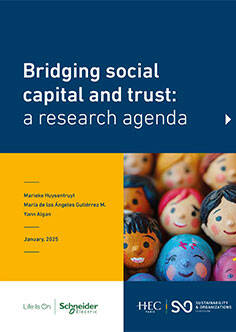
Toward an “Economy of the We”
Taken together, these dynamics point toward a deeper transformation: the emergence of an “economy of the We”, based on cooperation, mutual support and shared value rather than pure transactional logic.
In a world of overlapping crises, social ties and solidarity are powerful vectors of resilience—socially and economically. For CEOs, positioning the company as an actor in rebuilding the collective “we” is not only a societal contribution, but a strategic narrative that resonates with employees, territories, investors and public authorities.
As Bénédicte Faivre-Tavignot argues, integrating social cohesion into innovation strategy—through intrapreneurial programs, partnerships with the social economy and new governance models—opens the way to performance that is both sustainable and meaningful.


 Geopolitics & Public Affairs