
"Every Custom Program Is a Research Field That Doesn't Know It Yet"
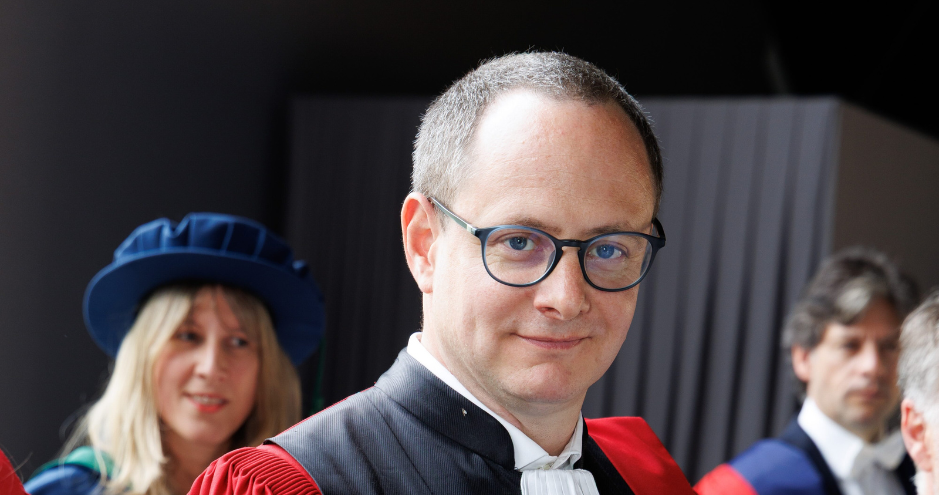
“What do I do on Monday morning when I get back to the office?” It all begins with this one simple question. It is the question that Emmanuel Coblence, Professor of Leadership and Academic Director of several custom programs at HEC Paris, uses to close every custom program.
Every participant leaves with a personal action plan, specific commitments to experimentation, and a peer community with whom to debrief results.
From Classroom to Research, and Back Again
This “Move to Action” is above all a signal for the researcher: a moment when the real friction points, real dilemmas, and real questions participants have managed - or failed - to articulate become legible. And it is often in that space of truth between the end of the program and the return to reality, that the most beneficial research topics emerge.
For the company and the program participants, the impact can first be measured in individual career paths: for example, when defense-industry executives get promoted during the program, and within the organization itself for example, when a new CEO of a major French company draws directly from the cohort of his HEC Paris custom program to renew part of his executive committee.
“We were part of the trajectory that helped make these leaders more visible, ‘empowered,’ and accountable so they could access the top circle during a period of transformation within their organization.”
But the impact of these custom programs does not stop with the participants. It reaches all the way back to research itself. This is the virtuous cycle we trace here through a conversation with Emmanuel Coblence.
The Company as Fieldwork: A Mini-Ethnography Before the First Module
The virtuous cycle begins well before the course, during the preparatory interviews professors conduct with leaders from the partner company.
These conversations are presented as a diagnostic phase: understanding the issues, identifying the populations, calibrating the content. And of course, that is exactly what they are. But for Emmanuel Coblence, they are something else as well:
"The company is not just our client. It is also our field of research."
When he sits down with a CEO, an HR director, or a member of the executive committee who speaks about company culture, management paradoxes, and what gets stuck in the leadership of their teams, he gathers, in real time, valuable material on how these high-level practitioners theorize their own experience — in their own words, with their own metaphors, and their own blind spots.
A recent example illustrates this well. In one of his programs, a client company had just appointed a new CEO. Emmanuel Coblence recalls being struck by this leader’s posture: humble and attentive, while also showing a real desire to shake up the status quo and move quickly.
"This is not a case I would have built from the literature. The literature came to me afterwards, to give a framework to what I had heard."
Beyond the individual interview, it is the confrontation with the DNA of an entire organization that proves most intellectually stimulating. Every company, he explains, has its own grammar of leadership: unspoken tensions between what it says it wants in leaders and what it actually rewards through promotion and recognition. Academic literature sometimes struggles to capture those tensions in all their contextual complexity.
"A leadership style that works brilliantly in a medium-sized German family business could be seen as too vertical in a French matrix organization, or too soft in a hypergrowth scale-up."
Each new custom program thus forces the researcher to question the degree of generality in their own frameworks. The partner company, far from being a mere sponsor, becomes a critical mirror for theory.
The Classroom as a Living Lab
Once the program begins, this fieldwork continues and intensifies. In custom programs designed for large organizations such as Deloitte, SPIE, MERIEUX and CMA-CGM, the classroom becomes a living laboratory.
When a general manager describes the failure of a multi-million-euro transformation, an HR director is dealing with a major social crisis, or an executive expresses difficulty giving meaning to their teams’ work - and these issues are brought into the classroom - theoretical concepts stop being abstract. They come to life.
Emmanuel Coblence borrows from philosopher Hartmut Rosa the word he finds most fitting to describe that moment: crackling.
"It is that intellectual and emotional spark that suddenly ignites in the classroom, faced with real, intense situations. Something catches fire, in the positive sense of the term."
To make that magic happen, the professor adopts a radically pedagogical stance inspired by philosopher Jacques Rancière and his book The Ignorant Schoolmaster: He does not come to explain. He comes to create the conditions for the spark.
"I see every executive who joins a program as someone who carries within them an intelligence of their own situation that I do not have. HEC Paris custom programs are mechanisms that force teachers into that form of humility."
From Classroom to Publication: AI as a Case Study
Faced with endless debates about artificial intelligence in their custom programs, professors Emmanuel Coblence, Julien Jourdan, and Catherine Tanneau decided to turn these field questions into an academic research topic.
Their work led to a powerful thesis: the likelihood that AI absorbs management tasks exceeds 50%: planning, reporting, control, staffing. But it has far less influence over what lies at the heart of leadership: mobilizing emotional, social, and political intelligence to navigate complex ecosystems.
Read the article in English If AI Manages, What’s Left for Managers?
"AI will intensify an already existing fault line: between leaders who are only managers and those who behave like true leaders. Leadership will become a job market currency: what will really make the difference when management practices are augmented and propped up by AI."
This research, born directly from classroom exchanges, made it possible to create new teaching cases, now used in HEC Paris Executive Education custom programs.
"We are intellectually stimulated by things that happen in a custom program. We launch a research project, get initial results, produce teaching cases, and come back to other participants a year later with sequences that did not exist before."
The Leadership Signature in Custom Programs: A Two-Way Mirror Effect
At the heart of HEC Paris Executive Education’s custom-program pedagogy lies a founding principle: there is no universal recipe for leadership. Faced with the noise of the literature on the topic — never more abundant, never more contradictory — HEC Paris has formalized a distinctive approach, the Leadership Signature, structured around five pillars: self-awareness, situational intelligence, paradox leadership, purpose-based leadership, and change and transformation management.
But it is in custom programs that this approach takes on a truly new dimension, and that is where the virtuous cycle perhaps achieves its most subtle feat.
When all participants share the same organizational DNA, the same codes, and the same constraints, something special becomes possible: the leadership paradoxes revealed by the program are no longer abstract. They can be named and recognized, because everyone in the room knows exactly what is being discussed.
This creates a dual dynamic. On the one hand, each participant builds their own individual signature: what is unique to them, what distinguishes them from their peers, and what they want to embody as a leader within that specific organization. Indeed, an introverted participant and an extroverted participant in the same organization cannot receive the same training — and it is precisely this that the custom design makes possible.
On the other hand, something unexpected emerges: a collective reflection on the organization’s own leadership signature.
"By helping each manager find their leadership signature, we end up revealing, together, something the organization may not yet have been able to articulate about itself. It is a kind of mirror effect: recurring paradoxes, cultural biases, behaviors the organization says it values and those it actually rewards rise to the surface."
That is also, Emmanuel Coblence concludes, how custom programs generate an impact that goes beyond individual development to reach the organization as a whole.
An Ecosystem in Three Movements
HEC Paris Executive Education’s custom approach is a living ecosystem that unfolds in three stages: before the program, when the company becomes ethnographic fieldwork; during the program, when the classroom becomes a research lab and space for formalization; and after, when the findings feed back into theory and into future programs.
As Emmanuel Coblence affirms:
"Every custom program is a research field that does not know itself."