How Bilal Hmedeh Built a Career Across Business, Public Service, and Society
"I joined the EMBA to become a better decision-maker and deepen my understanding of French business culture. The entrepreneurship specialization later proved key in preparing me to launch my own company."
One year after graduating from the HEC, Bilal Hmedeh (EMBA24) launched Datavera, a digital transformation and data management company that builds on his decade at Intalio and supports the group’s activities across the African continent. Based between the UAE, Saudi Arabia, and Lebanon, he also travels regularly to several African countries for monthly missions. Before this, he spent a decade at Intalio shaping the group’s strategy and growth, and while he has stepped down from that role, he continues to serve on the executive board.
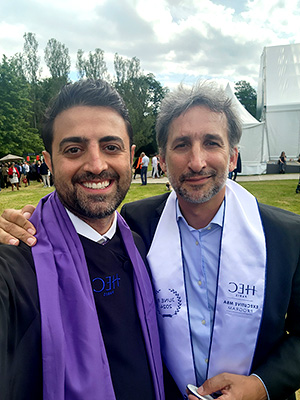
Bilal decided to get his EMBA as an opportunity to better his leadership and strategic thinking, not to chase a title, but to become a more structured and reflective decision-maker. This mindset has continued beyond graduation: he has been invited to return to HEC as a Capstone Advisor, supporting future executives as they shape their own projects and ideas.
Outside of work, Bilal is deeply committed to Lebanese causes and believes in giving back to his home country. He volunteers his time to digital transformation initiatives within several Lebanese ministries by putting his professional and organizational capabilities to serve public institutions. His EMBA capstone was a reflection of this and centered around connecting volunteers, NGOs and corporations for social impact— a belief he sums up simply, "A meaningful career should include contribution across the private sector, the public sector, and civil society."
His journey has also been recognized with the HEC Mercure Award for Best Entrepreneur in the Middle East. This award celebrates entrepreneurs across sectors and company stages, and reflects criteria such as ambition, achievements, and alignment with HEC priorities including inclusion, sustainability, and prosperity.
In the Q&A below, Bilal shares what led him to pursue the EMBA, his entrepreneurial leap, and the purpose that drives him.
Why did you decide to pursue an Executive MBA?
At a certain stage in my career, I felt the need to step back and structure the way I think rather than simply rely on experience. I was already operating at an executive and board level, but I wanted to deepen my perspective and challenge my own assumptions. For me, the EMBA was not about a promotion or a title, but about becoming a better decision-maker. The timing felt right both professionally and personally.
Why did you choose HEC Paris?
Choosing HEC Paris was both a strategic and cultural decision. Beyond HEC being the number one school offering an Executive MBA, I specifically wanted to study in France. My company had French roots, and I wanted to better understand French business culture, leadership style, and decision-making approaches. Being in France also allowed me to immerse myself in the culture rather than study it from a distance. I knew this would later help me operate more effectively with French stakeholders and business environment.
Which intake did you join?
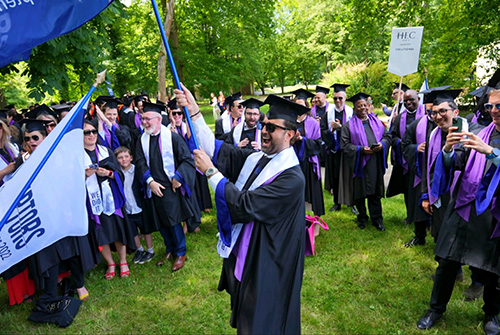
I chose the September 2022 in Jouy-en-Josas intake very deliberately. Starting in September gave me a strong boost as it was right after the summer and gave me the right mindset to fully commit to the program. As cultural immersion was a key objective for me, and I wanted to experience the academic environment, discussions, and interactions directly in the French context.
Were you able to immediately apply EMBA lessons to challenges at work while you were studying?
Many concepts from corporate strategy and business strategy were directly applied to challenges I was facing, especially around market positioning, growth decisions, and competitive dynamics. I also applied several finance practices early on, particularly related to investment decisions, financial structure, and value creation. Overall, the EMBA changed my work style by making me more structured, reflective, and analytical in decision-making.
How has the program contributed to your leadership skills?
It contributed significantly to my leadership development, particularly through exposure to different leadership styles and situational leadership. I learned that leadership is not about applying one single style, but about adapting based on context, people, and circumstances. This made me more attentive to human dynamics and more intentional in how and when I lead, coach, or step back.
The EMBA played a major role in shaping my ambition and readiness to launch Datavera. The strategic frameworks, entrepreneurial exposure, and leadership learning helped me approach Datavera in a more structured and confident way.
How did you customize your EMBA?
I chose the entrepreneurship specialization because I knew that after the EMBA I wanted to build my own business journey, and this specialization supported that ambition. I also wanted to engage fully with everything HEC had to offer. We organized several activities on campus, including sports and social events. In addition, I joined the FDC program in Brazil with HEC and completed a GNAM course at Yale University.
What has been the most memorable experience?
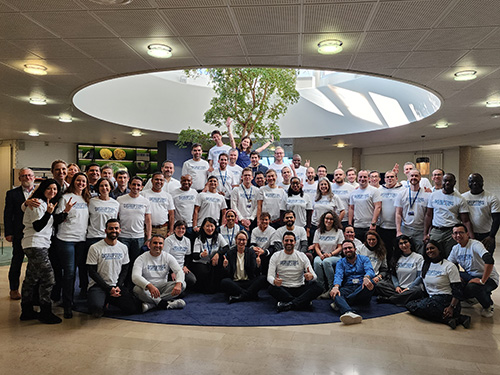
The most memorable and valuable experience was the strength of the cohort. Even after graduation, we continued to stay closely connected. So far, we have organized more than five gatherings, and in one of them, more than seventy percent of the class was present. That level of engagement is quite unique and reflects the strong bonds built during the program.
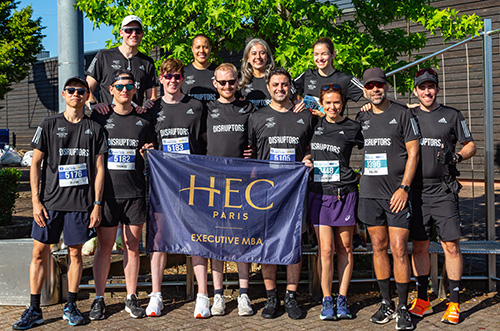
We are now organizing yearly gatherings, including one in Portugal this year and another planned in Corsica in France in 2026. We also organize a yearly marathon and a yearly ski event, with an upcoming ski gathering in Italy this January. Our Disruptors cohort became well known at HEC for being highly active and engaged. One of my main goals was to build a strong and meaningful network and being elected as the social representative of the class helped me achieve that! It allowed me to actively engage with everyone in the cohort and contribute to the overall experience.