Leading from Within: Inside the HEC Companionship Experience
Leading from Within: Inside the HEC Companionship ExperienceNavigating a career can be scary at any stage in one’s life but it doesn’t have to be. The HEC Paris MBA Companionship program helps students feel more confident to make conscious - “purposeful” - choices about their professional trajectory with the help of both alumni and classmates. The Companionship program matches students with alumni to better understand who they are, what they are looking for, and how to get where they want to be through both private and group sessions.
Three Companionship students share their life-changing experiences:

Name, Graduation Year:
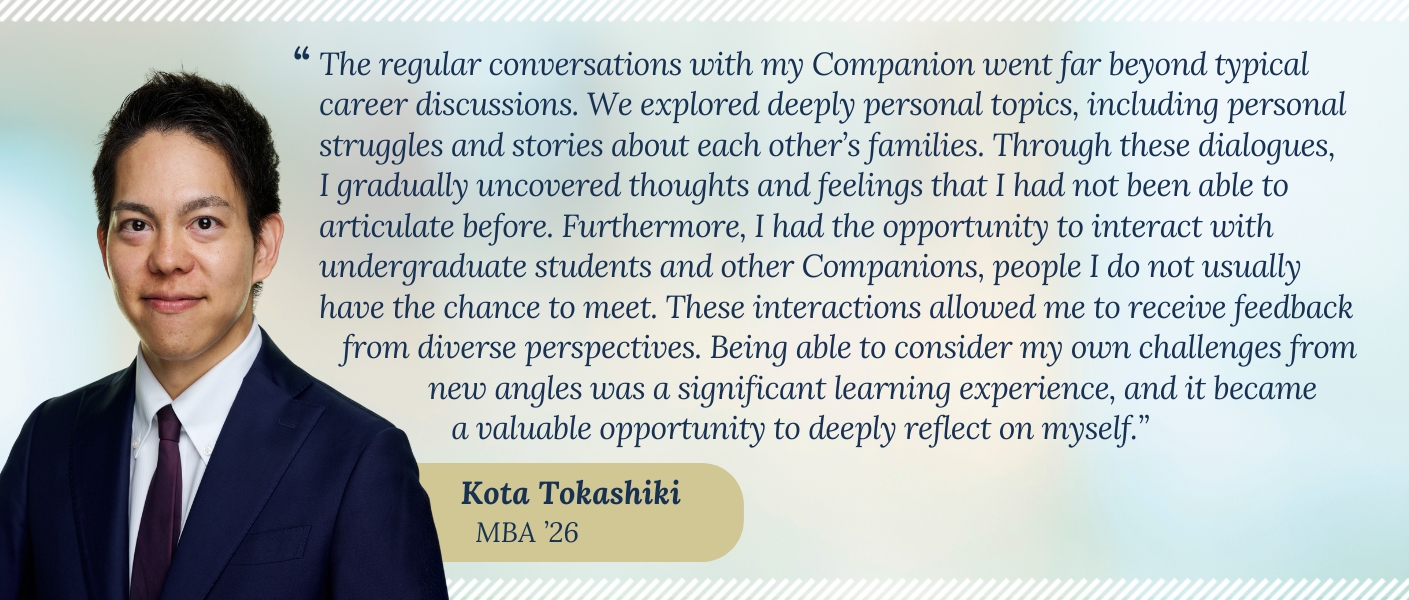
Kota Tokashiki, MBA '26
What motivated you to participate in the Companionship program?
During my MBA, I have been exposed to so much information and so many options that I found myself unconsciously influenced by others’ values. To rethink how I want to shape my career after graduation, I joined this program to pause and reflect on what I truly want to prioritize in life. With the support of my companion, it became a valuable opportunity to clarify my values and face what will guide me in the future.
What was it like to be paired with an HEC alumnus as part of this program?
My companion was an experienced female leader in the IT industry. Since I have also built my career in the same field, I was able to speak openly with her about my work-related dilemmas and career direction. Her insights, grounded in extensive experience, carried great weight, and through our conversations, I gained valuable reflections and learning.
What was the most powerful or surprising moment you experienced during the companionship sessions?
The most powerful moment for me was realizing my own growth through the repeated sessions. In the beginning, I couldn’t clearly express the dilemmas and uncertainties I was facing, but through ongoing dialogue, I gradually began to organize my thoughts and articulate them in my own words. It was not just a one-time consultation—because this program allowed me to engage in continuous conversations with the same companion over time, I was able to confront and reflect on deeper values and emotions that I hadn’t been fully aware of before.
What tools or frameworks introduced during the program will you continue using in your career?
The “Have to Protocol” introduced by Louis Faure felt like a highly practical framework. Experiencing it through small-group exercises helped it naturally settle within me. The process of organizing my emotions and needs, and making intentional choices, is something I believe will be very useful in future career decisions.
How did this course influence your definition of success or reshape your career goals?
Through the program, my definition of success shifted from externally imposed standards to a sense of fulfillment that arises from within. Rather than chasing a career path that is socially recognized or validated, I learned the importance of deepening the questions that truly matter to me. Engaging in ongoing dialogue and carefully facing my inner compass — that, to me, is the greatest value of the Companionship program.
How important was the peer-to-peer interaction in the classroom setting?
Sitting in a circle of chairs, with only a notebook and pen, and no one on their laptop, it created a quiet and extraordinary space where peer-to-peer conversations felt truly grounding. When I shared my personal struggles, other students listened with genuine attention and offered sincere feedback. Some of their reflections revealed perspectives I hadn’t considered. The classroom itself became a space of mutual support, where everyone contributed to each other’s growth.
What advice would you give to incoming students thinking about taking this course?
It was a special and profound experience that deeply enriched my MBA journey. Through conversations with my companion, I was able to truly face myself. For those who want to reflect on how they want to live from this point forward, this program offers an irreplaceable opportunity.
Was there anything particularly challenging or uncomfortable about this course? How did you work through it?
I felt unsure whether I could truly be of help to my companion, who was far more experienced than I was. At first, I saw myself mainly as someone being supported, but as she listened to me with genuine interest, I gradually came to see that simply sharing my perspective and thinking together as equals had meaning. It wasn’t about having the right answers, but about showing up with sincerity—and gradually, that helped ease my initial uncertainty.
Name, Graduation Year:
Pyone Myint, MBA '26
Before taking the course, how clear were you about your next career move or your professional intentions?
I was fairly clear about my professional goal; however, I didn’t have a concrete picture of what the journey would look like or the exact steps I needed to take to achieve my professional goals. Being part of this program and having numerous discussions with my companion helped me realize the importance of approaching conversations with authenticity.
What was it like to be paired with an HEC alumnus as part of this program? How did your dynamic evolve over the four meetups?
The pairing process was smooth. I was matched with a companion who is open-minded and has professional experience in the industry I aspire to work in. Our first meetup was facilitated by the organizing team, which helped break the ice. Both my companion and I took the initiative to maintain regular conversations and continued to meet regularly. The first two meetups were focused on getting to know each other and sharing our backgrounds. From the third meetup onward, our conversations became more in-depth, and we developed a better understanding of each other’s expectations.
What was the most powerful or surprising moment you experienced during the companionship sessions?
One particularly powerful moment occurred during my third meetup with my companion. We were walking through the Louvre, discussing the artwork, when he suddenly asked me what I was expecting from this program. That question brought back a memory of the first speech given by our MBA Program Associate Dean, who emphasized the importance of being intentional in our lives. In that moment, I realized how crucial it is not only to set clear intentions but also to communicate them openly with others. I shared my expectation - that I hoped to have a companion outside the MBA circle with whom I could openly discuss both personal concerns and professional decisions. This was especially important to me as I was still adjusting to a new environment at the beginning of my MBA journey.
Has your approach to communication or leadership changed as a result of this course? Can you give an example?
Alongside active listening, I also discovered the transformative power of sharing, particularly in the context of building a relationship with my companion. Each meeting with my companion offered me invaluable insights. What made those meetings truly impactful was not just the guidance I received, it was the act of opening up about my personal goals, challenges, and aspirations.
At first, I hesitated to share; however, I realized that holding back only limited the support I could receive. When I began openly discussing the projects I was working on and the outcomes I hoped to achieve, my companion was able to provide far more tailored advice. It helped him understand not just what I was doing, but why it mattered to me.
This transparency had several benefits. Firstly, it reinforced my own sense of commitment. By articulating my goals out loud to someone I respected, I felt more accountable. It was no longer just an internal ambition - it was something I had declared, and that declaration gave it weight. It fostered a sense of ownership over my work and pushed me to follow through more diligently.
Secondly, sharing fostered a deeper connection with my companion. Rather than a transactional relationship centered on advice-giving, our companionship became a genuine partnership rooted in mutual respect and curiosity.
Moreover, the act of sharing taught me that vulnerability is not a weakness but a strength. It is through revealing our uncertainties, dreams, and limitations that we create space for meaningful dialogue. My companion responded to my openness not with judgment, but with empathy and encouragement. This, in turn, inspired me to adopt the same approach with others - to meet their vulnerability with compassion and curiosity, and to create environments where they too felt safe to share.
How important was the peer-to-peer interaction in the classroom setting? Did you find value in the reciprocal exchanges with fellow students?
I found the peer-to-peer interaction in the program classroom setting to be one of the most enriching aspects of the course. It was particularly interesting and refreshing to meet peers from other programs, each bringing their own unique background, perspective, and life experiences.
The stories shared during each session were incredibly inspiring. There was a genuine openness and willingness to listen, which created a strong sense of psychological safety within the group. That environment allowed people to share deeply personal and meaningful stories, which in turn fostered empathy, connection, and mutual learning.
How did this experience compare to more traditional career development workshops or coaching sessions you’ve done in the past?
Unlike traditional career development workshops or coaching sessions, which often focus on structured advice, technical skills, or goal-setting frameworks, this program offered something more personal and reflective. It created space for conversations where I could explore my thoughts, doubts, and aspirations with someone outside of my usual circle. It gave me access to different perspectives and, at times, non-technical advice. Rather than focusing solely on career tactics, this program encouraged me to think more holistically about my growth, both professionally and personally, which made it a unique and enriching complement to traditional development formats.

Name, Graduation Year:
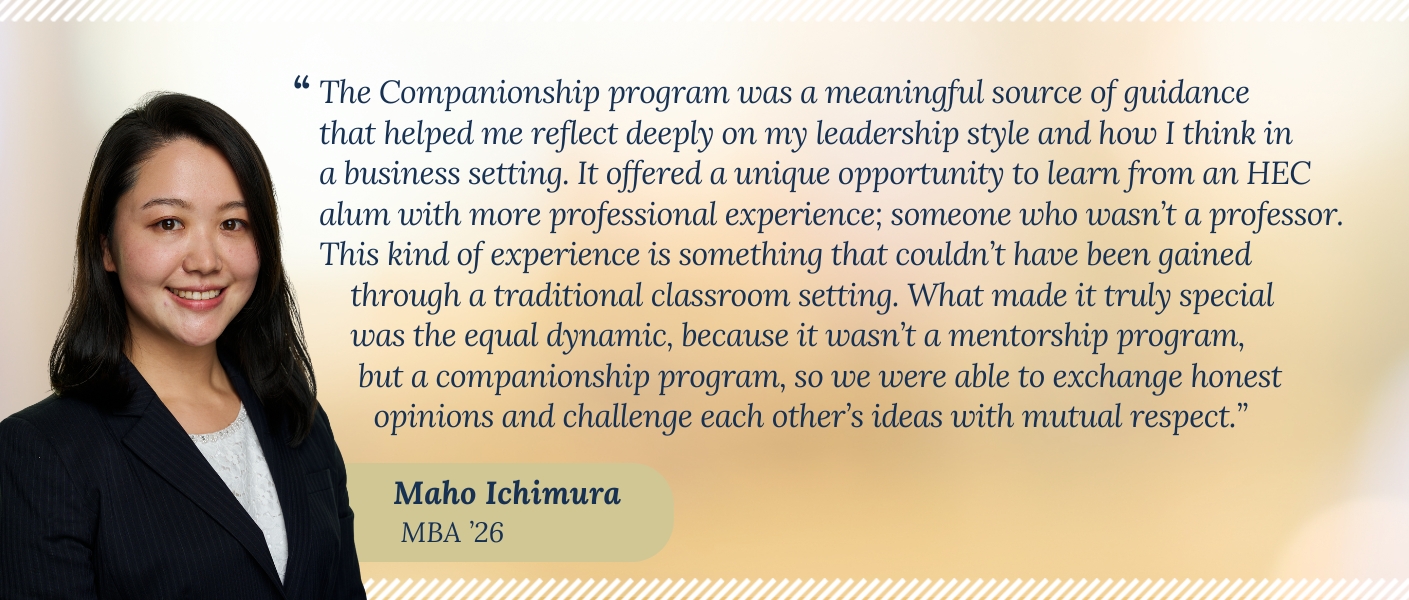
Maho Ichimura, MBA '26
What motivated you to participate in the Companionship program?
When I decided to pursue my MBA, I knew I wanted it to be a time for deep reflection, both personally and professionally. I was actively looking for a mentorship-based experience, something beyond what traditional courses offer. I chose the Companionship program because I was craving a space where I could be truly honest with myself, explore my past, embrace both my strengths and vulnerabilities, and begin shaping the kind of person and leader I want to become.
Were you familiar with the idea of “purposeful leadership” before this class? How did your understanding of it evolve during the course?
Before taking this course, I thought I knew what purposeful leadership meant, but this course changed my view. I used to associate leadership with impact and vision. Now, I see it as showing up with courage and clarity, especially when things are uncertain. Now I see purposeful leadership as aligning actions with your truth, not just your goals.
What was it like to be paired with an HEC alumnus as part of this program? How did your dynamic evolve over the four meetups?
Being paired with [my companion] Rozenne, it felt like a truly meaningful match. Having also spent years living abroad, she intuitively understood the nuances of navigating life across cultures—often without me needing to explain much. From our very first meeting, she created a space where I felt safe to voice my inner thoughts and struggles. What began as a structured school initiative quickly evolved into something deeper. We connected outside of the formal sessions, and I was even welcomed into her home, where I met her family. Over time, our relationship blossomed into a genuine companionship—rooted in mutual respect, trust, and shared humanity.
What was the most powerful or surprising moment you experienced during the companionship sessions?
There wasn’t a single powerful or surprising moment, because from the very beginning, we intentionally shaped our relationship as a companionship, not a mentorship. We approached each other as equals, not as mentor and mentee, which created a rare kind of openness. Despite being at different stages of life, we built a bond grounded in honesty, mutual respect, and emotional sincerity. That foundation allowed every session to feel meaningful not because of dramatic revelations in our conversation, but because of the trust that we continuously shared.
How did this course influence your definition of success or reshape your career goals?
Before this course, I saw success as reaching a prestigious position at a well-known company, it was about the destination. Now, success means staying grounded in who I am while I pursue my goals. I’m still ambitious, but my definition has evolved. I want to build a career where I can lead with empathy, stay true to my values, and prioritize my well-being, rather than simply chasing titles or financial rewards.
Has your approach to communication or leadership changed as a result of this course? Can you give an example?
This course completely transformed how I view leadership and communication. I used to hide pain behind competence, believing that admitting struggles made me seem weak or incapable. But through the course, I learned that vulnerability is not a flaw, it’s a form of strength. I began practicing this within the Women in Leadership Club, which I led. Being open about my challenges, I noticed a shift: team members started offering not only more ideas, but deeper support. Our meetings and conversations became more authentic, and I realized that real leadership starts with being authentic and human.
How important was the peer-to-peer interaction in the classroom setting? Did you find value in the reciprocal exchanges with fellow students?
Hearing others share their fears, dilemmas, and personal growth made me feel less alone in my own internal battles. We weren’t just classmates, but we became a source of genuine support for one another’s journeys. The vulnerability in those exchanges created a depth of learning that simply doesn’t happen in typical MBA classes.
What advice would you give to incoming students thinking about taking this course?
Come into this course with openness and intention. It’s not a typical MBA class and it’s a rare space to pause, reflect, and connect on a deeply human level. The more honest and vulnerable you allow yourself to be, the more transformative the experience becomes. One of the most powerful aspects is treating your companion as an equal. That mutual exchange, listening to their dilemmas, offering your thoughts, and being there for each other, creates a unique bond that goes far beyond traditional mentorship.