
Women in Leadership Spotlight: Laura Pérez
Laura Pérez (MBA ’27), Co-President of the HEC Paris MBA Finance Club, shares how her leadership journey has evolved—from high-stakes M&A to leading with presence, empathy, and authenticity. In this Q&A, she reflects on defining moments at HEC, the role of emotional intelligence in leadership, and what it means to build impact beyond performance.
What moment in your career - or during your MBA at HEC Paris - has most shaped the leader you are today?
I think there are two moments, one external and one internal, that deeply shaped the leader I am becoming. The first was early in my M&A career in the buy-side of a portfolio company in telco infrastructure, when I realized I was often the only woman, and usually the youngest person in the room. At the beginning, I thought leadership meant doing everything by myself, proving technical mastery, and taking up space in the “traditional” way. Over time, especially while leading cross-border deals across 17 countries, I understood that my real strength was different: clarity under pressure, emotional intelligence in negotiations, and the ability to align people across cultures. That shift, from trying to fit the mold to owning my style, was foundational.
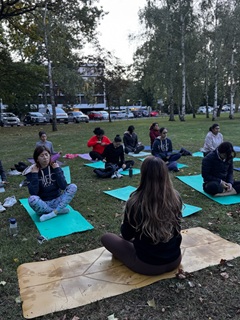
The second defining moment happened during my MBA at HEC Paris, when I saw the visible energy shift in a yoga class I was leading. My classmates came in exhausted, overwhelmed, carrying the weight of recruiting, academics, and life transitions. And within one hour, the room softened. People reconnected. Something changed. I realized leadership is not only about driving outcomes but also about holding space. It’s about creating environments where others can perform, breathe, and grow.
Between leading in high-stakes M&A rooms and holding space on a yoga mat, I learned that leadership is both precision and presence and strategy and humanity. The more I integrate both, the more authentic and effective I become.
How has your time at HEC Paris influenced or reshaped what leadership means to you?
HEC Paris has reshaped leadership for me in a much deeper way than I expected. Before the MBA, my definition of leadership was strongly performance-driven. It was about execution, analytical sharpness, delivering results under pressure, which makes sense after seven years in M&A and infrastructure investing. Leadership meant being the most prepared person in the room.
At HEC, that definition has expanded. Through leading the Finance Club, and facilitating weekly yoga sessions, I started to see leadership as energy management, not just performance management. In this environment, where everyone is talented, ambitious, and stretched, what differentiates leaders isn’t IQ; it’s emotional steadiness, intentionality, and the ability to create psychological safety.
One moment that shifted me was realizing that when I walk into a room, my emotional state sets the tone more than my technical expertise does. If I’m grounded, others settle. If I’m clear, others align. That awareness made leadership feel less like proving and more like calibrating.
HEC also exposed me to vulnerability in a new way. Through courses like Evidence-Based Leadership and honest peer feedback, I saw how much growth comes from acknowledging blind spots, especially as a woman in finance who learned early to over-prepare and over-perform. Leadership now means allowing space for imperfection while still holding high standards.
Today, leadership to me is:
• creating clarity in complexity;
• holding both ambition and empathy;
• building communities, not just outcomes;
• and understanding that presence is often more powerful than authority.
HEC Paris has helped me integrate my leadership style with something more human, or at least become far more conscious of that dimension. It's that integration that has felt truly transformative.
Who is a woman who has inspired you during your career or MBA experience, and why?
A woman who has inspired me from outside my immediate environment is Christine Lagarde. What I find powerful is how she navigates highly technical spaces: global finance, central banking, international policy, where there are still few women, with composure and clarity. She blends intellectual authority with emotional intelligence, a balance I deeply value.
What inspires me most is her presence: firm without rigidity, strategic without losing humanity. She reinforces my belief that in finance, sharpness and grace can coexist.
What do you wish more people understood about women’s experiences in business school today?
Representation still matters deeply. When there are few women in certain industries, leadership tracks, or even classrooms, the pressure to perform can feel amplified. You’re not just showing up for yourself; at times, it feels like you’re representing something larger. Seeing more women in positions of authority doesn’t just inspire confidence; it normalizes ambition.
I also wish more people understood that for many women, business school is not only an academic or professional experience but also an identity negotiation. On the surface, we’re all competing on the same metrics, but internally, there can be constant calibration. How assertive is too assertive? How warm is too warm? When do I push? When do I soften? That invisible layer of self-awareness takes energy.
At the same time, women in business school today are redefining leadership. Many of us are deeply ambitious, but also intentional about the cultures we want to build: integrating performance with empathy, ambition with sustainability. Acknowledging these dynamics doesn’t lower the bar. It simply creates a more honest and stronger environment for everyone.
If you were mentoring the next cohort of women arriving at HEC, what’s the one thing you’d want them to know?
At HEC, you’ll be surrounded by extraordinary talent: ambitious, articulate, impressive people. It’s easy to feel like leadership means speaking the most, networking the hardest, or performing confidence at all times, but your strength doesn’t have to look like anyone else’s.
Be deeply competent. Be prepared, but don’t abandon your intuition, your warmth, or your way of thinking just to fit an imagined mold. The rooms you’re walking into need your perspective, not a diluted version of it.
You belong in every room you step into. The goal isn’t to adapt your identity to the space, it’s to expand the space by being fully yourself.
What hobby, passion, or personal interest has helped keep you grounded during your MBA at HEC, and why is it important to you?
The MBA is intense: intellectually, socially, emotionally. There’s constant stimulation from recruiting, to leadership roles, group work, and big ambitions concentrated on one campus. Yoga gives me the opposite. It brings me back to my breath, to my body, to the present moment. And truly, yoga is more off the mat than on the mat.
What makes it especially meaningful is that it’s not only a personal practice. The space we’ve created through weekly sessions on campus has become powerful. It’s a different kind of community, one where performance isn’t encouraged, where slowing down is allowed. Grounding isn’t a luxury; it’s a leadership skill. The ability to regulate your own energy changes how you show up everywhere else.
Yoga matters to me because it reconnects me with who I am beyond performance, beyond CV lines, beyond titles. It reminds me that clarity starts internally. And from there, everything else becomes more intentional.