
Foundation Student Awards 2025: Local Research, Global Fault Lines
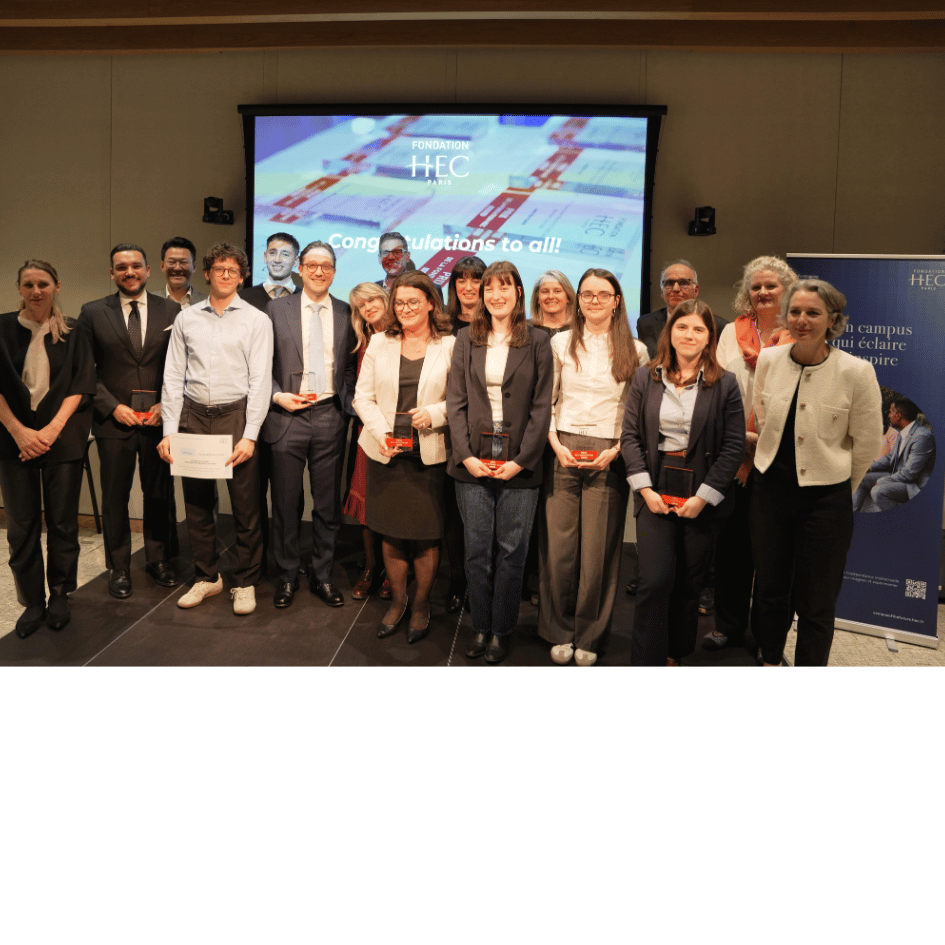
This year’s HEC Foundation student winners show how local investigations can yield global lessons, especially on sustainability, resilience, and the conditions for lasting value creation.
Key Takeaways |
• Several of the winning projects are rooted in sustainability, yet each of them also speaks to competitiveness, governance, and long-term value. |
• A local exploration into a company, a region, a sector, or a policy framework, often opens onto lessons that travel far beyond its original setting. |
• A year after the 2024 awards, some laureates already show how these prizes amplify projects that continue to circulate in public debate or professional practice. |
The diversity of this year’s laureates’ research subjects reflected the horizons the recipients came from. But the HEC Foundation ceremony - for the first time hosted by A&O Shearman in their Parisian headquarters - also highlighted subjects that could easily be treated as niche or technical. Instead, they revealed much larger questions: how organizations absorb AI, how small companies are pushed into sustainability transitions, how local productive systems survive globalization, how industrial waste becomes strategic, and how decarbonization only advances when policy, pricing, and profitability move together.
Climate responsibility and Shadow AI
Among the award-winning research projects, there was a study of shadow AI inside organizations and how it reflects on governance. A thesis on SMEs and CSR becomes an argument about ecosystems. An inquiry into Italian craftsmanship becomes a wider meditation on value, identity, and competition. A Saudi case study on gas flaring becomes a universal lesson about waste and industrial inertia. A paper on hydrogen and CBAM becomes a sharp reminder that climate ambition depends on whether the economics hold.
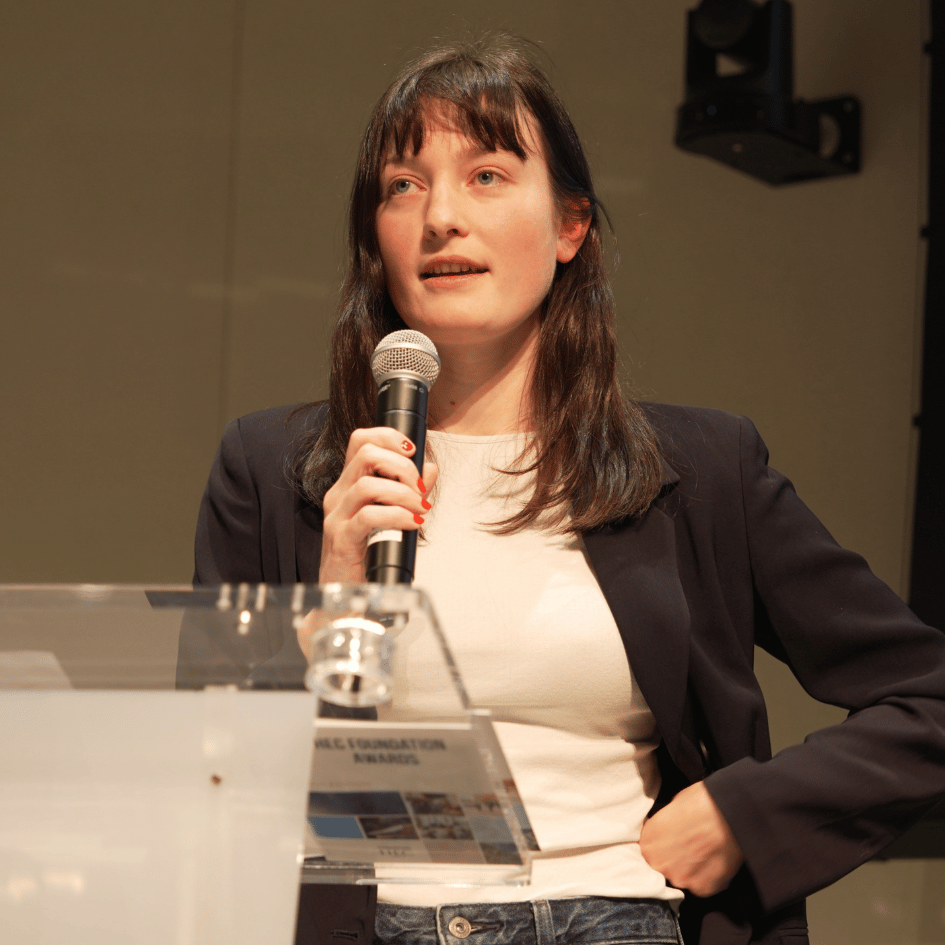
Salomé Raymondjean’s winning Master’s thesis sits at one of the clearest fault lines of the moment. Her work on shadow AI examines the informal use of generative AI tools inside organizations and the widening gap between technological acceleration and institutions’ ability to absorb and regulate it (see Focus below). The Foundation jury stresses that her thesis treats shadow AI as more than a compliance issue and proposes governance mechanisms that can restore visibility and channel informal initiatives into collective performance. That already makes her paper one of the timeliest of the year. Indeed, the jury noted that her thesis not only captured a problem many companies are living before they have fully learned how to name it; it also develops its own analytical framework (called SHAD-AI) “that is immediately applicable by companies, thus creating an essential bridge between academic excellence and managerial relevance.” As a Cyber Strategy Consultant for Deloitte, Raymondjean is already applying her framework to the company strategy.
Carmen Bertojo’s thesis has the same power of revelation, in a very different register. CSR in SMEs can still be framed as a secondary subject compared with the obligations facing large groups. Her research (and even more clearly her interview with Dare after the ceremony), shows the opposite. As she put it, the SME now finds itself “at a crossroad between conflicting interests”: those of the large client that passes regulatory pressure down the value chain, those of banks that increasingly link financing to carbon assessments and sustainability performance, and those of employees who want to work in places aligned with their values. Bertojo’s thesis also opened onto another question that she said she would now gladly explore even further: the role of local authorities. In her words: “It’s (France’s) territorial authorities who are the first contact point between the administration and the SMEs.” That idea gives her paper real originality. It anchors CSR in the local ecosystem rather than in corporate communication alone. And it’s a field she aims to explore further in the coming years as she seriously considers embarking on a doctorate on the subject.
What also made Bertojo’s work all the more appreciated and appreciable was her decision to transform the theoretical work she explored into a real world startup. In the course of her studies, the economist co-founded Best Value, a strategy consulting firm specializing in sustainability. “We’ll continue to accompany firms but we’re now aiming to create an entire ecosystem, that’s we’re all the more incisive and faster.”
Where local can go global
Salvatore Mamone’s MBA capstone moves from one national case toward a much larger diagnosis. His subject is the decline of Italian artisan craftsmanship, but the tensions he describes resonate well beyond his native Italy. After receiving his award, he boiled the problem down with memorable clarity. When an artisan brings a handmade product to market, he said, the customer often has two poles of attraction: low-cost mass retail on one side and brand-driven luxury on the other. "The value of the artisan that does not have a brand will be in the middle of these two forces," he underlined. Mamone’s project combines the tools of finance with a deeply personal understanding of succession, local economies, and family businesses. With a family business to draw from, he brought firsthand understanding to the challenges small enterprises face today, speaking with rare empathy about generational transition, with founders who saw their workshop not as a company to be sold, but as a legacy to be protected.
The capstone’s recommendations follow that same line: growth, branding, outside capital, internationalization, and legal adaptation all matter, but they matter because they help preserve quality, identity, and know-how. Here again, a local exploration produces a global lesson. In many sectors and countries, the question is no longer whether heritage has value, but how to make that value legible and durable in a market that rewards scale and image.
Juan Simon Arteaga’s Executive MBA project offers another striking example of a highly specific case opening onto a universal problem. His capstone focuses on reducing routine gas flaring in Saudi Arabia through a modular solution that can monetize associated gas on site. Yet what makes the project compelling is the broader lens it brings to industrial waste. In his words, gas flaring is "literally burning money," but also a source of major environmental damage. The power of his argument lies in the fact that he refuses to separate the two. His proposal is grounded in commercial realism, engineering feasibility, and environmental urgency at once. The chemical engineer also insisted that the model is widely transferable. Saudi Arabia, Arteaga noted, already performs strongly on gas capture, and “even so there’s still routine flaring”. He insisted the case is not only Saudi. It is global. His work suggests that one of the major questions for the energy transition is not only inventing new systems but finding faster ways to use what is already being wasted.
Sustainability is the common thread
The Bernard André Parent Foundation Award went to Mélanie Pasta and Clotilde Guihard for a thesis on CBAM and the decarbonization of the hydrogen value chain – a remarkable performance, given the competition across all categories (full disclosure: this author was a jury member and strongly defended this candidacy). Their award-winning paper lives at the intersection of policy, industry, engineering, and finance, and they speak that language fluently. The two Master graduates stressed that the hydrogen debate remains too theoretical when studies are not followed by subsidies, investment programs, and the conditions for deployment. They returned repeatedly to one point: cost. As Guihard put it, green hydrogen remains too costly compared to its fossil-based alternatives, meaning that projects and companies developing those solutions are often not profitable. Their reflections on the carbon market were especially sharp. "Carbon credits act as subsidy that help bridge the gap, making decarbonization solutions economically viable" she said. Pasta added that decarbonization requires predictable carbon pricing to support investment decisions, acknowledging that geopolitical disruptions can impact that stability. Their work is highly European in its policy focus, yet the lesson is much wider. Climate strategies only move from intention to implementation when incentives become readable, stable, and economically credible.
Taken together, these papers also make another pattern visible. Sustainability is one of the strongest threads running through this year’s laureates, even when it is not the sole or explicit label of the project. Bertojo examines the sustainability transition as it reaches the oft-neglected SMEs. Arteago addresses waste, emissions, and monetization in the energy industry. Pasta and Guihard work on hydrogen, carbon pricing, and decarbonization. Mamone’s capstone is about the long-term sustainability of productive ecosystems, skills, and local employment. Raymondjean’s thesis is not environmental, but it shares the same concern for durable governance in the face of fast-moving transformation. The sustainability dimension is embedded in strategy, finance, operations, and industrial reality.
Liu Zeyang, who received the third prize in the same Bernard André Parent category, brought another form of structural change into focus. His capstone, “From Land Finance to AI Fiscalism,” starts from a Chinese reality but has broader implications. For decades, land finance has helped fuel local development, but AI and new technologies are changing what companies need from physical space. As Zeyang explained after the ceremony, the old model worked when factories, logistics, and industrial growth depended on land. Technology companies need something different: less land itself, but more stable electricity, cooling capacity, and digital infrastructure. In Shanghai, Zeyang noted, local authorities are already experimenting with new forms of support, such as computing-power platforms tied to industrial parks. His subject is China, but the lesson extends beyond it. Developing countries still building out their industrial systems may be able to learn from China’s experience and adapt faster, combining urban development with technological change rather than suffering the same lock-ins later on.
Lasting impact of award winners
This year’s student awards show where those transitions become operational. They also show that the scale of a project’s starting point has little to do with the scale of the lesson it can generate. The students’ works mirror one of the deepest ambitions of management research itself, which is to start from close observation and arrive at a form of understanding that travels.
There is also a useful bridge here with last year’s winners. The 2024 cohort already pointed toward themes that remain central now, including AI, health access, and social impact. What has become clearer over the past year is that some of those award-winning projects continued to expand after the ceremony. Nicolette Gopaul’s MBA-winning project EmpowerHer, on menstrual health and educational equity, went on to receive wider public recognition in her native South Africa and became part of her later Poets&Quants profile. Meanwhile, after receiving the Executive Master award for her thesis on restructuring mid-sized companies in crisis, Charlotte Chauvel published on the subject in Finance & Gestion, while her professional trajectory as CFO of Neotiss gives that work an ongoing managerial afterlife.
That may be the most compelling way to read this year’s student ceremony. The Foundation continues to go beyond academic praise and attention in identifying the pressure points that shape organizations and societies before they harden into crisis. This year’s laureates looked closely at their own chosen terrains, whether a company, a market, a region, an industrial practice, or a policy instrument, and found questions that reach much further.
FOCUS
Salomé Raymondjean’s Multidisciplinary Approach Yields New Vision of Shadow AI
Salomé Raymondjean research confirms shadow AI as one of the school’s most timely research subjects this year. It also places Raymondjean’s work within a broader HEC conversation on how organizations can govern fast-moving technologies without losing sight of collective learning and managerial responsibility.Currently working at Deloitte on cyber and AI sovereignty, Raymondjean insists on the company’s willingness to integrate her shadow AI work in its inner workings. Her capstone study of the informal use of generative AI tools inside organizations was supervised by Stéphane Madoeuf. The jury praised both the relevance of the topic and the rigor of the work, highlighting its multidisciplinary scope and the analytical framework it develops, called SHAD-AI. The thesis examines the gap between technological acceleration and institutions’ capacity to absorb and regulate it, and proposes governance mechanisms intended to restore strategic visibility, enable secure experimentation, and channel informal initiatives into collective performance.
The award confirms shadow AI as one of the school’s most timely research subjects this year. It also places Raymondjean’s work within a broader HEC conversation on how organizations can govern fast-moving technologies without losing sight of collective learning and managerial responsibility.