
Women in Leadership Spotlight: Tarbiya Jamil
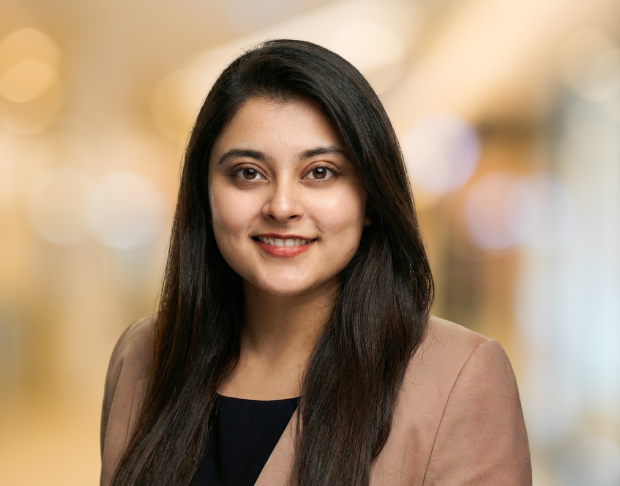
Tarbiya Jamil (MBA '27), Co-President of Product Management Club, reflects on the pivotal moments that shaped her leadership, how HEC sharpened her perspective on systems and decision-making, and her commitment to driving more equitable outcomes.
What moment in your career, or during your MBA at HEC Paris, has most shaped the leader you are today?
One of the most defining moments in my career was not a boardroom victory. It was a quiet performance review. I was a young Technical Lead, negotiating multi-million-dollar client contracts with ease. I could defend margins, challenge vendors, and argue strategy without blinking. But when it came time to negotiate my own salary, I froze.
I asked for what I believed I was worth. I was told, gently, that my compensation reflected the “market rate.” At the time, I accepted it. I thought the market was neutral. Rational. Fair.
Years later, during my MBA, in a class on evidence-based leadership, that illusion shattered. I learned about social role theory and the double bind women face. Be assertive and you are penalized for not being “communal.” Be accommodating and you fall behind financially. Suddenly, that moment was no longer a personal failure. It was a systemic pattern.
That realization changed me.
It made me understand that leadership is not about being individually strong enough to survive broken systems. It is about being courageous enough to question them. That experience shaped the leader I am becoming, someone who refuses to hide behind “market forces” when injustice is clearly structural.
How has your time at HEC Paris influenced or reshaped what leadership means to you?
My understanding of leadership has always been grounded in performance and accountability. Throughout my career in technology, leading teams meant delivering results, solving complex problems, and ensuring execution under pressure.
What HEC Paris has added is perspective.
The MBA experience exposed me to leaders from different industries, markets, and cultural contexts, which made me realize that strong outcomes are rarely driven by technical excellence alone. Leadership also requires judgment, the ability to balance short-term performance with long-term consequences, and to make decisions under uncertainty.
At HEC, I became more deliberate about how decisions scale beyond immediate results, whether in compensation structures, team dynamics, or strategic choices. I began to appreciate that effective leadership lies in making rational decisions that sustain both organizational performance and people’s trust over time.
As a result, my leadership style today is more analytical and more intentional. I still value execution deeply, but I now place equal emphasis on context, incentives, and long-term impact when making decisions.
Who is a woman who has inspired you during your career or MBA experience, and why?
During my MBA, I realized that inspiration doesn’t always come from one extraordinary woman. Sometimes it comes from watching many ordinary moments very closely. I’ve been inspired by the women around me at HEC.
Women who raise their hands even when their voices shake. Women who return to class after maternity leave and quietly rebuild momentum. Women who negotiate offers and then second-guess whether they asked for too much. Women who carry the weight of being the first in their family to be here, and the pressure of not wasting the opportunity.
What inspires me is not perfection. It is persistence. Watching these women has reminded me that leadership is not always loud or linear. Sometimes it is simply showing up again, even when you are tired, unsure, or afraid of being judged. They have taught me that courage often looks very ordinary from the outside.
What do you wish more people understood about women’s experiences in business school today?
I wish more people understood the invisible calculations women are constantly making. We are calculating how assertive is too assertive. How visible is too visible. Whether negotiating harder will earn respect or backlash. Whether taking space will cost us social capital.
Business school can be empowering, but it can also amplify these tensions. Many women arrive already carrying the weight of being the first in their families to study abroad, the first to enter certain industries, the first to dream beyond what was modeled for them.
We are not just managing coursework and recruiting. We are negotiating identity, ambition, and belonging in rooms that were not always designed with us in mind. Understanding that emotional labor is essential if we want true inclusion.
If you were mentoring the next cohort of women arriving at HEC, what’s the one thing you’d want them to know?
Do not shrink yourself to make others comfortable. You were not admitted by accident. You are not a diversity statistic. You are here because you earned it.
There will be moments when you feel behind, when everyone else seems more confident, more polished, more certain. In those moments, remember that confidence is often rehearsed. Your voice deserves space even when it trembles.
And negotiate. Negotiate your salary, your role, your boundaries, your ambition. The system will not correct itself out of kindness. You have to participate in reshaping it.
What hobby, passion, or personal interest has helped keep you grounded during your MBA at HEC, and why is it important to you?
Working on my idea for an investment app designed specifically for women has kept me grounded.
It began as a response to something deeply personal. Growing up, I saw how limited access to financial tools constrains choices. During my MBA, when I learned how structural pay gaps compound into generational wealth gaps, it became more urgent.
Building something tangible, even at the ideation stage, reminds me why I am here.
It is easy in business school to get swept up in rankings, offers, titles. But thinking about women in tier two and tier three cities in India who might gain financial independence through accessible investment tools brings me back to purpose.
For me, staying grounded means staying connected to impact. Everything else is noise.