
How Researchers, Leaders and Practitioners Face Up to the Backlash Against Purpose
Key Takeaways
Research shows that purpose becomes credible when it is anchored in strategy, governance, and work routines.
Some research argues that long-term performance depends on purpose being implemented seriously inside the firm. There is also evidence that internal reception and role level translation shape whether purpose holds.
The launch of the HEC NAOS Lab for Leadership extends the discussion into leadership, AI, and the human qualities needed to turn purpose into collective action.
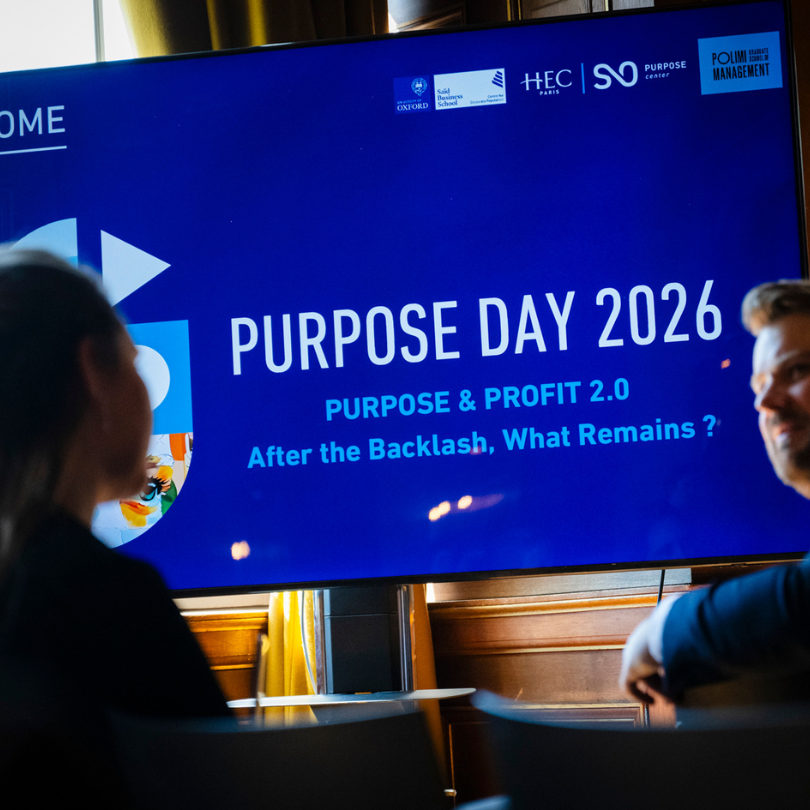
A year after Purpose Day 2025, this year's edition gathered researchers, executives, and policy voices around a sharper question. The title, “Purpose & Profit 2.0: After the Backlash, What Remains?”, gave the day its frame. One overriding conclusion seemed that purpose holds when firms can show what it does, where it sits in governance, and how it is experienced in work. “Our mindset shape our mindset, and vice versa" said Marya Besharov, professor of organizations and impact at Oxford Saïd Business School.“If people think it's purpose versus profit, we're going to create a world where it is indeed purpose versus profit. We need to think profit through purpose, not profit versus purpose.”
The point is strategic as much as normative. Besharov says the short term can bring real tensions, especially in a more polarized environment. Yet her argument stayed with the long run: purpose can be “a source of profitability” when it is well implemented. That formulation brought precision to a debate that, according to several attending scholars, often slips into slogans. Her answer also connected directly with her broader research on hybrid organizations and competing goals. Multiple Institutional Logics in Organizations examines how organizations navigate competing demands. In Paris, Besharov, whose expertise includes social innovation and leadership, translated that concern into a practical test for corporate purpose. Durable purpose grows out of a firm's history, communities, and stakeholders. It cannot simply be attached from above. It also has to be embedded in formal policies and governance and in informal norms. “It has to become the guiding way we do things around here.”
Translating research into governance
The research of Besharov’s colleague, Professor Colin Mayer, takes that question into the boardroom. His intervention gave the April 7 event one of its strongest governance conclusions. “The backlash has occurred quite reasonably and justifiably because of cynicism,” he says, adding that many corporate statements from a few years ago were “no more than marketing and promotion.” Mayer does not believe that purpose needs a new legal category in order to exist, however. Companies can define and implement purpose under current corporate law, he argues. Yet, he does admit that serious commitment has to be visible in governance. “It should be the overriding framework within which the strategy of the business is formed.” More concretely, he insists, “every board meeting should start off” from that point.
That insistence carries the logic of Mayer's long-running work on trust, ownership, and purpose, including Firm Commitment, his major study on how to restore trust in failing corporations. It also answered one of the strongest pressures hanging over the conference on Purpose, the fourth of its kind organized by HEC Paris: political instability and shareholder time horizons. Mayer's response was practical. Firms with owners aligned with purpose have more room to protect the long term. Widely listed firms need leadership that can demonstrate long term value while also showing immediate returns. Purpose, in his view, can act as a stabilizing force in a polarized environment.
Trust is the key
Jeongwon Choi, a postdoctoral researcher at Oxford, has been studying speculative sectors such as nuclear fusion. Her fieldwork centers on the value of the evidence that organizations choose when they make promises. “It's more about quality of the proof instead of quantity,” she confides. A breakthrough, in her account, has to be publicly understandable and genuinely meaningful. That emphasis matters in any environment where companies ask stakeholders to trust long-term ambition. Choi's practical advice is simple and exacting: show progress on the path, step by step, because public trust and political trust build around recognizable progress.
Fellow researcher Ximeng Fang pushes the same credibility question through a different dataset and reached a complementary conclusion. Unusually, Fang works with official International Skating Union data, and scraped results from 18,000 performances between 2012 and the start of the pandemic to study what happened when judges' scores became public. The reform, he shows increased transparency – but it did not remove effective national favoritism. “Transparency allows for evidence. Transparency doesn't automatically generate evidence,” Fang confides. He also draws the managerial consequence directly. Transparency has to be joined to scrutiny, governance, incentives, and consequences. Without that architecture, he says, public reporting can improve appearances without changing underlying behavior.
An executive vision
Put together, Choi and Fang seem to show that companies need proof that stakeholders can recognize, and they need systems that turn disclosure into accountability. The same pressure surfaced during Barbara Martin Coppola's keynote talk, this time from the executive side. “People will understand vulnerability and imperfection when there is intention and action,” she told the audience of scholars gathered at the conference in Paris’ Cité Internationale Universitaire. “When there is no action, following the words, that's when it's absolutely unforgivable.” The former executive at Decathlon and IKEA chose as an example Patagonia's decision to publish a report detailing where the company was progressing and where it was stuck. Coppola presented transparency as a trust building practice tied to action, measurement, and follow through.
At the conference, it was the research grazing sessions which showed that the hardest implementation work often happens inside the firm. Can He, a doctoral researcher at HEC in strategy and business policy, has been studying purpose receptivity in a family-owned manufacturing company in Southeast Asia. Her findings focused on the firm’s 6,000 employees who understood the purpose being communicated to them but were not emotionally ready to accept nor legitimize it. “If you find the purpose fail or not sticking in your company, do not just restate the purpose,” she told Dare. “Try to build an emotional infrastructure to enable your employees to stay open and consider the proposed purpose at the beginning.” In her fieldwork, that transformation took years, began at the top, and became visible in everyday cooperation and in the language that employees used about labor and belonging. This is music to the ears of Pascal Jauffret. The CEO of Forvis Mazars has been following research on purposeful leadership closely: “These days, the more technology is in the room, the more leaders care about human capabilities and invest in human capital/leadership development," he said. “Somehow artificial intelligence triggers human intelligence, both for organizations and the leaders who want to see their employees – and the company – thrive.”
Strengthening purpose clarity
Andrew Montandon, another doctoral researcher at HEC Paris, adds a second internal test in his approach. Drawing on employee survey data and LSEG data on corporate social responsibility actions, he argues that CSR does not automatically strengthen employees' sense of purpose. In his research, he distinguishes between “embedded CSR” and “peripheral CSR.” When social initiatives connect with the stakeholders and issues employees already handle in their roles, they can reinforce purpose clarity. When they introduce stakeholders that sit outside employees' daily work, they can create cognitive strain and weaken coherence. “Take someone working in human resources” he explains. “Your primary consideration is the welfare of employees. And so when firms engage in CSR actions that deal with things like, say, improved health and safety in the workplace, these can resonate strongly with those employees who are already tasked with this responsibility in their role. Whereas an employee who, in their primary role, doesn't really deal with employee welfare, those actions maybe can disrupt their sense of purpose. The key mechanism I’m exploring is that understanding of purpose is funneled through the work that employees are doing and the roles that they're in.” Montandon's practical implication seems clear. Societal ambition has to pass through communication, roles, routines, and work design if leaders want employees to experience it as meaningful.
“Ethical motivated agents”
In the closing sessions of the annual conference, Tim Besley's keynote speech pulled these organizational questions into politics and policy. The British economist at LSE told Dare that firms are “producers of public, not just private,” because their decisions shape the kind of society people live and work in. Besley also described workers as “ethical motivated agents,” people whose values are expressed through work. His line gives political depth to his empirical findings, many of which were echoed through from the day. If work is a site where values are lived, then governance, proof, and internal reception are central business questions. They are also civic questions. Besley said legislators are more receptive than usual to that debate because anxiety about work extends beyond pay to treatment, belonging, and contribution to the social good.
From purpose to NAOS
From the concluding panel, it seemed clear that purpose survives pressure when companies can tie it to strategy, boardroom priorities, evidence, incentives, and work. Karina Litvack brought a board perspective shaped by climate governance and non-executive oversight. She serves on several boards including Italian Oil & Gas major Eni S.p.A., where she chairs the Sustainability & Scenarios Committee. Since the passage of the Paris Agreement in 2015, Litvak has been working to build a global network for fellow board directors to share experiences, engage with technical experts and stakeholders, access specialized training, and help to drive the adoption of effective Paris-aligned climate transition strategies in the boardroom. The co-founder of the Climate Governance Initiative (CGI) was joined onstage by Pascal Jauffret who reflected on how leadership changes when AI increases the volume of information and uncertainty, and when trust still rests on judgment, accountability, and human credibility.
That same question ran through Brad Harris's reflections on the launch of the NAOS Lab for Leadership, which was announced at the end of this fourth edition of Purpose Day. Harris called purpose and leadership “different pillars of the same house,” and described the lab as a way to understand “the who, what, and how things like purpose are formed and disseminated into collective action” (see below).
Purpose Day 2026 delivered a serious research brief on the state of the field. Amongst a plethora of speakers and attending scholars, Marya Besharov and Colin Mayer supplied the conceptual and governance frame. Jeongwon Choi and Ximeng Fang showed how credibility depends on evidence people can read and systems that make that evidence matter. Can He and Andrew Montandon revealed how purpose succeeds or stalls inside organizations. Barbara Martin Coppola and Tim Besley connected those findings to executive practice and public life.
Arguably, the strongest conclusion from the day seemed to be that purpose claims rise or fall on evidence, governance, and work. And that they are built on the dialogue between scholars, leaders and employees on the ground. A conclusion that has been tentatively reached by Can He in her study on the manufacturing company and its 6,000 employees: “We are saying to the practitioners, if you find the purpose fail or not sticking in your company, do not just restate the purpose. Try to build an emotional infrastructure and make employees capable of accepting that. the mechanism.” She continues: “We're trying to understand the purpose implementation strategy within the workplace, and this approach is multidimensional. It combines economics, management and entrepreneurship with sociology and psychology. And we see that the impulse is initially really driven by the CEO, the very, very top level: they deliver enough time and resources to develop this social emotional foundation to foster employees’ purpose receptivity. But it needs time: in this case, the company needed to wait for seven years to see tangible results – and that is quite risky.”
NAOS Lab for LeadershipThe launch linked the Purpose Day debate to a research agenda on the human qualities leaders need in a world shaped by AI, uncertainty, and organizational complexity.
Brad Harris described the launch as an effort to study “the decidedly human factors that underly leadership” and to ask how those qualities will matter when technology can handle more information and more routine analysis. “These raw things that make us people, and make us want to follow other people, are now one of the most critical currencies leaders can have.” The lab's public framing also aligns with the official launch description from HEC Paris, which presents it as a center devoted to leadership rooted in intuition, empathy, courage, critical awareness, and discernment in the face of complexity and uncertainty. ·The lab emphasizes intuition, empathy, courage, critical consciousness, and discernment. Why do those qualities matter more now? Why do these qualities matter? For Harris it’s all about scarcity. “We know that you can only build strategic important things when you’ve got elements that are valuable, rare, and non-substitutable,” he explains. “Now that technology and corporate structures have commoditized things like information, basic writing tasks, and even some things that used to require technical expertise, what’s left? For me, it’s something about these under-the-surface, hard-to-see things that we all seem to recognize as fundamental to the human experience. Who are the people that will motivate us to take chances, persist, and show up for really big challenges? That’s the question we all have to tackle, starting with the research we hope to instigate at the NAOS Lab.” For more information on the launch of NAOS see this: https://www.hec.edu/en/news-room/hec-paris-naos-and-heart-leadership-university-announce-creation-naos-lab-leadership-rethink-leadership-world-facing-profound-change |