
Beyond the Hype: Mastering Generative AI as a Strategic Tool
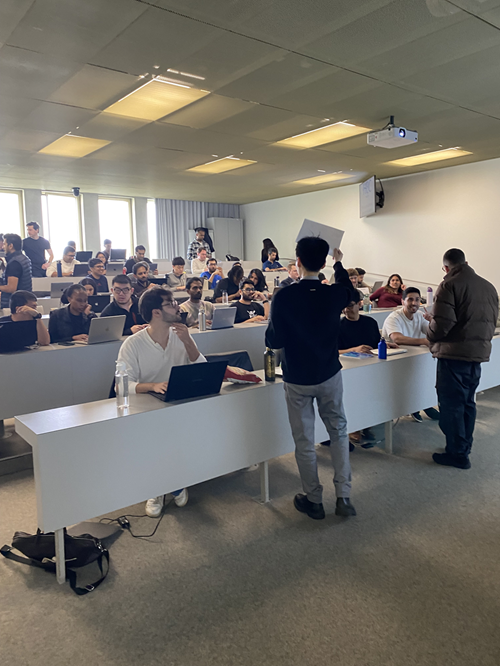
The course filled up so quickly that I couldn't secure a seat in the initial registration round. I was waitlisted, and honestly, I was frustrated. But when the acceptance came through, I knew immediately why everyone wanted in the Generative AI course. Within the first few minutes of Associate Professor Shubin Yu taking the stage, the hype made complete sense. He commanded the room with the kind of preparation and energy that signals this isn't going to be a typical HEC Paris MBA class. For the next 2.5 days, I was rarely disappointed.
If I had to compress this course into one lesson, it would be this: everyone knows ChatGPT and Claude exist. But knowing a tool exists and knowing how to wield it effectively are two entirely different things. The real lesson here learning how to craft prompts that actually generate the outputs you want.
The Journey: Three Days of Discovery
On day one, Professor Yu threw open the doors to an entire ecosystem of AI tools I had no idea existed. ChatGPT and Claude yes, but that was just the foundation. He introduced us to Suno, and suddenly, I was generating music. Not placeholder background music, but actual compositions. Watching AI compose in real time was surreal. What struck me most wasn't the novelty factor, rather it was the realization that each tool serves a specific purpose. Understanding when and how to deploy them is a management skill, not just a technical one.
Day two was where things got playful and productive. We used Nano banana to generate and edit images, and our assignment was delightfully creative: design a marketing campaign poster for a company of our choice. But here's the catch: the model featured in every design had to be Mimi, Professor Yu's adorable dog. If you're a dog lover, this day alone was worth the course price. Mimi sat with us in class the entire day, and her photo appeared on nearly every slide.
It was impossible not to smile while working, and that surprisingly made us better designers. When you're not stressed, you're more creative I guess.
But day two had more in store. We then pivoted to Google AI Studio, where we had 45 minutes to build a functioning app from scratch. No prior coding experience required. The goal was simple: create an application that solves a real problem you encounter in daily life. I was skeptical. Forty-five minutes seemed impossible. I was wrong. By the end of that window, everyone had a working app to present. The barrier to entry that I thought existed simply didn't. I realized that creating an app is more accessible than I imagined, and this lesson will stick with me far longer than the app itself.
On the final day, the course shifted gears to the business side. We ran through a role-play exercise that forced us to think strategically about how companies should implement generative AI. The key insight: just because you can integrate AI into a process doesn't mean you should. Prioritization, risk assessment, and alignment with company objectives matter more than the technology itself. It's a humbling reminder that tools are only as smart as the strategy behind them. We also explored virtual world-building using Marble, dabbling in VR. Then came a final in-class group project: take a real product and imagine how generative AI could enhance it to solve genuine customer problems.
The Breathing Room
One thing that surprised me was how the course structure actually works to your advantage. Yes, it's an intensive, compressed into 2.5 days, but the substantive work, the projects you submit for grading, happen over a month afterward. That means you have time to sit with what you learned, experiment without pressure, and apply the tools more thoughtfully. You're not just rushing through concepts; you're actually developing competency. The intensive creates momentum and excitement, but the extended project timeline ensures depth.
The Bigger Picture
Among all the courses I've taken at HEC, this one raised the bar highest. It's not because it introduced me to fancy technology. That's almost secondary. It's because it treated AI as what it actually is: a transformative toolkit that requires strategic thinking to deploy responsibly. Professor Yu could have spent three days showing off tools, instead, he spent three days teaching us to think like operators, not just users. We learned prompt engineering because clear communication drives better output. We learned when to use each tool because context determines capability. We learned to ask "should we?" alongside "can we?" because that's what leadership demands.
If you're considering this course, don't think of it as a technical training. Think of it as a masterclass in understanding one of the most significant forces reshaping your industry. The tools are the vehicle; the thinking is the destination.
by Pranev Sharma, MBA Student at HEC Paris