
Making Climate Count: The Strategic Case for Internal Carbon Pricing
What if companies finally started putting a price on the true cost of their decisions? Internal carbon pricing is neither a tax nor a regulatory requirement — it is a voluntary management tool with significant strategic potential.
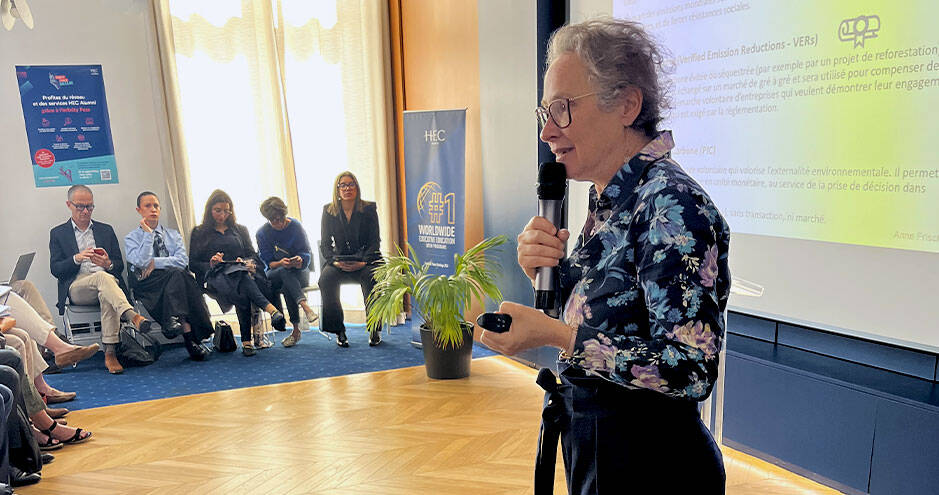
At a recent HEC Paris Executive Education Day, Anne Frisch, Associate Professor at HEC and former CFO, drew on her hands-on experience to shed light on a subject that remains far less understood than it deserves to be.
Carbon-Blind Decisions: A Choice That's Getting Harder to Justify
Can companies still run their operations without factoring in carbon? Regulation may not yet demand a clear-cut answer, but reality increasingly does.
An Economy That Can't See What It's Doing
For a long time, corporate accounting has been remarkably good at measuring almost everything, except what matters most: the real-world impact of economic activity. Pollution, deforestation, resource depletion, social exploitation — none of these side effects appear in any conventional balance sheet.
These environmental and social impacts are what economists call "externalities."
An externality is a side effect of a company's economic activity that isn't reflected in the market price of the goods or services it produces," says Anne Frisch.
The concept was first theorized by Arthur Cecil Pigou, writing from the industrial heartland of 19th-century England, a time when factories poured pollutants freely into the air and water at no cost to their owners.
Externalities can be negative: industrial pollution, greenhouse gas emissions, child labour.
But some are positive. Creating jobs in a region generates a ripple effect of related activity: "people shop at supermarkets, buy cars, build houses." A company that invests in R&D "generates spillovers that benefit others, even outside its own sector." Frisch also points to infrastructure - mobile networks, roads - and to Mobile Money in West Africa, which "brought millions of previously unbanked people into the financial system."
The problem, she argues, is their accounting invisibility:
You can't see carbon. And if you don't give it a price, it's as though it doesn't exist. But it does, and it's an enormous problem.
Without a monetary value attached to them, externalities remain invisible in financial and strategic decision-making. Hence the challenge - and the opportunity - for companies: to turn what has always been intangible into a fully operational management metric.
Three Ways to Put a Price on Carbon
Three mechanisms currently coexist to encourage economic actors to reduce their emissions.
The first is the carbon tax - a government-imposed instrument designed to internalize the environmental cost of emissions. In Europe, the principal embodiment of this is the EU Emissions Trading System (EU ETS). "It covers a significant share of industrial emissions, and the price was around €80 per tonne at the time of the study," says Frisch, commenting on a global map of existing schemes.
Globally, however, just 24% of greenhouse gas emissions are currently covered by any form of carbon pricing - and these initiatives remain fragile, exposed to intense political and social pressure.
You only need to look at what happened with the carbon tax in France to understand the kind of resistance these measures face.
The second mechanism is carbon credits. Here there is no regulatory constraint: a company or individual can choose to offset their emissions by funding a green project - reforestation, carbon sinks, and the like. These certificates, known as offsets, are traded on a parallel market, often over the counter. The approach, however, has attracted scrutiny. "A lot of it has been bogus," warns Frisch. "That's why you need labelled, certified projects - so there's real traceability." Voluntary offsetting, however promising in theory, has too often functioned as a communications tool rather than a genuine driver of transformation.
The third lever — and the most transformative, according to Frisch - is the internal carbon price (ICP). Here, no regulatory obligation exists. The company itself chooses to assign a monetary value to its CO₂ emissions and factor that cost into its decisions.
Putting a price on what you can't see is the first step to managing it.
The ICP is just one of the tools explored in the HEC Paris Executive Certificate in Financial and Extra-Financial Performance Management — a 12-day in-person programme led by Anne Frisch, designed to equip decision-makers for the new ESG imperatives. Discover the programme |
Internal Carbon Pricing: How It Works
A simple, practical, and surprisingly powerful method for embedding climate considerations at the heart of business management.
The Mechanics
Internal carbon pricing works by assigning a notional but consequential value to greenhouse gas emissions - what economists call a "shadow price." This converts an invisible externality into actionable information.
"It's not a complicated calculation. You take the volume of CO₂ emitted, multiply it by an internal price, and you get the cost of emissions," explains Frisch.
| Tonnes of CO₂ equivalent × internal carbon price = cost of emissions |
This simple formula makes it possible to add a new "cost of emissions" line to the company's management tools. In a profit and loss statement, this figure sits alongside familiar items like overheads or R&D expenditure. "It adjusts the operating result and allows you to compare two projects not just on the basis of their immediate profitability, but also their carbon impact."
The implications can be profound. An industrial project previously dismissed as too costly may become viable once avoided emissions are counted as a gain. Conversely, a decision that looks profitable on paper may conceal a prohibitive climate cost that has simply gone unnoticed - until now. But before this tool can be put to work, a company first needs to know what it actually emits.
Two Essential Prerequisites
"When you want to introduce an internal carbon price to improve decision-making, the first prerequisite is calculating your carbon footprint. Otherwise, you're talking in the dark," warns Frisch.
This diagnostic relies on a now widely adopted methodology: the Greenhouse Gas Protocol (GHG Protocol), which distinguishes three categories of emissions - known as "scopes":
● Scope 1: direct emissions (industrial processes, company vehicles, etc.)
● Scope 2: indirect emissions from purchased energy
● Scope 3: indirect value chain emissions (raw materials, transport, product use, end of life...)
Some companies go further still, assessing impacts at the product level through lifecycle analysis (LCA). This approach is particularly relevant in sectors with long product lifespans, such as construction or heavy industry. "At Tarkett (a specialist flooring company), for example, the end-of-life of a floor installed today won't come for another 20 years - and often under a different owner. How do you anticipate the emissions linked to its disposal or recycling when the company no longer controls its use or fate? That is precisely the challenge - and the complexity - of downstream Scope 3, which covers the carbon impact of products long after the point of sale."
Of course, pricing carbon alone is not enough — you have to actually reduce emissions. The second prerequisite is setting clear, measurable reduction targets aligned with the Paris Agreement.
"It's not enough to vaguely say you'd like to lose weight," Frisch quips. "You need to say how much, at what pace, and by when."
De plus en plus d’entreprises s’engagent dans des trajectoires validées par la Science Based Targets Initiative (SBTi), qui garantit l’alignement avec les données scientifiques. C’est le cas de Nexans, qui vise une baisse de 46 % de ses émissions (scopes 1 et 2) d’ici 2030, et 30 % sur le scope 3, avant d’accélérer.
"These trajectories need to be realistic, sector-specific, and grounded in science — not in PR."
A growing number of companies are committing to trajectories validated by the Science Based Targets initiative (SBTi), which ensures alignment with scientific consensus. Nexans is one example, targeting a 46% reduction in Scope 1 and 2 emissions by 2030 and 30% on Scope 3 — with further acceleration to follow.
Good to know: Calculating an internal carbon price, structuring an adjusted P&L statement, and analysing Scope 1, 2, and 3 emissions are all part of the practical casework covered in the HEC Paris Executive Certificate. CPF-eligible programme (French professionnal training funding)
|
Why You Can No Longer Manage Without an Internal Carbon Price
Putting a price on carbon is a decision that fundamentally reshapes how a company makes choices, allocates capital, communicates, and engages its people.
It Changes How You Invest
One of the most direct applications of an ICP is its power to reshape investment decisions. By embedding a carbon cost into profitability calculations, companies are steered towards lower-emission solutions.
Frisch describes a company facing a classic dilemma: should it convert a biogas boiler to a biomass boiler — a cleaner option, but one that underperforms on conventional financial metrics? By factoring in an internal carbon price, the avoided emissions become a "gain" that counts towards projected returns. The result: the investment becomes viable.
The same logic applies in R&D, where timescales are longer. Some companies, including Saint-Gobain, apply a differentiated internal carbon price depending on the business area. "They used €50 per tonne for industrial operations and over €100 for R&D," Frisch explains.
It Prepares You for What Regulation Will Require
Adopting an internal carbon price is also a way of getting ahead of the regulatory curve. The European free allowances system is tightening, and the Carbon Border Adjustment Mechanism (CBAM) will progressively impose levies on carbon-intensive imports. An ICP allows companies to model the impact of these future obligations today and adapt their industrial strategy before the pressure becomes acute.
It is also a tool for strategic alignment between financial and non-financial performance. Some companies have already begun to translate this logic into their public reporting. Frisch cites two pioneering examples:
● Danone experimented with a carbon-adjusted earnings per share figure. The initiative was ultimately dropped, but it stands as a bold attempt at genuine integration.
● Getlink, the operator of the Channel Tunnel, now publishes a "decarbonised margin" — calculated by deducting a notional carbon charge (based on a price of €200 per tonne) from its EBITDA. The result: 97% of its performance survives intact, while sending a powerful strategic signal to investors.
It Mobilises Teams and Lends Credibility to Your Commitments
An internal carbon price also changes behaviour from the inside out, embedding a climate culture across the organisation.
The day you're asked to incorporate an internal carbon price into your budgets and decisions, it affects everyone. It makes the subject accessible — and it changes behaviour.
At Saint-Gobain, the effect was twofold: low-carbon projects were prioritised, and employees felt more proud of and more committed to their work. Microsoft has implemented a similar mechanism, a form of internal carbon charge, where the highest-emitting business units contribute to a fund that finances other climate projects across the company.
And then there is the question of credibility. Under the Corporate Sustainability Reporting Directive (CSRD), large companies will now be required to disclose whether they have an internal carbon price and at what level. A price that is too low - economists recommend figures closer to €300 per tonne - risks becoming a signal of disengagement in itself.
"It's not mandatory today, but once it appears in a public report — with NGOs and investors scrutinising every line — it becomes a question of credibility."
To go further: Join the HEC Paris Executive Certificate in Financial and Extra-Financial Performance Management.
Download the brochure or contact Sandrine Merian, HEC's finance programme consultant. |