
From Value Creation to Value Sharing: New Insights from HEC Paris
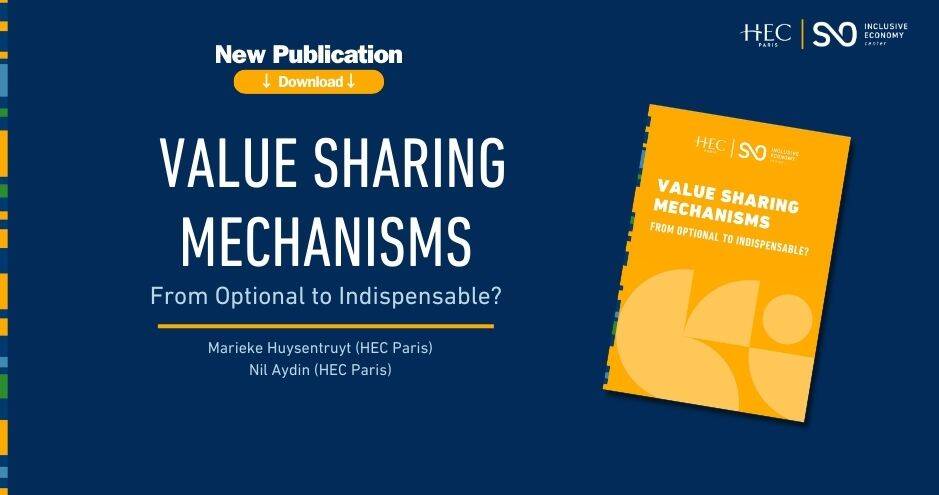
A report from the Sustainability & Organizations Institute explores why value sharing within companies is becoming a critical element of sustainable and competitive business strategy. But how should companies distribute the value they create in an increasingly unequal economic landscape? Titled “Value Sharing Mechanisms: From Optional to Indispensable?”, the report by Marieke Huysentruyt, Associate Professor of Strategy, and Nil Aydin, a graduate of the HEC Paris Master in Sustainability and Social Innovation, examines how companies distribute the value they create—and why doing so more equitably matters now more than ever.
A growing imbalance in how value is distributed
Across many OECD countries, workers are receiving a shrinking share of national income, while income and wealth inequalities continue to widen. At the same time, rising inflation and the increasing concentration of market power among firms have intensified concerns about fair compensation and economic justice.
Against this backdrop, calls are growing—from employees, investors, governments and society at large—for businesses to reconsider how they distribute value among stakeholders.
The report argues that value sharing, often referred to in France as “partage de la valeur,” is emerging as a key concept in strategic management. Unlike traditional approaches focused on value capture—how firms retain profits—value sharing considers how companies distribute a portion of the value they create to employees, suppliers, communities and other stakeholders.
Why companies cannot afford to ignore value sharing
Ignoring employee value sharing can expose firms to significant risks. The report highlights examples of global companies that have faced criticism or reputational challenges due to issues such as low wages, poor working conditions or lack of employee benefits.
Beyond reputational concerns, neglecting employee welfare can lead to employee unrest, regulatory pressure and increased turnover costs. According to stakeholder theory, investing in employees and addressing their needs can improve loyalty and productivity while strengthening long-term firm performance.
From theory to practice: How firms can share value
The report outlines several practical mechanisms companies can use to distribute value more equitably, particularly with employees.
These include:
- Profit-sharing plans, which allow employees to receive a share of company profits
- Employee stock ownership plans (ESOPs) that give workers equity stakes in the firm
- Skill development and training programs that invest in employees’ long-term capabilities
- Wellness and benefit programs that support physical, mental and financial wellbeing
- Collaborative decision-making structures, including employee representation in governance
Evidence suggests that such mechanisms can improve productivity, employee engagement and organizational resilience. For example, profit-sharing has been associated with productivity gains of up to 5 percent in some studies.
Beyond employees, value sharing can also extend to suppliers, local communities and customers, through practices such as fair pricing, long-term supplier partnerships, inclusive pricing models and community development initiatives.
A new frontier for competitive advantage
As sustainability regulations expand—particularly with frameworks such as the Corporate Sustainability Reporting Directive (CSRD) in Europe—many practices that once differentiated companies are quickly becoming standard expectations.
In this context, the report suggests that a company’s ability to share value effectively with its stakeholders could become a new source of competitive advantage. Organizations that successfully balance value creation, value capture and value sharing may be better positioned to build trust, attract talent and strengthen long-term performance.
Research for a more inclusive Economy
The report contributes to ongoing research on how businesses can play a meaningful role in building a more inclusive and resilient economy.
Through its work at the intersection of strategy, sustainability and social impact, the S&O Institute seeks to provide businesses and policymakers with the tools and insights needed to navigate complex economic and societal challenges.
| Why value sharing within companies is becoming a critical element of sustainable and competitive business strategy? |