
Academic Awards Pinpoint Challenges of a Changing World
From AI in the classroom to impact investing and sustainable finance, this year's HEC Foundation Awards celebrated research that clarifies some of today's noisiest debates.
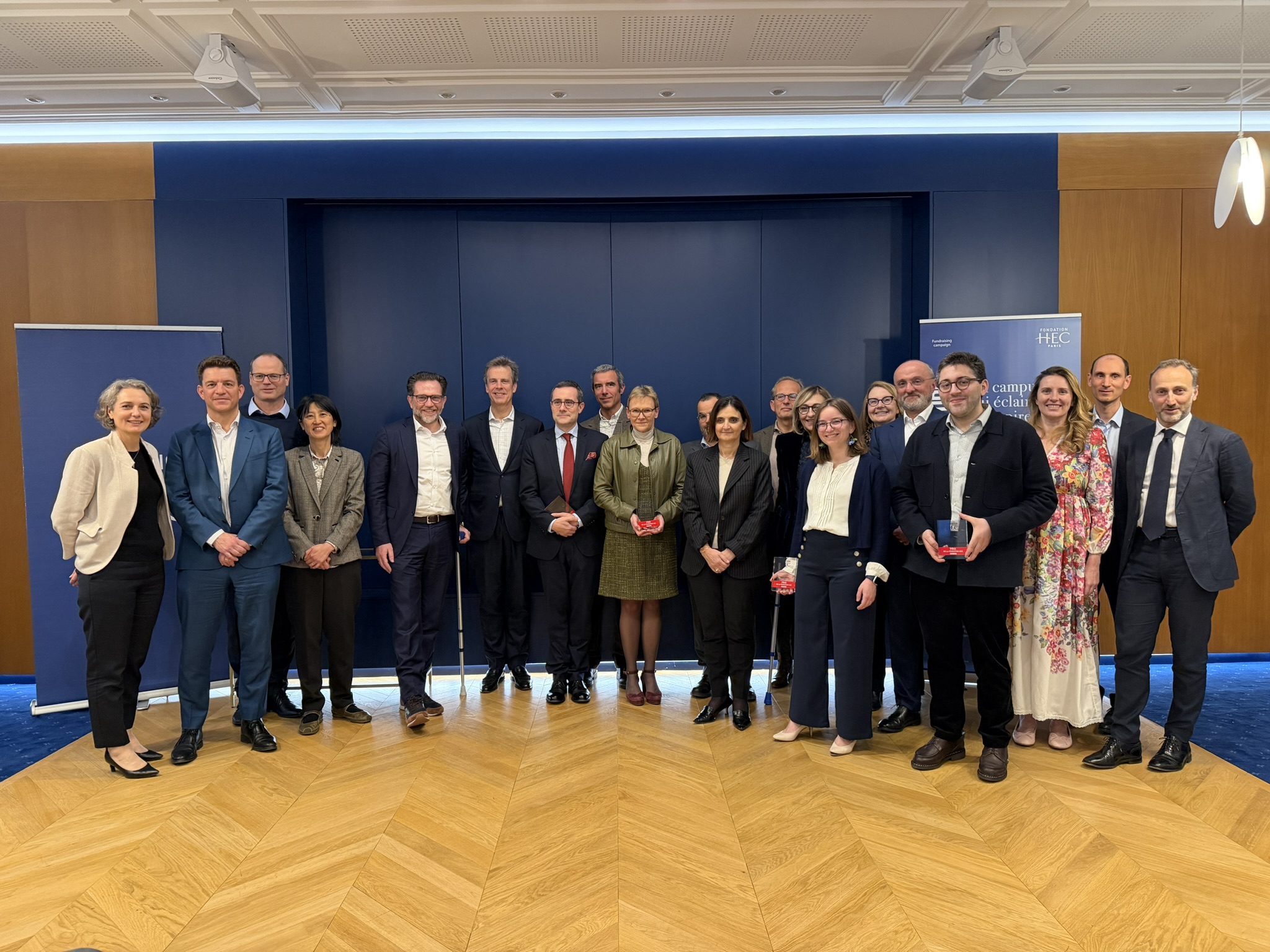
The 2025 Foundation laureates and members of the jury (C) Irène Krienen
Three key takeaways • AI is changing education fast enough to force a rethink of what teaching is for. • Impact investing looks different when performance is judged with risk. • Sustainable finance has more leverage when it changes incentives across whole value chains. |
At a moment when AI in education, impact investing, and sustainable finance are all surrounded by noise, award-winning professors Laurence Lehmann-Ortega, Jessica Jeffers, Stefano Lovo Jeremy Ghez and Olivier Chatain have, in their own ways, explored heated debate long enough to produce stronger evidence on the impact of this machine learning instrument. Lehmann-Ortega is rethinking how teaching should work once AI becomes part of students’ everyday learning environment. Jeffers is testing how impact funds should be judged when risk is measured seriously rather than rhetorically. Lovo’s work, meanwhile, keeps returning to the design of incentives, ratings, and market mechanisms in sustainability. Put together, they show research at its most useful: probing new realities and clarifying the debate.
Teaching after the Arrival of Generative AI
Laurence Lehmann-Ortega’s Foundation award for pedagogical innovation recognizes a body of work beyond her work over the last year. Her approach centers on what happens before, during, and after class, with AI tools, cases, simulations, field visits, guest speakers, peer feedback, and experiential learning. They all serve the larger purpose of keeping curiosity, judgment, and human interaction at the center of the classroom experience.
Lehmann-Ortega’s remarks at the March 2 ceremony made that philosophy much more concrete. “We are now in the age of AI,” she told the audience at the Foundation headquarters in central Paris. “There will be a lot of disruption in the way our students are learning, and hence we need to also completely rethink the way we teach.” She called the work “a commitment to reinventing teaching in the coming years, in the age of AI,” and described the tools she has built around the classroom, including web apps that allow students to interact with cases rather than simply read them. “It’s not only about reading cases,” she said, “it’s really about interacting with the cases.”
Indeed, across higher education and executive learning, the question is no longer whether AI belongs in the learning process. It already does. The harder question is what kind of pedagogy remains worth defending once students can outsource parts of their preparation, synthesis, and drafting. Lehmann-Ortega’s answer is clear and specific: teaching has to become more intentionally designed, more interactive, and more explicitly human. The jury captured that well in praising learning experiences that, through the teaching of the Professor (Education Track) of Strategy remain “meaningful, rigorous and deeply human in the age of AI.”
Impact Investing Beyond Slogans
Jessica Jeffers’ winning article, “The Risk and Return of Impact Investing Funds,” takes on one of the most argued-over questions in finance: what exactly should investors conclude from the performance of impact funds? Using a new dataset of impact-fund cash flows, Jeffers and her two co-authors study risk exposure and market risk-adjusted returns in private markets. The study shows that impact funds have lower market exposure than comparable private-market strategies. The researchers argue that the funds’ financial merit depends on the investor’s broader portfolio and hedging needs. In other words, the paper shifts the discussion away from blanket verdicts and toward portfolio context.
Jeffers’ acceptance remarks at the Foundation insisted on why that shift mattered. She said the debate over impact-investing performance was “a heated debate,” but one in which “there wasn’t a lot of very concrete evidence.” Her team, she explained, had to find the data and create a methodology suited to a question existing methods did not handle well. Most importantly, they wanted to restore risk to the conversation. “Not just what’s the IRR (Internal Rate of Return, ed.) of this strategy, or what’s the multiple, but how does it fit into a portfolio?” the professor of finance said. “When you look at impact investing as part of a portfolio, then the assessment can really change.”
Impact investing is often discussed in moral or political language - and sometimes dismissed just as quickly. Jeffers’ work insists on evaluating impact funds with the rigor investors already expect elsewhere. In its award statement the jury praised her research, saying it allows professionals to discuss the relevance of impact investing “rationally, rather than emotionally.”
Why Stefano Lovo's Work Keeps Resonating
Stefano Lovo’s Researcher of the Year award, his second Foundation distinction in as many years, recognizes a broader trajectory rather than a single publication. The jury stressed the breadth and intellectual consistency of work that ranges from consumer behavior and sustainable eating habits to socially responsible investment, ESG rating models, and AI implications for financial intermediation. What ties those projects together is a sustained interest in how incentives are structured and how information travels through markets.
In presenting the award, the Dean of Faculty and Research, Andrea Masini, contrasted productive scholars who know how to navigate the publication process with another kind of researcher: “Those who ask the right questions.” He praised Lovo for applying rigorous methods to problems that matter beyond academia, and for spanning topics from individual behavior to companies and society at large. This echoed the jury’s emphasis on work showing how capital allocation, supply-chain incentives, and rating systems can maximize environmental and social impact.
Lovo’s own remarks gave the award a wider resonance. “In a period when science is often under attack,” he said, “recognition of this kind matters because it acknowledges not only one scholar’s contribution but the larger research effort made at the HEC Finance Department.” The formal rigor of the finance professor’s approach to subjects which are repeatedly pulled into public controversy (ESG ratings, sustainable finance, AI pricing, and the mechanisms that shape collective behavior) has contributed to a wider understanding of their complexities.
Refusing Simplification
The rest of this year’s professor and PhD awards pointed in the same direction, even if they belong to a different article. Antoine Hubert de Fraisse’s doctoral work examines how public interventions in financial markets affect the real economy. Jeremy Ghez and Olivier Chatain’s Faculty Impact Award recognized their work on a major June 2025 conference titled “Business Strategy in a Fragmented World”. This brought students, scholars, policymakers, business leaders, and civil-society voices into the same conversation. «The project,” noted the jury, “is a concrete step to onboard on the necessity of a better understanding of the complexity of the current world with business challenges, geopolitical realities and industrial policies. In the context of a constantly changing world,” concluded the jury, “curiosity, open-mindedness and agility are key skills for our future leaders to determine and implement a sustainable strategy and create impact.”