


 Geopolitics & Public Affairs
 Tech & AI

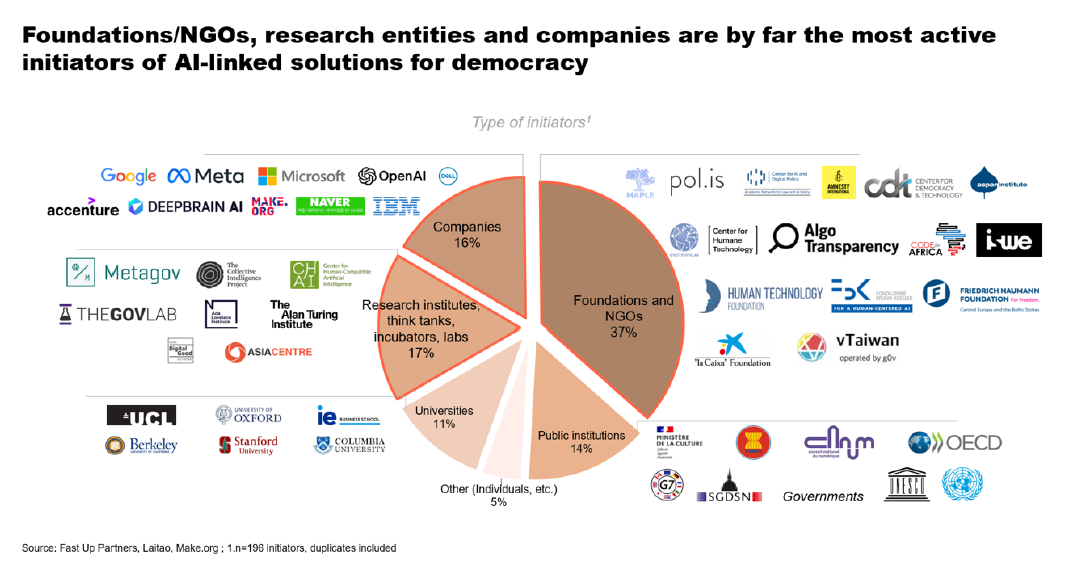
- Civil society and tech companies dominate AI-democracy initiatives, with limited involvement from governments or academia.
- AI poses risks to democracy, including emotional manipulation, polarization, and the rise of algorithm-driven governance.
- Three worldviews are emerging: defensive regulation, democratic reinvention, and libertarian decentralization.
- Public oversight, algorithm transparency, and early AI education are critical to democratic resilience.
- A balanced approach is needed—where AI supports democracy, and democracy regulates AI.
Who Leads and Funds AI-Democracy Initiatives
The majority of AI-democracy initiatives are led either by civil society and foundations or by private companies. Governments and universities play a much smaller role in shaping these discussions. The most active AI-democracy initiatives are concentrated in the United States, far more than in Europe or other regions.
AI initiatives in the world mapping
We found three broad categories of initiatives, representing three different worldviews on the future of democracy in the AI era:
1. Protecting democracy from AI
This category includes initiatives, primarily from civil society and some governments, focused on safeguarding democracy from the risks posed by AI. These risks include deepfakes, polarization of public debate, emotional manipulation, and mental health concerns. AI can reinforce echo chambers, escalating emotions rather than fostering rational discourse.
There is also the question of "hypnocracy"—a digital governance system that manipulates public consciousness through AI-driven engagement algorithms. Are we at risk of creating a new "digital idiot," driven by AI algorithms that prioritize emotional reactions over critical thinking?
To counter these risks, initiatives in this group advocate for stronger regulatory frameworks, independent oversight mechanisms, and safeguards to protect democratic integrity.
2. Leveraging AI to Reinvent Democracy
A more optimistic approach focuses on how AI can enhance democratic processes. AI has the potential to reduce human biases in decision-making, particularly in governance, justice, and public administration. It can also foster large-scale citizen collaboration and improve public service efficiency.
For instance, AI can be used to generate collaborative policy recommendations based on citizen input, as seen in Taiwan’s use of AI-powered open consultations. AI can also enhance judicial fairness by mitigating cognitive biases in legal rulings. However, concerns remain about the potential dehumanization of public decision-making.
Recent advances in open-source AI—such as the Chinese-backed Deepseek—illustrate both the opportunities and the challenges in ensuring democratic control over these technologies.
3. The Rise of Libertarian AI Governance
The third vision, largely promoted by American tech giants, embraces AI as a tool for a radically decentralized, algorithm-driven democracy. This perspective, influenced by figures such as Peter Thiel and Elon Musk, prioritizes efficiency and individual freedom over democratic safeguards.
In this model, AI and decentralized autonomous organizations (DAOs) could replace traditional governance structures, reducing the role of state institutions. However, this raises critical concerns:
-
If AI decisions are driven by private interests, who ensures fairness and accountability?
-
Should algorithms operate without democratic oversight?
-
Does the push for “liquid democracy” ultimately weaken democratic sovereignty?
On Forbes: A European Call To The AI Summit: Use AI To Bolster Democracy, Not Undermine It!
A Balanced Approach: AI for Democracy, Democracy for AI
In our report, we propose a middle path:
Addressing the roots of democratic dissatisfaction. The crisis of representative democracy is not caused by AI—it stems from citizens’ frustration with political and economic systems that fail to protect them. Addressing these underlying issues is essential.
Rebuilding social trust. Digital platforms have isolated individuals, eroding real-world social interactions. We need to restore face-to-face democratic engagement through initiatives like local debate forums and public AI discussions (e.g., “Café IA”).
Ensuring democratic control over AI. AI algorithms must be open-source, auditable, and governed by citizen oversight bodies. We propose creating citizens' assemblies dedicated to AI governance.
Education as the foundation of AI democracy. AI literacy must start from an early age, not just to understand how algorithms work but to teach collaborative problem-solving and social resilience.
Our research underscores the urgency of democratic engagement with AI. Whether AI strengthens or undermines democracy will depend on how societies choose to govern and integrate it. AI must serve democracy, just as democracy must guide AI’s development.
Professor Yann Algan's explanation on video (in French) “L’IA menace-t-elle la démocratie ?”
Sources
Based on the article "AI and Democracy: The Coming Civilization" by Yann Algan and Gilles Babinet.




 Sustainability & Society


 Innovation & Entrepreneurship


 Economics & Finance