
HEC Paris International Advisory Board Explores AI and the Future of Higher Education
The HEC Paris International Advisory Board convened in Jouy-en-Josas on May 21-22, 2026, bringing together global leaders from academia, business, public policy and innovation to reflect on one of the most debated questions facing universities and business schools today: how artificial intelligence is reshaping the future of higher education.
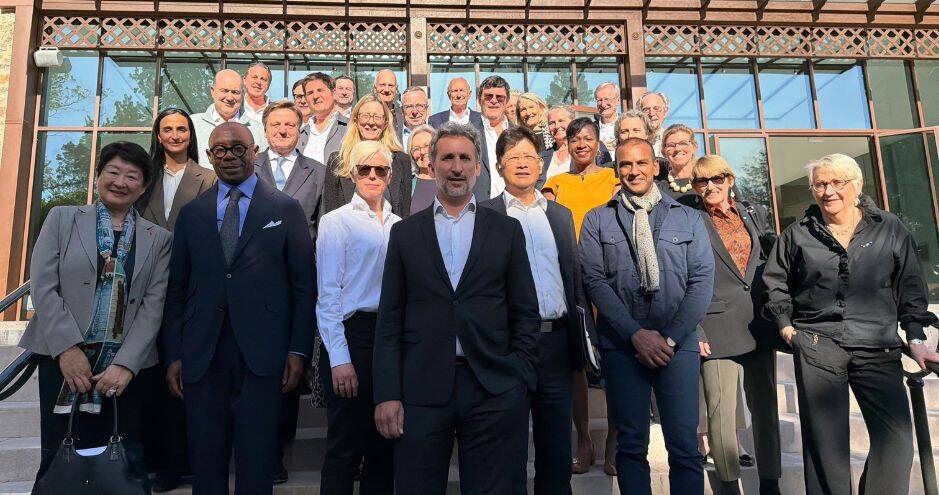
The HEC Paris International Advisory Board gathered in Jouy-en-Josas for its annual meeting, bringing together influential voices from across the globe to explore a central theme: AI and the future of higher education.
Over two days, discussions focused on how artificial intelligence is transforming not only the tools available to students, faculty and institutions, but also the very foundations of learning, knowledge and assessment.
AI is already changing how knowledge is produced, accessed, transmitted, interpreted and validated. For higher education institutions, this represents a profound shift. It challenges the traditional value proposition of universities and business schools, while forcing them to ask a fundamental question: what is education for in an age of AI?
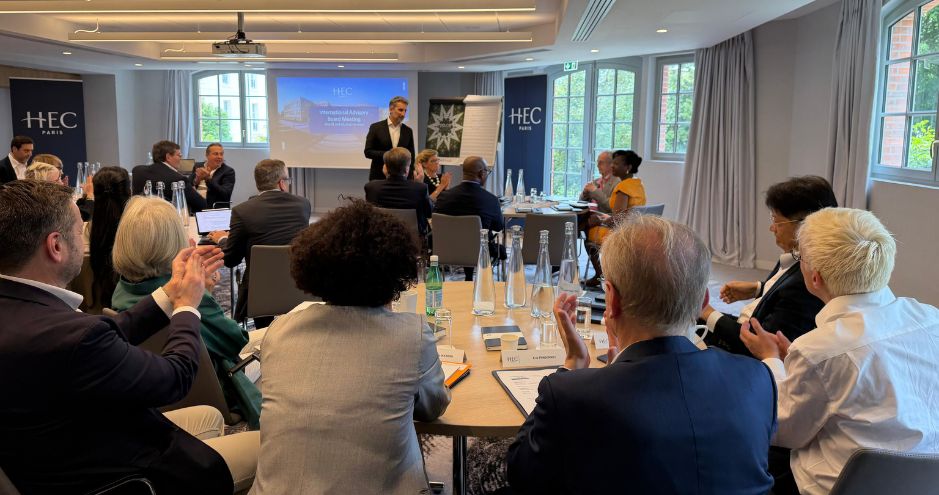
Enhancing Learning Beyond the Final Grade
Together, members of the International Advisory Board reflected on how institutions like HEC Paris can deploy AI thoughtfully, with clear guidance and a strong educational purpose.
A key objective emerged from the discussions: to ensure that AI enhances learning beyond the final grade.
This means equipping students with the critical thinking, judgment, skills and knowledge they need to achieve their full potential. It also means helping them develop highly valuable and non-replicable capabilities that will allow them to thrive in a new economy, with impact.
For HEC Paris, this reflection goes far beyond the integration of new technologies into the classroom. It calls for a deeper reinvention of how learning experiences are designed, how students are engaged in the learning process, and how progress is assessed.
Preparing Students for an AI-Pervasive World
Two priorities emerged from the discussions. The first is to prepare students for a world where AI permeates almost every field of activity. Future leaders will need to understand how to work with AI, make informed decisions about its use, and navigate the ethical, strategic and organizational challenges it raises.
The second is to guard against the risks of cognitive offloading. If AI can generate, summarize, calculate and produce at unprecedented speed, higher education must ensure that students do not lose the intellectual effort required to learn deeply, think critically and build their own judgment.
Experimenting, Learning and Failing Intelligently
As Jean-Lou Chameau, President Emeritus of the California Institute of Technology, reminded participants, AI is the fastest-moving technologies in the history of tech. Higher education institutions will have to learn to experiment, adapt and evolve with far greater agility than ever before.
However, two prerequisites can be highlighted, drawing on the work of Amy C. Edmondson, Novartis Professor of Leadership and Management at Harvard Business School, who took part in this International Advisory Board session: psychological safety and intelligent failure.
Institutions need to create conditions where faculty, students and staff can speak up, test new approaches, learn from what does not work, and improve collectively. This is especially important when the pace of technological change requires experimentation without losing sight of the core mission of education. Most universities and schools have now developed policies around the use of AI. But what will truly make a difference, Amy Edmondson emphasized, is building “a culture of experimentation”.
A Global Perspective on AI in Higher Education with GMAC CEO Joy Jones
The 2026 meeting also welcomed Joy Jones, CEO of the Graduate Management Admission Council (GMAC), as a new member of the International Advisory Board.
She delivered an insightful presentation on the state of AI adoption in higher education, drawing on data from universities around the world, students’ evolving use of AI, and recruiters’ expectations.
A full interview with Joy Jones will soon be published, exploring how AI is changing the way students choose the right business school? and how GMAC can help schools, candidates and recruiters navigate this transformation.
Advancing HEC Paris’ Reflection on AI and Learning
As artificial intelligence raises fundamental questions for universities worldwide, HEC Paris is proud to draw on the diversity of perspectives and high-level expertise of its International Advisory Board members to explore how higher education can remain both relevant and transformative.
The outcomes of this work will contribute to HEC Paris’ ongoing reflections on AI, learning and the future of education, in close dialogue with its faculty and academic leadership, with further developments expected in fall 2026.
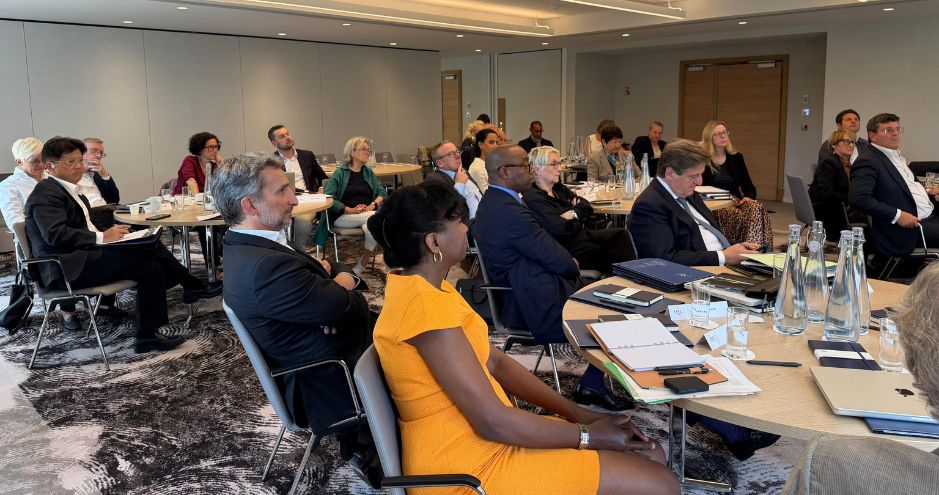
List of Attendees
HE Sheikha Hind bint Hamad Al Thani, Vice Chairperson of Qatar Foundation
Jean-Lou Chameau, President Emeritus of the California Institute of Technology (Caltech)
Tony Chedraoui, Founding Partner, Chief Investment Officer, and Director of Tyrus Capital
Charles Cheng, former Chairman of Société Générale (China) Ltd
Valérie Colloredo, Founder of Fondation 104
Christophe Cuvillier, Chairman of the Board of Directors of SMCP (Sandro, Maje, Claudie Pierlot, Fursac), Former CEO of Unibail-Rodamco-Westfield
Prof. Amy C. Edmondson, Novartis Professor of Leadership and Management at Harvard Business School
Serge Ekue, President, West African Development Bank (BOAD), Chairman of the Board of Directors, Chairperson of the International Development Finance Club (IDFC)
Mercedes Erra, Founder and President of BETC Worldwide (Havas Group)
Michel Fattal, Senior Vice President of Fattal Group
Jean-Yves Fillion, Chief Executive Officer of Societe Generale Americas (TBC)
Suzanne Fortier, Principal and vice-chancellor emerita of McGill University
Prof. Dr. Gunther Friedl, Managing Director, Dieter Schwarz Foundation
Joy Jones, CEO, Graduate Management Admission Council (GMAC)
Leah Marshall, former Operations and Culture Ambassador for Oetker Collection
Deepak Rao, Vice chairman of FICOFI Partners Holding Pte. Ltd. and founder of Heritage Investment Company Limited
Federico Sturzenegger, Minister of Deregulation and State Reform of Argentina
Mostafa Terrab, Chairman and CEO of the OCP Group (TBC)
Emmanuelle Wargon, President of the French Energy Regulatory Commission, Chair of the board of regulators ACER, Europe’s Agency for Cooperation of Energy Regulators
Cecilia Weckstrom, Director, Digital Consumer Engagement (DCE) Transformation Initiatives, LEGO Group
Lan Yan, Independent Member of the board of directors of Edmond de Rothschild, former Chairman and CEO of Lazard Greater China
HONORARY MEMBERS
Jean-Paul Agon, Chairman of the Board of L’Oréal, Chairman of the Board of HEC Paris
Jean-Luc Allavena, Chairman of the Investment Company Atlantys (in partnership with Apollo Management) and Honorary Chairman of HEC Alumni and Foundation
Hortense De Roux, Lawyer and partner at Ashurst, President of HEC Alumni
Stéphane Fratacci, Director General of the Paris Île-de-France Regional Chamber of Commerce and Industry
Jean-François Palus, Chairman of the HEC Foundation