When Good Intentions Meet Reality: Inside S&O’s 11th Research Day
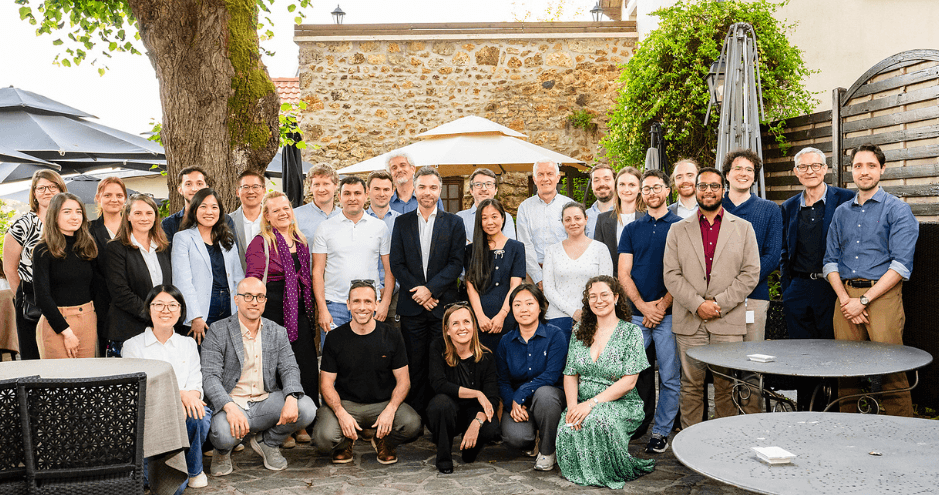
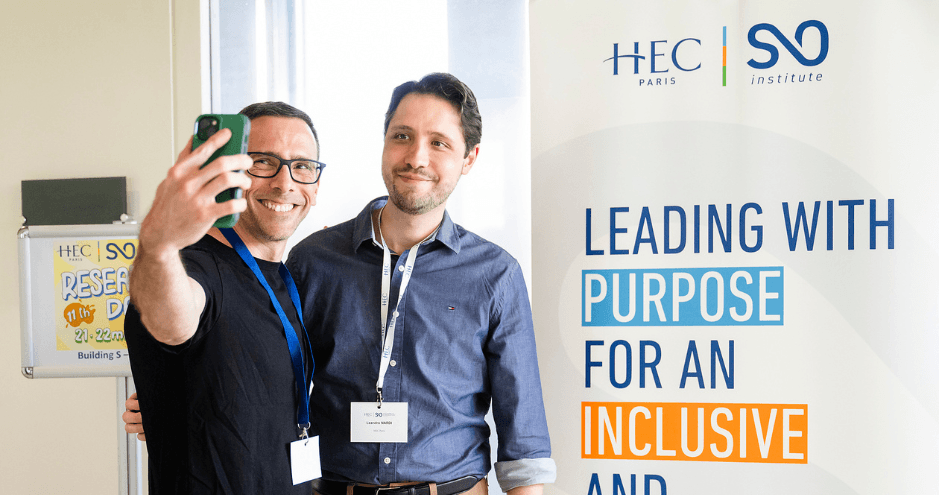
What happens when sustainability research confronts the complexities of the real world? On May 15–16, 2025, the Sustainability & Organizations Institute at HEC Paris brought together faculty, PhD students, affiliated researchers, and international scholars for its 11th Research Day. Through presentations and discussions spanning climate, purpose, and inclusive economy, participants explored why even the best intentions can produce unexpected outcomes—and how research can help navigate these tensions.
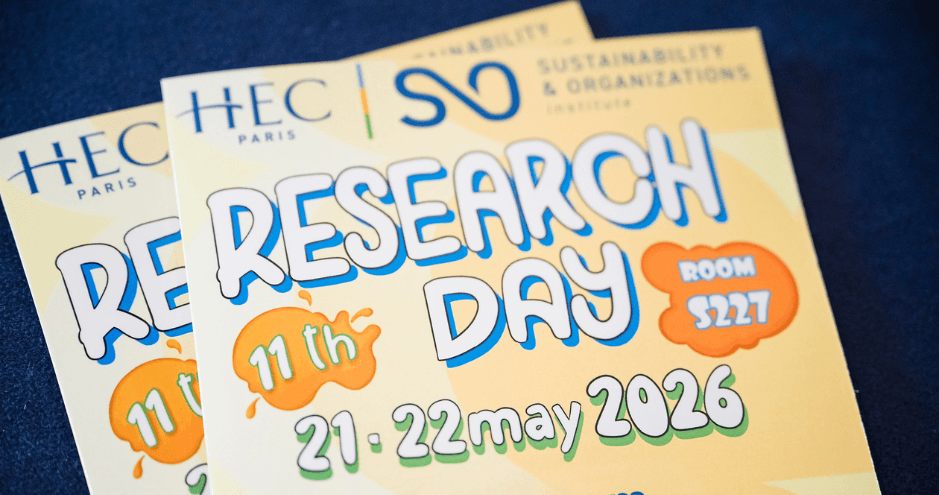
- The 2026 S&O Research Day held on May 21-22, 2026, gathered researchers from 14 countries around 24 paper presentations and two keynote addresses by Anna Kim of McGill University and Sérgio G. Lazzarini of Insper.
- A recurring question ran through the two days: what happens when organizations move beyond pledges and confront the consequences of their actions in labor markets, media systems, climate shocks, refugee policy and entrepreneurship?
- HEC Paris academics and doctoral researchers contributed work on climate-related racial pay gaps, refugee allocation, equality law, green innovation, entrepreneurial exit, ESG voice, sanctions and stakeholder reactions to activism.
- Visiting scholars brought empirical work on gendered penalties after failure, loyal journalists, intergenerational inequality, sustainability investments and the organizational production of scientific entrepreneurs.
- The event’s deliberately intimate format, with no parallel sessions and extended discussion, again made the Research Day a place where early-stage work could be challenged without being diminished.
It is often tempting, in writing about sustainability and organizations, to remain at the level of intention. Firms make commitments. Investors demand disclosure. Governments design policies. Universities convene expertise. The vocabulary is familiar, and often reassuring. Yet
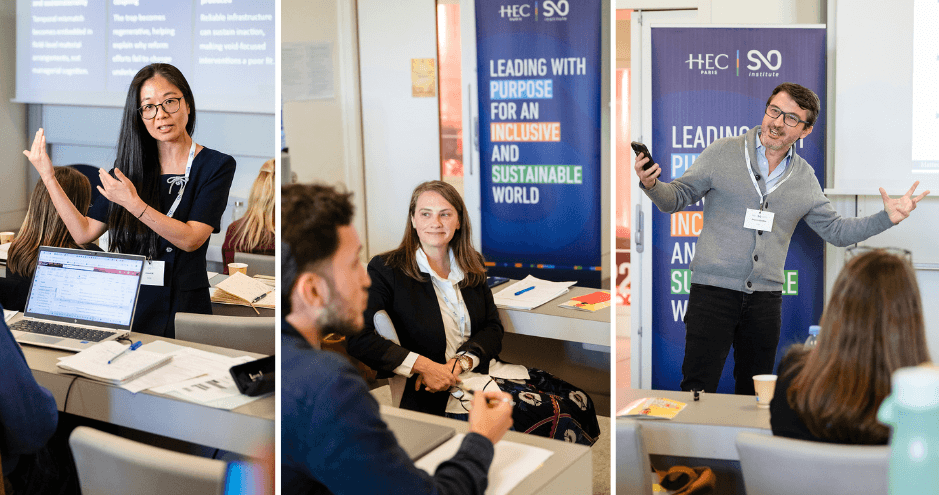
Across two days, the 11th Sustainability & Organizations Research Day at HEC Paris, repeatedly returned to a question of what happens next? What happens next once firms make commitments, investors demand disclosure, governments design policies or universities convene expertise? The May event on the HEC campus invited young and seasoned researchers to share their studies and open them up to constructive yet challenging questions.
The annual conference brought together researchers from around the world for 24 paper presentations and two keynote addresses. The co-organizer, HEC Paris Associate Professor Lisa Baudot, described the selection process as an effort to build “a really diverse set of scholars” around sustainability and organizations, diverse not only by institution but also by method, discipline and career stage. This year, she observed, the work seemed to widen the definition of sustainability toward “social types of implications and adaptation processes.” This reflected the continued expansion of the sustainability agenda of previous Research Days, bringing environmental, social and governance themes together in more holistic ways.
The papers and presentations did not ask only whether organizations should do good. They asked how employees, journalists, investors, refugees, courts, entrepreneurs, boards, social movements and local communities respond when good intentions, market pressures and institutional rules meet the world as it is.
Anna Kim, A William Dawson Scholar and Associate Professor in Management for Sustainability and Director of Sustainability at the Desautels Faculty of Management, McGill University; Lisa Baudot, Associate Professor at HEC Paris at Accounting and Management Control Departement and co-organizer of the S&O Research Day; Sergio G. Lazzarini, A Chafi Haddad Professor of Management at Insper (Brazil) and founder of Insper Metricis.
Learning from the Ground, not Above It
The first keynote, by Anna Kim, Associate Professor in Management for Sustainability at McGill University’s Desautels Faculty of Management, set the tone. Kim’s research is rooted in ethnographic and qualitative work in settings including Fairtrade tea and coffee producer organizations in Kenya, Uganda and Tanzania. Kim also looks at social impact initiatives in several other contexts. Her work has examined the temporal and spatial dimensions of sustainability, often showing how initiatives designed to help communities can create unintended consequences when they fail to understand local realities.
In conversation after her keynote, Kim framed sustainability as a field that requires unusual intellectual humility. “Sustainability issues are at the intersection of social, ecological, economy, cultural trajectories,” she said. “Often the consequences are complex, unintended, they may vary across time.” An intervention may appear encouraging in the short term and prove less so later. Conversely it may take years to reveal its value. For that reason, she argued, sustainability research needs “diverse perspectives from anthropology, sociology, economics, policy management strategy.”
Kim’s own method embodies that conviction. She spoke of the long preparation behind her immersive fieldwork: reading and training across anthropology, sociology, African studies and development studies, but also a more direct education that came from “really listening to people on the ground.” There were, she said, “so many wow moments” in which communities revealed “so much wisdom, so much knowledge, so much strategy and interventions in their own ways.” The researcher’s role, in this view, is to make sense of wisdom that already exists in communities and organizations. “Eventually the knowledge actually often comes from communities and organizations and people,” Kim said. “We as researchers we do the sense making, we do the writing, we do the speaking.”
Kim’s keynote address was a fitting climax to the Early Stage session of Research Day unusually attentive to consequences. Kim said she was pleased to see studies that were “not just staying with the intentions or discourses” but looking at “intended or unintended” effects, and at “the short-term and the long-term elements.” Sustainability, she reminded the audience, is by definition about what can be sustained over time.
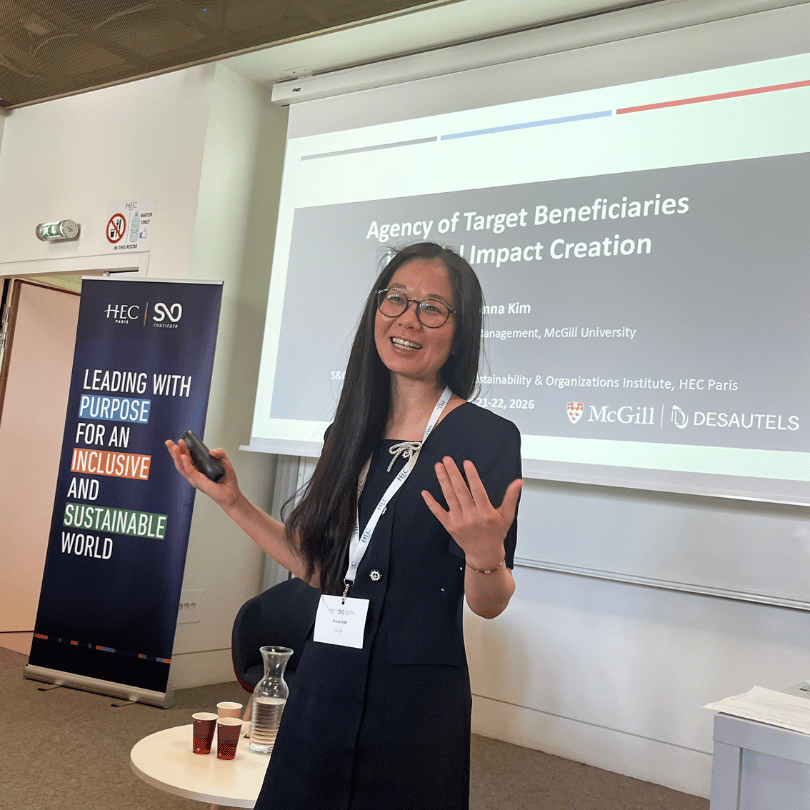
Keynote speaker, Anna Kim, is Associate Professor in Management for Sustainability at McGill University’s Desautels Faculty of Management
Failure is not Evenly Distributed Between Genders
One of the day’s clearest illustrations came from Isabelle Solal of ESSEC Business School and her co-authors from INSEAD Kaisa Snellman, Kamil Stronski and Eric Uhlmann, who study mixed-gender film production teams after box office failure. Their empirical setting is characteristically sharp: 3,497 producers in 887 mixed-gender teams, a context where men and women share the same project outcome and where performance can be measured through box office results.
The findings are unsettling. After a box office success, women and men in mixed-gender production teams are able to raise money for their next project at a similar pace. After a failure, however, women take significantly longer than men to produce their next film. The authors argue that the penalty may stem not from failure itself but from how failure is interpreted. After her presentation, Solal explained that when a film is an outright catastrophe, “even the male producer can’t really get away with that,” narrowing the gender gap by bringing men down rather than women up. But when failure is moderate, interpretation has more room to operate. “That’s where the attribution theory really gets room to play,” she said. Evaluators ask why the failure occurred and what it says about future ability. “For men, if the failure isn’t too catastrophic, they’re going to discount that as information, whereas for women, they are going to go in line with their gender beliefs.”
The project deliberately focuses on large-budget films, where the stakes are high and the producers have already demonstrated professional competence. “We really wanted to focus on these women who theoretically have already proven themselves,” Solal said. They are producing “incredibly big box office movies,” at a level where one might expect the usual questions of capability to have been settled. The findings suggests otherwise. Even at the top, ambiguity may reopen the space for bias.
The Journalist as an Organizational Actor
If Solal’s paper asked who pays for failure, David Gomulya of Singapore Management University and his co-authors Dongdong Huang and Yalin Wang turned to a different arena of organizational life: the relationship between firms and the journalists who cover them. Their ongoing research, titled “The Birth of Loyal Journalists,” examines whether journalists who repeatedly cover the same firm over time engage in impression management that supports the focal firm and disadvantages rivals.
Prior research has shown how CEOs and firms may attempt to influence journalists after disappointing earnings, including through ingratiation - or more coercive approaches such as limiting access to company information. Gomulya’s paper reverses the angle. It asks whether journalists themselves can become active participants in impression management. The study proposes several tactics through which “loyal journalists” may shape coverage in ways that favor one firm over others.
The topic carried obvious resonance in a moment of intense debate about media independence, corporate influence and the economics of news. Gomulya was upfront about the origins of the project, crediting a former PhD student who approached him with the idea at a conference. The senior academic brings to the project his prior work in corporate governance and impression management. But he also appreciated, during the Research Day exchange, a form of feedback that a data set alone could not offer. “Sometimes in academia we like to write whatever we want, but there’s no face validity to it,” he said candidly. Statistical analysis may show that a pattern exists, he noted, but it cannot alone tell scholars whether journalists will find the claim novel, accurate or important. “I can prove something is there,” he said, “but it doesn’t mean that journalists will value that.”
The Long Shadow of Childhood
Jamie Hentall-MacCuish of the Economics and Decision Science department at HEC Paris presented research on intergenerational earnings persistence using the British National Child Development Study, which has followed a cohort born in 1958 across much of their lives. The methodological choice is central. More recent cohort studies may contain richer variables, but their subjects are still young. “The really attractive thing about this data set,” Hentall-MacCuish explained, “is that they kept it going from 1958 right up to now, following the same group of individuals really consistently. So we see their whole life.”
The measure at the heart of the paper, intergenerational elasticity of earnings, is not new. “The IGE is anything but original,” he said. “It is a very simple, classical measure of earnings persistence between one generation and the next.” What is novel is the decomposition: the attempt to explain how parental investments, school quality, skills, educational attainment and family background contribute to the persistence of earnings across generations. Hentall-MacCuish and his co-authors Uta Bolt, Eric French and Cormac O’Dea are especially cautious about measurement error. Parental time investments, for instance, cannot be observed perfectly, so the researchers use multiple measures such as teacher assessments of parental interest, outings, library card membership and reading to children, combining them in a latent factor system rather than treating any one indicator as definitive.
The research explains a substantial share of intergenerational earnings persistence, but not all of it. When asked about the residual, Hentall-MacCuish was careful. “The answers we don’t know,” he said. The missing channels may include social connections, social class and directly inheritable health conditions. In a field that touches deeply held beliefs about merit, fairness and family, the paper’s strength lies partly in its refusal to explain more than the data allow.
Anecdotally, the subject brought echoes of the classic British documentary Up series, which famously followed children from different social backgrounds every seven years, beginning with Seven Up! in 1964. Hentall-MacCuish noted that in longer presentations the research team sometimes shows a still from one of the episodes, directed by the late Michael Apted.
When Climate Shocks Widen Inequalities Inside Firms
HEC’s Leandro Nardi, with Luis Ballesteros (Boston University) and Xia Li (LBS), brought climate risk into the internal life of firms. Their paper geolocates large business establishments in Brazil and tracks their exposure to severe floods, storms and landslides between 2003 and 2017. The question is not only how firms recover from climate disasters, but who benefits when compensation is adjusted after such shocks.
The findings point to a significant widening of within-firm racial pay gaps after climate disasters. Average compensation rises after a disaster, but the gains accrue primarily to white employees. The authors find little evidence that the widening gap is driven by changes in occupational or skill composition, or by a shift toward more precarious contracts. Their interpretation is that intensified competition for labor can magnify existing racial inequality through bargaining dynamics. The paper’s force lies in bringing together two urgent conversations often treated separately: climate adaptation and racial inequality. It shows that adaptation inside firms is not only a technical or operational matter but it can also redistribute income within the organization.
Law, Refugees and the Micro-foundations of Inclusion
Two HEC Paris doctoral researchers presented work that brought inclusion down to the level of professions and places. Haila Amin, a PhD researcher at HEC Paris who passed the Bar exam for England & Wales in parallel to her studies, examined the country’s Equality Act 2010 in that very sector. Her paper argues that inequality in the legal profession cannot be fully understood as a series of discrete and wrongful acts. It emerges cumulatively through role-taking, impression management and the everyday processes by which professional actors define situations and evaluate one another. The legislations that shape the anti-discrimination effort, Amin insisted, should stay up to date with emerging digital technologies to present evidence, the pluralistic way of self-identification, and the increasing nurturing or destructing roles of informal communities. The courage of the project lies partly in its proximity, as Amin knows the profession from the inside.
Rui Li, another HEC doctoral researcher, examined refugee allocation and regional revitalization in France. Her paper studies the local effects of refugee center openings between 2004 and 2014, exploiting quasi-random allocation to estimate local demand effects. The findings suggest that the opening of a first refugee center can raise the number of auto-entrepreneurs, increase firm entry and employment. In a field often dominated by stories of loss and displacement, the research asks whether refugee hosting can also generate local economic activity in shrinking towns. Discussant Frank Wijen described it as a highly original project and a rare positive story emerging from a context of heartbreak.
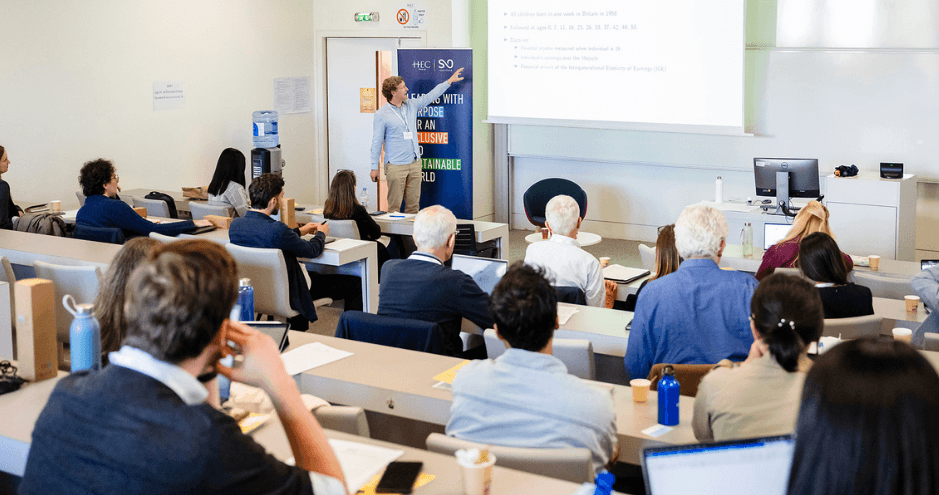
The Exit after the Exit
Haris Krijestorac of HEC’s Information Systems and Operations Management department, signed research with Rand Gerges-Yammine of ESCP Business School which he presented to the packed S building audience. It brought the discussion to entrepreneurship. The world of startups, he noted, is organized around the promise of exit. “From the beginning, people always asking, what’s your exit strategy?” he said after his presentation. Exit becomes “this white whale” that founders chase throughout the entrepreneurial process, presumed to be “a uniformly positive moment of triumph.”
The two academics’ research challenges that presumption. Using large-scale panel data on founders’ tweets before and after exit, the paper studies changes in emotional expression and emotional volatility. The findings show that exit is associated with increased emotional volatility across both positive and negative emotions. The entrepreneur, it seems, may have achieved a central goal while losing an emotional identity.
Krijestorac described the puzzle in plain terms: “You start a company, you get the capital, you fight, fight, fight for that exit, and then you go and then you’re sad. What kind of ecosystem is this?” The paper cannot answer that social question in full, he said, but it can establish and quantify the phenomenon and identify conditions that may mitigate it. The role of online networks appears important as a possible buffer after exit. Thanks to the feedback and informal exchanges, Krijestorac felt the event offered a valuable interdisciplinary test. “Everybody here comes from this umbrella of sustainability organizations,” he said, “but everybody at the same time has different perspectives. Such broad interaction is priceless for us.”
Sustainability, Markets and the Danger of Reliable Routines
The later sessions of the first day widened the lens further. Matteo Burato, Maurizio Zollo (both Imperial College) and Filippo Pellegrino (Glasgow University) examined 1.3 million sustainability initiatives from 75,000 sustainability reports, using transformer models to distinguish advocacy, preparation and transformation. Their findings suggest that only transformative sustainability initiatives are linked to higher future Returns On Asset, while conventional ESG ratings and less strategic forms of sustainability activity do not show the same positive link. The study shared by Burato also finds that markets were slow to understand complex transformative initiatives, with a positive alpha that gradually disappeared by 2022.
Florencio Portocarrero, Aaron Aujla (both LSE) and Katerina Gonzalez (Suffolk University) compared corporate-sponsored volunteering with personal volunteering across multiple studies. Their work suggests that corporate-sponsored volunteering is more strongly associated with favorable organizational outcomes, while personal outcomes are more nuanced. Warwick Business School’s Muhammad Umar Boodoo, returning to a Research Day he clearly values, presented a study cosigned with Sara Hajmohammad (Ottawa University) on adaptive capacity traps: situations in which infrastructures built for short-term stability make long-term adaptation harder. The argument is not simply that organizations fail because their systems are broken, Boodoo noted in his presentation. Sometimes they fail to adapt because existing systems work reliably for the wrong temporal horizon.
The first day closed with work on government venture capital in Europe, green technological repurposing and the organizational production of scientific entrepreneurs. Sevket Camoglu (Venice University, on a visiting leave at HEC) estimated the additionality of government venture capital across Europe, finding that a large share of GovVC-funded firms would otherwise have remained unfunded, while also documenting an exit-rate gap for additionality firms. Ho-Wei (Alison) Hsu and Denisa Mindruta of HEC Paris examined gas separation technologies repurposed for carbon capture and storage, showing how suppliers, adopters and research organizations take on different innovation roles after technologies are redirected toward environmental goals. Yaëlle Amsallem of ESCP Business School unfortunately could not attend, but she sent in her research paper. This challenges the mythology of the heroic scientist-entrepreneur by studying how specialized organizations produce scientific entrepreneurs through structured communities, commercialization processes and organizational lifecycles.
Day Two: Governance, Activism and Labor Markets
The second day continued the same movement from intention to consequence, though in a more compressed form here. Carlos Inoue (Illinois University), Octavio Augusto de Barros (HEC Paris) and Sandro Cabral (Insper) examined the Brazilian meatpacking industry after the liberalization of beef exports to mainland China. Their paper finds that exporting plants expanded employment without significant changes in wages or accident rates, while non-exporting plants within the same firms experienced employment growth and rising workplace accidents without corresponding wage gains. The result is a careful account of how global demand shocks can be transmitted internally across multi-unit firms, with consequences for workers who are not directly tied to export activity.
Olivia Askheim (Bocconi University), Anne Jacqueminet (ESSEC) and Brandon Prettyman (North Carolina University) studied how a board’s political ideology shapes responses to financial misconduct. Their paper asks why boards facing similar restatement events choose different responses, from defensive moves such as dismissing executives or auditors to more accommodative changes in oversight. Angèle Marinelli and Georg Wernicke, of HEC Paris, joined forces with Cédric Gutierrez Moreno (Bocconi University) to examine stakeholder reactions to corporate activism. They argue that ideological agreement is not enough: when stakeholders agree with a firm’s stance, they also evaluate whether the firm is an authentic and appropriate advocate.
HEC Associate Professor Arnd Vomberg and Jan Kleinhans of Mannheim University explored ESG ECHO, or employee ESG chatter online, using hundreds of thousands of Glassdoor reviews. As firms become quieter about ESG, the paper argues, employees may become more salient voices, shaping employer prestige, satisfaction and performance. Marusa Rus, a doctoral researcher at HEC Paris, and HEC Professor Julien Jourdan studied what happens after organizations are sanctioned for misconduct, focusing on when sanctions succeed in making firms abandon deviant practices and when they have wider market effects.
The final session included Clemens Lauer of HEC Paris on ESG-related executive compensation and voluntary financial disclosures; Edoardo Cortesi and Veronica Chiodo (both Politecnico di Milano) on how corporate purpose reshapes innovation routines; HEC’s Tomas Farchi and his four co-authors on labor limbo and accompanied liminality; and Panikos Georgallis (Amsterdam University) and two co-authors on social movements and solar photovoltaic adoption across Europe.
Taken together, the second day extended the Research Day’s central question into governance, disclosure, activism, work and violence. Going beyond corporate policy, board decisions, purpose statements, social movements or sanctions, they discussed research scrutiny, and chains of consequences distributed across people, places and time.
A Small Forum for Large Questions
The 11th Research Day also offered a reminder of what academic formats can make possible. Lisa Baudot said the organizers began by selecting the keynote speakers, then built a program from roughly 32 submissions, balancing early- and later-stage work, internal and external scholars, methods and disciplines. The keynotes were chosen, she said, as a complementary pair: Anna Kim bringing ethnographic and qualitative depth, Sérgio G. Lazzarini bringing a complementary methodological perspective on social impact.
More early-stage papers were submitted than later-stage ones, which Baudot read as a sign of trust. “I think it shows that Research Day is a kind of safe and welcoming space,” she said. Doctoral students received dedicated discussion, including written comments, in what she called a way of “taking care of our emerging scholars.”
The phrase might sound gentle, but the intellectual work was not soft. What distinguished the two days was precisely the combination of protection and pressure: the willingness to ask hard questions in a format small enough for people to answer them honestly. Gomulya called it “fantastic,” noting that the common theme of responsible business was broad enough to include diverse research questions and coherent enough to allow scholars to “fill gaps” in their knowledge. Krijestorac called it “a superb forum to get feedback on early-stage work,” adding that rejected journal submissions are “the most expensive way of getting feedback in this business.”
For Baudot, the larger stakes are also public. She pointed to a renewed debate about the role of public intellectuals and the need for academics not to remain in “our ivory tower.” Researchers, she argued, “can be and should be involved in policy debates,” particularly around grand challenges.
That ambition remained what it has long been: a serious academic gathering, deliberately limited in size, committed to the slow improvement of ideas. Yet the research presented there spoke directly to some of the most urgent questions facing organizations today. How does climate risk redistribute pay? Why does failure follow women more closely than men? When do journalists become part of the corporate field they cover? Can refugee hosting revive local economies? What happens to founders after the celebrated exit? What do employees say when firms fall silent on ESG? When do good intentions miss the people they are meant to serve? And so much more.
The answers, largely based on ongoing research might have been partial, cautious and empirical, but that was precisely their strength. At a time when organizations are often judged by what they claim to stand for, the 11th S&O Research Day asked a more exacting question: what do their actions, systems and interventions actually do, and to whom, over time?