
Charleen Case Named One of World's 40 Best Under-40 MBA Professors

The recognition highlights a scholar whose work bridges organizational behavior, social psychology and evolutionary science to examine how people navigate hierarchy, leadership, mentorship and workplace relationships.
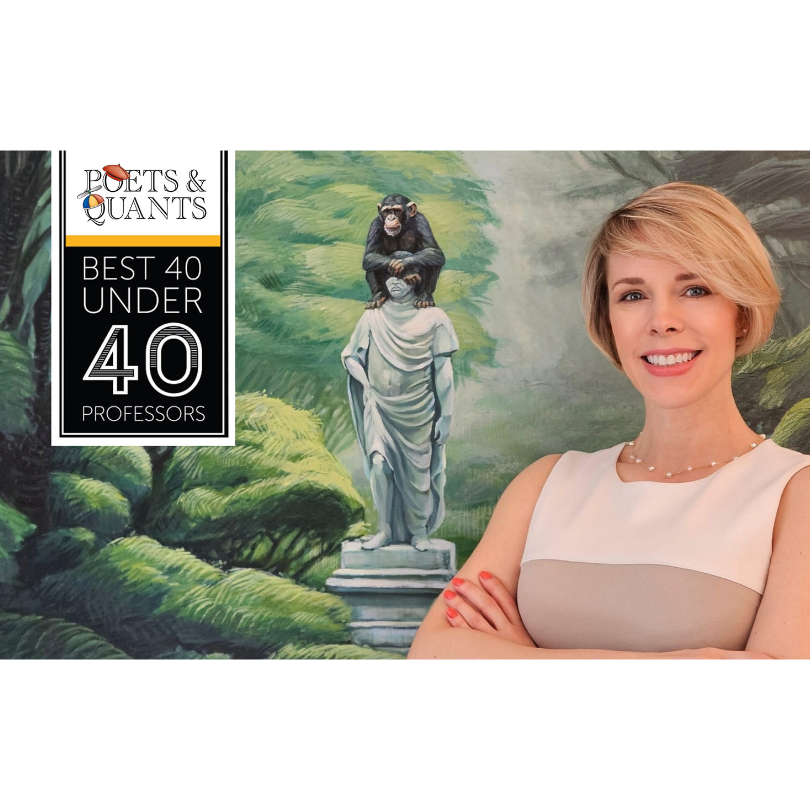
HEC Paris Assistant Professor of Management and Human Resources Charleen Case has been selected for P&Q’s 2026 list of the world’s 40 Best Under-40 MBA Professors. Case’s research focuses on how fundamental human motives, including status, affiliation and kin care, shape behavior in hierarchically structured workplaces. Her work asks how people acquire and maintain status, exercise influence, invest in relationships, and build connections across differences in rank. These questions are especially timely as organizations confront new forms of technological disruption, changing expectations around leadership, and the risk that human connection at work becomes an afterthought.
“As AI reshapes how work gets done,” Case argues in her exchange with P&Q journalist Kristy Bleizeffer, “the relational and interpersonal dimensions of organizational life risk being deprioritized precisely when they matter most.” Companies, she insists, need to do a better job of “investing in genuine human connection.”
Her current research stream examines the motivational processes behind mentorship. Mentorship is widely seen as an essential workplace relationship, but Case approaches it through a more precise hierarchy question: why do higher-ranking people invest time, advocacy and emotional energy in more junior colleagues, often with no guarantee of return? Her research suggests that mentorship can activate psychological mechanisms associated with caring for, protecting and investing in a developing dependent. In her words, mentorship is “not just a reciprocal exchange,” but a relationship that can draw on motivational architecture linked to long-term care and developmental investment.
Circuitous Path to Academia
The path to this research agenda was anything but linear. Case describes her route into business academia as “circuitous,” adding that, in many ways, “business school chose me.” As a first-generation college student from more modest means than many of her peers, she says she noticed hierarchy dynamics early. She became interested in “the why’s and how’s of social status navigation: the inner workings of competition, cooperation, and coalition formation.”
That curiosity took her across a wide intellectual landscape. She studied psychology and anthropology at Miami University in Ohio, conducted primatological fieldwork in the Amazon, pursued lab-based comparative neuroanatomy research, and later completed her PhD in social psychology at Florida State University. During her doctoral studies, she was also a visiting research fellow at Northwestern University’s Kellogg School of Management. It was there, she says, that she realized the questions that mattered most to her were also central to organizational life.
Before joining HEC, Case was Assistant Professor of Management and Organizations at the University of Michigan’s Ross School of Business, where she taught leadership development in the MBA program and coordinated a core undergraduate course in Behavioral Theory of Management. Her work has appeared in leading academic journals including the Journal of Personality and Social Psychology and Advances in Experimental Social Psychology, and has been featured in The New York Times, The Wall Street Journal, The Boston Globe, Harvard Business Review, Glamour and Psychology Today.
Blending Rigor and Humanity
Since joining HEC in 2025, Case has taught Organizational Behavior in the Master in Management program, contributed to custom leadership programs in Executive Education, and served as Doctoral Coordinator for the Department of Management and Human Resources. She is also a Faculty Affiliate of the NAOS Lab for Leadership, HEC Paris’ initiative examining the human foundations of leadership in an age of artificial intelligence and complexity.
Her teaching reflects the same blend of rigor and humanity that marks her research. Case says what makes her stand out is best answered by her students. But she offers a modest guess: “Some combination of my unconventional background, my genuine enthusiasm for discussing ideas, and my investment in getting to know my students as people.” She adds: “I care deeply about them and their futures, and I think (and hope) that shows.”
That warmth does not mean leniency. Asked how students would describe her grading, Case answers with characteristic clarity: “Fair, though perhaps stricter than they had expected.” She continues: “I think my warmth in the classroom leads some students to assume the grading will be equally forgiving. It is not. I take grading seriously precisely because I take my students seriously.”
Case is equally candid about the challenge of teaching organizational behavior to business students who may arrive focused on finance or consulting. The challenge, she says, is to earn genuine engagement quickly enough for the material to matter before internships, interviews and early career decisions begin. The reward comes later, when students return to say that a framework from class helped them navigate a difficult teammate, sell an internal initiative or earn a promotion.
Being Deeply Human
Her own model of professorship traces back to Scott Suarez, who taught her biological anthropology, primate behavioral ecology and senior capstone courses at Miami University. Case remembers him as “brilliant, delightfully eccentric,” with “a dry sense of humor that rewarded your close attention.” More importantly, she says, he was “deeply human.” He did not perform a sanitized version of professorship, and that authenticity made him trustworthy. “He is the professor I have been trying to become.”
The same human note appears in Case’s reflections on the business school of the future. She would like to see more interdisciplinary thinking, because “the most interesting questions in organizational life rarely respect disciplinary boundaries.” It is a fitting statement from a scholar whose work moves from anthropology and psychology to leadership, mentorship and social hierarchy without losing sight of the people inside organizations.
And if she were not a business school professor? “I would be a novelist. Hands down,” Case says. She loves “character- and world-building,” especially stories shaped by folklore, hidden worlds and strange social rules. Then comes the practical caveat: “Whether I could make ends meet as a novelist is another question entirely, so I’d also be happily keeping a day job at a natural history museum.”
That answer says a great deal about Charlie Case: rigorous, imaginative, self-aware, and quietly funny. It also explains why her recognition by Poets&Quants feels so apt. Her work asks how people live with hierarchy, how they care across it, and how leaders can remain human within it. At HEC Paris, those questions are now part of the classroom, the research agenda, and the future of leadership education.
Background
This is the 14th edition of P&Q’s annual recognition. Its self-proclaimed goal is to “identify and celebrate the most talented young professors currently teaching in MBA and graduate business programs around the world”. To date, the publication has highlighted 560 exceptional professors. Professors on this year’s list come from 39 different business schools, including 14 schools outside of the United States. Overall, P&Q received more than 1,700 nominations from students, colleagues, administrators, and professors themselves. Its editorial staff evaluated each nominee on teaching (given a 70% weight) and research (given the remaining 30% weight).