Dunkerque: Inside France’s Laboratory for Industrial Decarbonization
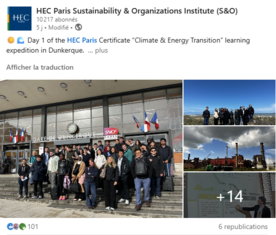
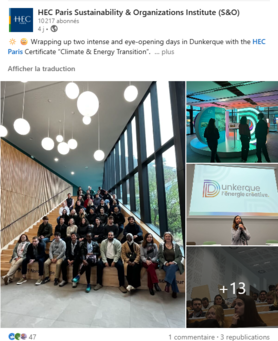
How can heavy industry reconcile competitiveness, sovereignty and decarbonization? To answer this question, 40 participants of the HEC Paris Certificate “Climate & Energy Transition” travelled to Dunkerque for a two-day learning expedition on May 18th and 19th. Through visits to major industrial sites and exchanges with leading experts, the cohort discovered how one of Europe’s largest industrial and port ecosystems is reinventing itself as a hub for green reindustrialization and low-carbon innovation.
A Territory at the Heart of the Energy Transition
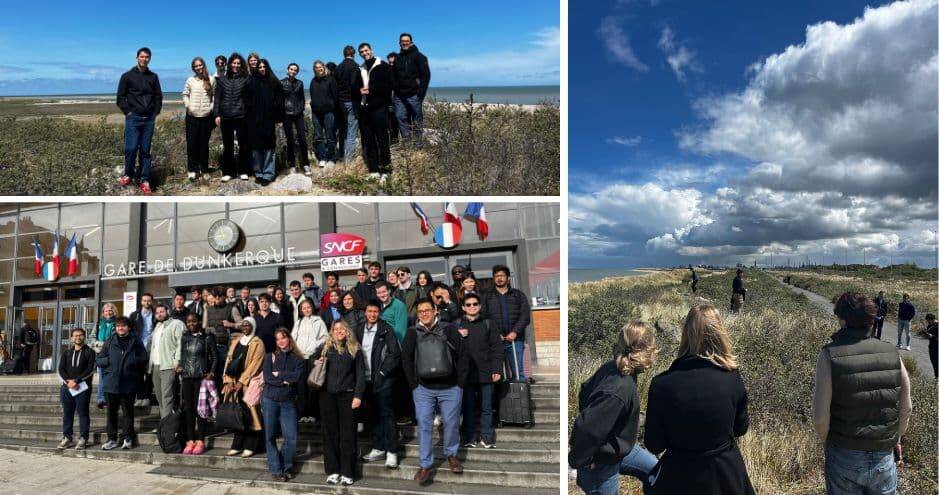
Dunkerque has become one of France’s most strategic territories for industrial decarbonization. Representing around 21% of French industrial CO₂ emissions, the industrial-port basin is now positioning itself as a laboratory for green reindustrialization, combining heavy industry, low-carbon energy projects and circular economy initiatives.
For students in the HEC Paris Certificate “Climate & Energy Transition”, the learning expedition offered a unique opportunity to confront the realities of this transformation firsthand. Over two days, they visited emblematic companies including Aluminium Dunkerque, ArcelorMittal, Ecocem and the Dunkerque LNG terminal, while also discovering local initiatives such as DKarbonation and its ZIBaC project (“Zones Industrielles Bas Carbone”).
The expedition took place at a moment of growing international momentum around climate accountability. At the same time on May 20th, the United Nations General Assembly adopted a strongly supported resolution urging countries to comply with their legal obligations to combat climate change, building on the International Court of Justice’s 2025 advisory opinion that protecting the climate is a duty under international law.
In this context, the Certificate “Climate & Energy Transition” aims to equip future leaders with the interdisciplinary understanding needed to navigate the technological, industrial and geopolitical dimensions of the transition.
Discovering the Scale of Industrial Transformation
One of the most striking aspects of the expedition was the sheer scale of the industrial infrastructures visited.
At Aluminium Dunkerque, participants discovered the largest aluminium smelter in Western Europe outside Norway. Producing primary aluminium used in automotive, renewable energy, batteries and transportation, the site alone consumes around 1% of France’s electricity production. Yet the company is also positioning itself as a lower-carbon player within a highly emissive global industry. Thanks to France’s electricity mix and operational efficiencies, its emissions are four times lower than the global industry average.
Students also visited the Dunkerque LNG terminal, a critical European energy infrastructure capable of supplying approximately 20% of the annual gas consumption of France and Belgium. The immense scale of its storage tanks and regasification facilities highlighted the complexity of ensuring energy security while preparing for future energy transitions and a CO2 distribution network.
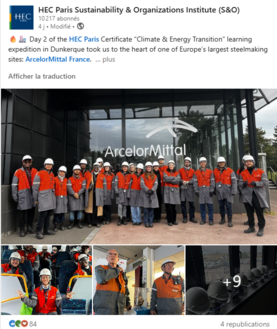
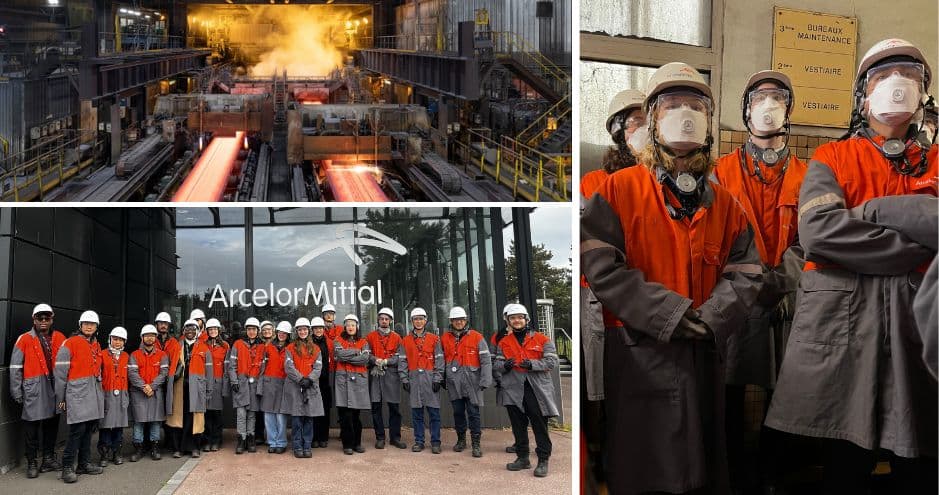
At ArcelorMittal Dunkerque, the cohort explored one of Europe’s largest steelmaking sites. The visit made tangible the enormous decarbonization challenge facing the steel sector, where producing one ton of steel still emits around 1.5 tons of CO₂ due to the continued use of coal in blast furnaces. Students learned about the group’s brand new €1.3 billion investment plan to progressively shift toward electric arc furnaces and increased use of recycled steel and green hydrogen.
Innovation, Circular Economy and Low-Carbon Technologies
Beyond heavy industry, the learning expedition also showcased how innovation and circular economy models are reshaping industrial processes.
At Ecocem, participants discovered how one of the world’s most carbon-intensive sectors — cement production — can be radically transformed. The company has developed low-carbon cement technologies that drastically reduce clinker use, the main source of emissions in conventional cement. Through over €070 million invested in research and development, Ecocem’s ACT technology combines slag from steel production with ultra-fine limestone while maintaining the same construction standards and methods as traditional concrete.
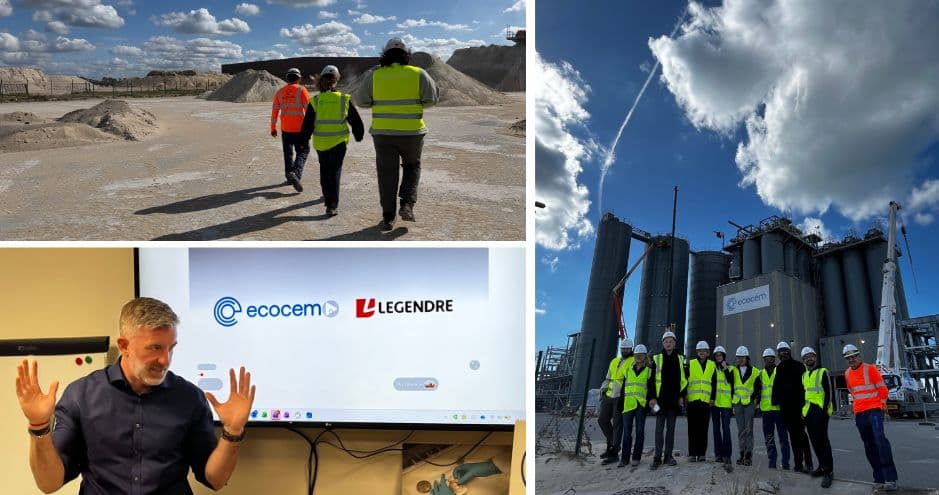
Students also explored local innovation projects such as Urbanloop, a low-energy autonomous mobility solution designed to rethink urban transportation through lightweight electric capsules on rails. Meanwhile, presentations on the DKarbonation program illustrated how industrial players can cooperate around shared infrastructures and collective low-carbon solutions within the ZIBaC framework.
The final discussions focused on the EPR2 nuclear project in Gravelines, where EDF plans to build next-generation nuclear reactors as part of France’s long-term low-carbon energy strategy. The project underlined another key lesson of the expedition: the transition will require not only technological innovation, but also new skills, massive infrastructure investments and long-term industrial planning.
A New Perspective for Future Leaders
For many students, the learning expedition profoundly changed their perception of both Dunkerque and industrial careers.
Fernando J. Díaz López, Executive Director of the HEC Paris Climate & Earth Center, IPCC AR7 lead author, emphasized the importance of immersing students directly into the realities of industrial transformation: “Our students were exposed to the reality of industrial transition through direct immersion within companies and infrastructures that are actively reshaping Dunkerque into a circular economy and decarbonization hub. From low-carbon cement and recycled steel to electrification, carbon capture projects and sustainable mobility initiatives, they could observe firsthand how industrial actors, public authorities and innovation ecosystems are working together to build new models for competitiveness and sustainability.”
Several students admitted they had never imagined visiting Dunkerque before. Yet they left deeply impressed by the ambition, energy and dynamism of the territory. More importantly, they discovered sectors and professions that are rarely highlighted in traditional business school curricula, despite being central to achieving climate goals.
As many students prepare to graduate in two weeks, the learning expedition also revealed the scale of opportunities emerging from the transition. Industrial decarbonization is not only an environmental necessity — it is already creating entire ecosystems of innovation, employment and impact.
The experience reinforced one of the central messages of the Certificate “Climate & Energy Transition” highlighted by François Gemenne, Academic Director of the HEC Paris Master in Sustainability and Social Innovation and lead author of the IPCC AR6 report: “the solutions to climate change already exist, but implementing them requires systems thinking, collaboration and leaders capable of navigating technological, economic and geopolitical complexity.”
More about the Climate & Energy Certificate
|