VivaTech 2026: François Gemenne Calls on Businesses to Turn Climate Data into Action
Speaking at VivaTech 2026's Sustainability Executive Summit, François Gemenne joined experts from Capgemini, ENGIE and WWF France to examine how AI, predictive modelling and scientific data can help organizations anticipate climate risks and accelerate adaptation.

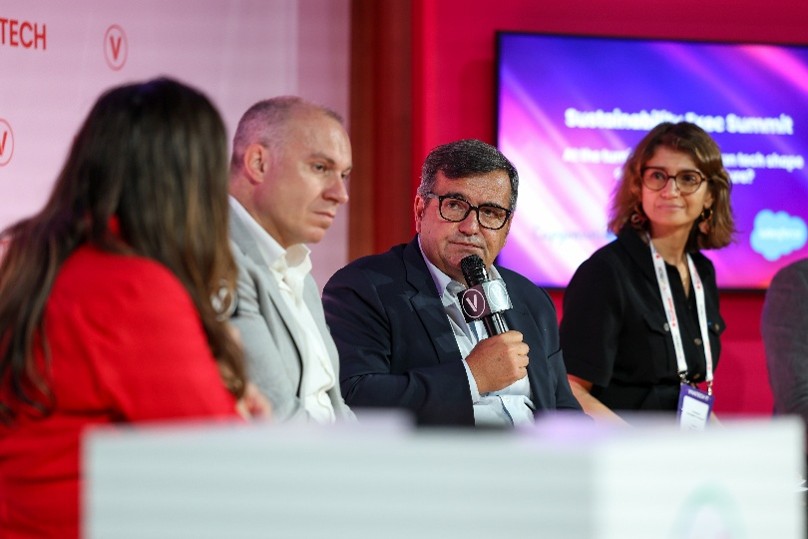
On June 18, 2026, at VivaTech's Sustainability Executive Summit, François Gemenne, HEC Paris Professor and IPCC expert, joined Cyril Garcia, Global Head of Sustainability Services, Corporate Responsibility and Group Accelerators at Capgemini, Florence Colombo-Fouquet, VP ESG at ENGIE, and Yann Laurans, Director of Conservation at WWF France, for the panel discussion "Predict the Unpredictable: Tech to Anticipate Natural Risks."
Bringing together more than 300 international business leaders and decision-makers, the Sustainability Executive Summit—the flagship event of VivaTech's sustainability programme—explored a pressing question: how can technology help organizations anticipate climate risks and build resilience in an increasingly uncertain world?
Climate risks are becoming increasingly predictable
According to François Gemenne, the scientific picture is clear: climate change is leading to a more unstable climate, with more frequent and intense heatwaves, floods, wildfires and other extreme events.
The encouraging news, however, is that our ability to predict these events has improved dramatically.

"We've become increasingly good at predicting climate extremes", Gemenne explained, noting that the IPCC's long-term scenarios have proven remarkably accurate.
The remaining challenge lies elsewhere. While global climate projections are increasingly reliable, organizations need localized information to understand the specific risks facing their assets, operations and supply chains.
"We're very good at predicting risks at the global scale", he noted. "We're less good at bringing those risks down to the local scale."
For businesses, this shift is critical, as climate risks must increasingly be understood as business, economic and financial risks.
From sustainability to risk management
This evolution reflects a broader transformation in how organizations approach sustainability.
As Cyril Garcia explained, the conversation has shifted from corporate social responsibility towards risk management, operational resilience and business continuity.
"Adaptation will drive our economies and our operating models over the next few years", he argued. "We need to build resilience in a world at risk."
Artificial intelligence, predictive analytics, digital twins and scientific data are giving organizations unprecedented capabilities to anticipate climate impacts, optimize resources and strengthen resilience. Yet technology alone is not enough.
"We know everything—we can forecast", Garcia observed. "The question is how we operationalize that knowledge."
Turning climate science into business decisions
Florence Colombo-Fouquet illustrated how this transformation is already taking place at ENGIE.
Operating in around thirty countries, the company combines IPCC climate scenarios with local scientific expertise to assess the exposure of its assets to future climate risks.
By downscaling global climate models to the regional level, ENGIE is able to integrate climate adaptation into both the management of existing infrastructure and the design of new investments.
For every asset, the company evaluates whether the risk should be accepted, further analyzed or mitigated through investment—making climate adaptation an integral part of business decision-making rather than a separate sustainability exercise.
As Colombo-Fouquet noted, ESG has become "a question of business."
Understanding how people respond to climate risks
While technology continues to improve our understanding of physical climate risks, François Gemenne highlighted another challenge: predicting human behaviour.
"There is a huge gap between what we know and what we actually do with that information", he observed.
People rarely make decisions based solely on scientific evidence. Instead, they respond according to how they perceive climate risks—perceptions that often differ significantly from observed reality.
Understanding these behavioural dynamics, Gemenne argued, is becoming just as important as improving climate models themselves.
"It is one of the reasons why we need to invest much more in behavioural science."
Combining technology with field expertise
Another recurring theme throughout the discussion was the importance of combining technological innovation with on-the-ground knowledge.
Drawing on WWF's work across more than 100 countries, Yann Laurans emphasized that local communities often detect weak signals and environmental tipping points long before they become visible in large-scale datasets.
Field observations, indigenous knowledge and local expertise therefore complement predictive models by providing insights that technology alone cannot yet capture.
Rather than replacing human expertise, AI and data analytics should reinforce it—combining global scientific knowledge with local experience to build more effective adaptation strategies.
A final message: follow the money
Asked what single action companies could take today to accelerate climate action, François Gemenne pointed to a frequently overlooked lever: investment decisions.
"Many companies know how to reduce their carbon footprint", he said. "But a significant share of their impact also depends on where they invest their money."
The comment served as a reminder that the climate transition is not driven solely by operational improvements or technological innovation. Financial decisions and capital allocation remain powerful levers for shaping a more resilient and sustainable economy.
HEC Paris' participation in VivaTech 2026 once again reflects the School's commitment to bringing together research, business and technology to address some of the defining sustainability challenges of our time.