
Doctoral Graduates on Bumpy but Rewarding Path to Success
A smaller graduating class made room for a more personal ceremony, as five researchers reflected on the bumpy journey of doctoral work and the next chapters ahead.
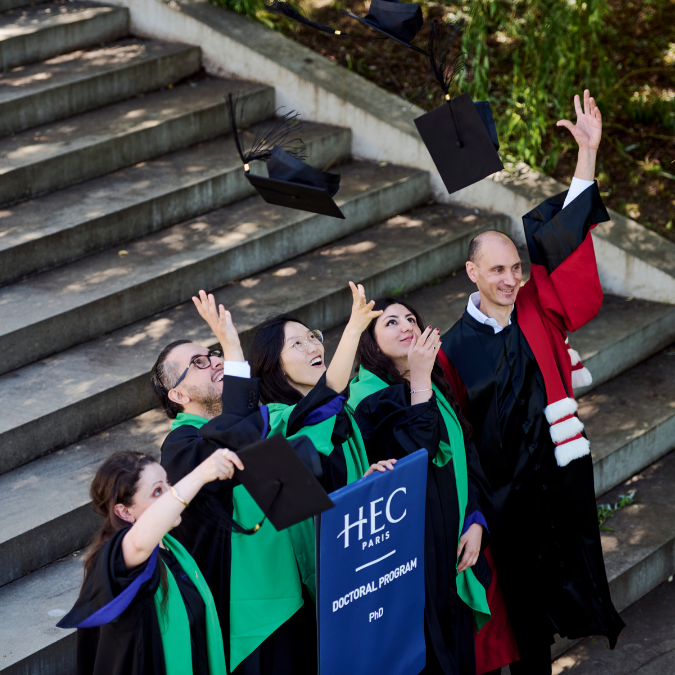
Five Doctoral graduates celebrating on Commencement Day on the HEC steps (C) Ciprien
Key takeaways
- The 2026 PhD graduation celebrated researchers working across decision sciences, strategy, finance, information systems and accounting.
- Graduates described the doctoral journey as demanding, uncertain and sustained by peers, faculty, family and friends.
- Associate Dean of the Ph.D. Program Johan Hombert paid tribute to the graduates, their support networks and the PhD team behind the program.
- The ceremony also emphasized international dialogue, constructive criticism and the importance of celebrating each stage of academic life.
(C) Hailee Tindale
At the 2026 HEC Paris PhD graduation ceremony, the mood was both intimate and expansive. There were five graduates to celebrate: Sarat Chandra Akella, Pauline Asmar, Teodor Duevski, Maya Jalloul and Yike Wang. The research they brought to the finish line ranged widely, from decision-making under uncertainty to corporate purpose, venture capital, online communities and information in financial markets. They were joined by four doctoral candidates awarded a Research Master for their ongoing work.
No Romanticization
Johan Hombert, Associate Dean for the PhD Program, opened the ceremony by naming the people gathered around the graduates: families, parents, friends, partners and HEC staff. They, too, had travelled a long way, he suggested, and they, too, had been part of the work. The ceremony marked the end of one chapter, but not the end of the academic journey. “The graduates have reached the finish line of the PhD”, he told them, but it was also “just the beginning of new chapters in their lives.”
Hombert did not romanticize the path that had brought them there. The PhD, he said, is “a very long journey” and “a bumpy journey, full of excitement, the search for new ideas, and the pursuit of findings that no one has produced before”. But it also brings doubt, frustration and, as he put it with a smile, the question of whether “the fifth robustness check is really all that necessary.”
In the age of AI, research skills developed at HEC matter more than ever, he said after the ceremony. “A PhD is not simply training in a narrow subject; it is training in how to think when answers are uncertain. Good research,” Hombert pursued, “begins with judgment: knowing which questions are worth asking. It requires critical and analytical thinking: testing assumptions, questioning established ideas, weighing evidence, and recognizing the limits of easy answers. And it depends on creativity, grounded in deep expertise: building on previous knowledge not merely to repeat or rephrase what is already known, but to discover something new. As AI makes information more abundant, these human capacities become even more valuable.”
Finding Effective Shock Absorbers
Sarat Chandra Akella, who works in economics and decision sciences, said the best shock absorbers for these PhD bumps were the people present at the ceremony: family and friends. His research uses experiments to understand how people make decisions when they do not know the odds of success or failure. That made the doctoral experience itself feel oddly familiar. “The experiment itself is uncertain,” he said. “You do not know what you are going to find,” he said with a slightly ironic smile.
For Akella, preparation mattered. Pilots before larger studies help improve research designs, but failures still occur. In those moments, he said, support mattered most. His work also changed the intellectual lens through which he sees decision-making. Studying uncertainty taught him that people can avoid information, especially when they expect to receive bad news. It also made him more aware of biases, even if he said it has not transformed his own personal decisions. At present, Akella is sharing his experiences at the Paris School of Economics where he has been working as a researcher for the past year.
Always an Open Door
Pauline Asmar, whose research examines corporate purpose and employees, also returned to the importance of people around the PhD. She described friends in the program, across cohorts, as essential because they made it possible to discuss both research problems and the wider challenges of doctoral life. Being part of the open research community in the Department of Strategy and Business policy, the Sustainability and Organization Institute where she studied at HEC also mattered. If she knocked on a professor’s door there with a question, she said, they were almost always ready to open their door and listen.
Asmar’s research asks what happens when companies adopt a purpose that reflects their values, and responsibility, and whether employees believe them. Her answer was clear: purpose has credibility only if the firm’s actions remain aligned with the purpose it has adopted. When companies claim lofty values and behave irresponsibly, she said, employees are negatively affected. They may distance themselves from the firm, become less willing to put effort into their work, criticize the company, or leave.
Criticism as a Motor for Improvement
Teodor Duevski, graduating in finance, described HEC Paris as a place where strict feedback became a form of support. In the finance department, he said, doctoral students are encouraged to speak to many faculty members. Those conversations can be tough, but they help researchers “kill bad ideas very, very quickly.” The point, he added, is not to take criticism personally, but to use it to improve the work.
Duevski will continue his research on capital allocation in private markets as an assistant professor in finance at the Chinese University of Hong Kong. His dissertation examines venture capital and the people who decide which young companies receive funding. The subject matters, he argued, because venture capital finances high-growth startups that may later contribute to economic growth and society, including in areas such as clean energy, renewable energy and artificial intelligence.
How Online Environments Impact Purchasing Decisions
Maya Jalloul is also teaching at the Paris School of Business. The transition to faculty life has already brought the teaching dimension of the job into focus. She said interacting with students has reminded her why she wanted to become a professor in the first place. She had professors who touched her life, and she wanted to be able to offer that to someone else.
Her research looks at online environments: influencers, online communities and open-source projects. Jalloul began noticing these phenomena during a period marked by technology and COVID. Quarantined, she spent time watching influencer videos and began asking how companies choose the influencers they recruit. More broadly, she said, online environments now change how people make purchasing decisions, work decisions and even personal decisions.
Behavioral Changes Amongst Retail Investors
Yike Wang, from the accounting department, focused on information in capital markets. People care about stock prices and market reactions, she said, and information is a central component of that process. Her research looks at how information is generated, used and processed in the stock market. She also noted how retail investors have changed in recent years, especially after COVID, with younger and less experienced investors entering the market and taking higher risks.
Wang will join Zhongnan University of Economics and Law in Wuhan, her hometown, in the accounting department. There, she said, she will continue her research on capital markets and begin teaching graduate and master’s students. She hopes to carry forward what she learned at HEC Paris, along with her “passion” and “eagerness for knowledge.”
Celebrate All the Process
Hombert’s ceremonial tribute placed these individual journeys within a collective one. The doctoral graduates, he said, arrived from different places, countries, cultures and ideas. At HEC Paris, they found themselves surrounded by people from many other places and cultures. They worked together, learned from each other, and built friendships in what he called the academic tradition of open and constructive dialogue. “We should not take this for granted,” he told them.
He also thanked the PhD team: Francoise, Jacqueline and Hailee. The program, he said, could not exist without their work supporting students and running the program. It was a reminder that doctoral training depends not only on advisors and research seminars, but also on the people who make the structure around the students work.
Hombert ended with a piece of advice for a happy academic life: celebrate throughout the process. Do not wait, he told the graduates, until tenure or retirement. Celebrate a first draft, a journal submission, a revise and resubmit, a new course taught, or a student learning something. In the PhD program, he added, this advice is taken seriously enough that students halfway through the program were also fêted on this Commencement Day for completing their coursework and graduating from the Research Master in Management Science.
For the five new PhDs, the ceremony was therefore less a closing statement than a pause, or even a beginning: a chance to recognize the research already done, the people who made it possible, and the new institutions and classrooms to which they will now carry it. Or, as Hombert put it, “You made it, and we are proud of you.”