
What Can the Arts Teach Future Leaders?
What can a Van Gogh painting, a Puccini opera, and a midnight jazz session teach future business leaders?
That question lies at the heart of Leadership and the Arts in Paris, an MBA intensive course led by Professor Daniel Newark. Over three immersive days, students explored leadership through paintings, literature, music, dance, and opera while visiting some of Paris's most iconic cultural institutions, including the Palais Garnier, the Musée d'Orsay, and the Opéra Bastille.
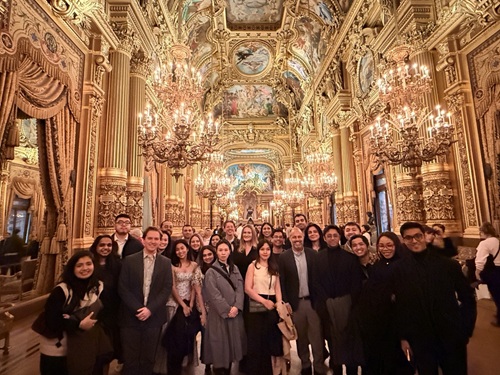
"The course stems from the conviction that there is substantial overlap between foundational topics of leadership and foundational topics addressed by the arts and humanities," said Newark. "In both cases, subjects like making and justifying decisions, motivating action, attention, meaning and storytelling, emotion, ambiguity, tension, and paradox are central."
Rather than offering leadership formulas or management hacks, the course invites students to engage with complexity through some of humanity's greatest artistic works. Along the way, they are encouraged to develop skills that are increasingly valuable for leaders: observation, interpretation, empathy, and reflection.
The course also reflects the mission of the NAOS Lab for Leadership at HEC Paris, which was created to rethink leadership education through research and innovative pedagogical approaches.
By designing immersive learning experiences that cultivate judgment, discernment, empathy, and the capacity to navigate complexity, the NAOS Lab aims to equip leaders with the distinctly human capabilities that are becoming increasingly essential in a rapidly changing world. This Paris-based intensive course is one example of that vision in practice.
For Kasia Krzowska (MBA ’27), one of the course's most important lessons was learning to slow down and notice.
"The professor constantly pushed us to observe before rushing to interpret," she said. "It sounds simple, but it goes against how most professional environments operate, since speed is rewarded and slowing down is often perceived as hesitation."
At the Musée d'Orsay, students were asked to analyze a work of art through the lens of leadership. Krzowska chose Gustave Caillebotte's Raboteurs de parquet and came away with a new perspective.
"It made me think about leadership differently, not as authority, but as attention," she said. "Who do you choose to see? Whose work do you make visible? These are questions I think every leader should ask themselves."
The course also challenged students to embrace ambiguity. Electronic devices were prohibited during class sessions, creating space for deeper observation and discussion.
One of the most memorable moments for Federick Nasol (MBA Class of ’27) came after a performance of Tosca, when students debated the opera's portrayal of power and authority.
"The men in the group tended to analyze the imbalance structurally like the mechanics of power, the logic of Scarpia's position," he recalled. "The women felt it differently. For them, Tosca's bind wasn't abstract."
The discussion highlighted how personal experiences shape the way leaders interpret situations. Leadership is not necessarily about finding a single correct interpretation, Nasol said, but about recognizing that people can experience the same reality in very different ways.
For Newark, these conversations are precisely the point.
"Much of leadership is interpreting and making meaning out of ambiguous stimuli and circumstances," he said. "The more one can perceive about one's environment and the people one is leading, the more effective a leader one is likely to be."
The city of Paris itself serves as an extension of the classroom. Whether discussing Van Gogh at the Musée d'Orsay, attending a performance at the Palais Garnier, or reflecting on leadership questions between cultural experiences, students are immersed in an environment that encourages curiosity and dialogue.
Reflecting on the experience, Nasol believes the course is particularly relevant at a time when technology is transforming the way people learn and work.
"It reminds us that leadership is still about people... that we are gloriously, stubbornly, inconveniently human," he said
The arts became more than a source of inspiration. They offered a new way to think about leadership—one rooted not in easy answers, but in observation, reflection, and a deeper understanding of the human experience.