
 Innovation & Entrepreneurship
 Strategy & Leadership
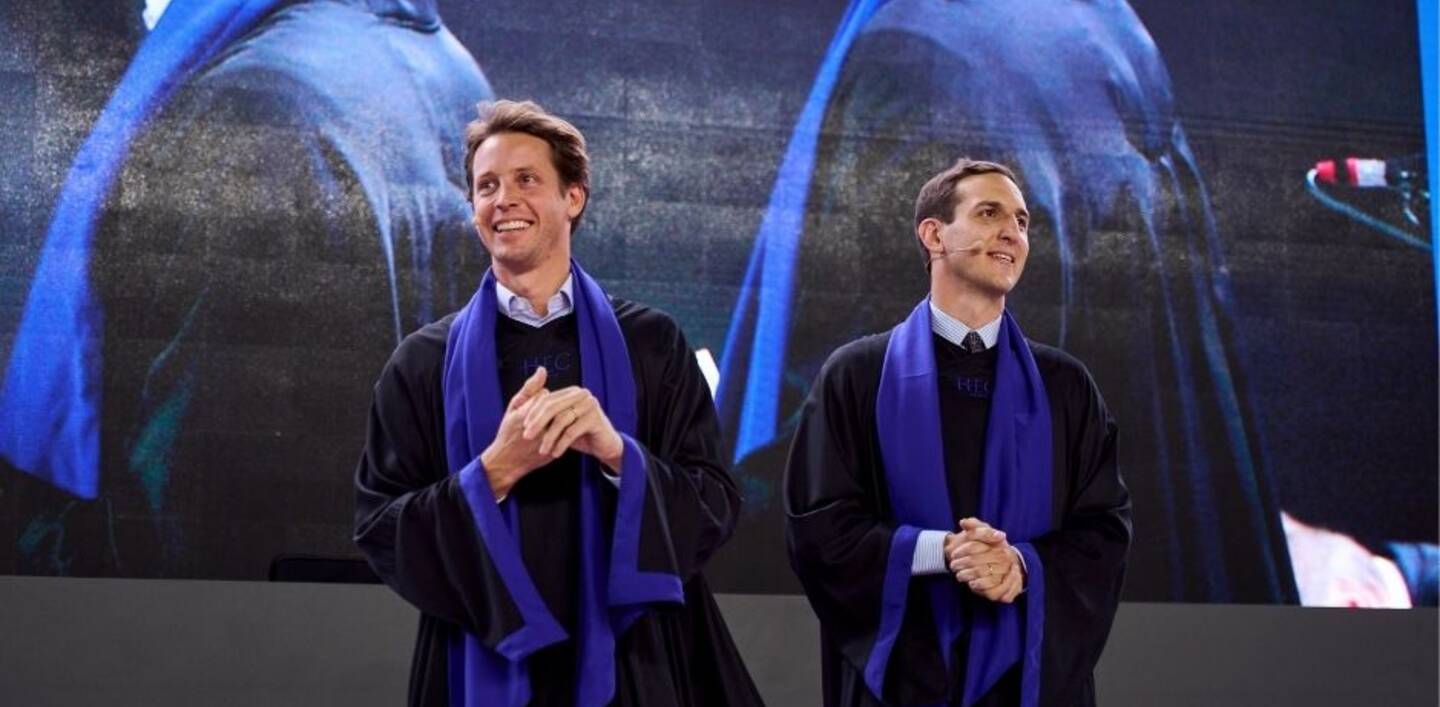
The setting had all the hallmarks of a triumphant return: a Commencement ceremony, standing room only, beamed live across the world, a perfect sunny day and an admiring introduction from HEC Dean Eloïc. But before Victor Lugger and Tigrane Seydoux spoke about Big Mamma, Sunday or the long road that took them from a campus pop-up to international expansion, Seydoux began with something far more intimate.
Standing in front of the graduating class 2026, he shared a story he has carried for years: the suicide of his brother, when Seydoux was still a student on the same campus. The details were devastating because they were ordinary in the most unsettling way. His brother had done everything “right”: the right degree, the right job, the right title, the right future on paper. And yet the people around him, the environment he entered, the culture that surrounded him, had broken him. “I had no idea he was depressed; it was devastating.” You could hear a pin drop, despite the 4,000 students and spectators in the marquee tent.
The point was the lesson Seydoux drew from it. Success, in the way many young graduates are taught to imagine it, is a fragile compass. The more important question is not whether you are building the right career, but whether you are building it with the right people, in the right environment, toward a life that feels worth waking up for.
Building a Life from the HEC Campus Upwards
The day before taking the stage, the two founders sat down at the HEC Bar Club to reflect on the journey that brought them back to Jouy-en-Josas. While the graduation speech focused on a few key lessons, the conversation revealed a story of friendship, community, hospitality, risk-taking and constant reinvention.
For Lugger and Seydoux, coming back to HEC is not merely an alumni visit. It is a return to the place where much of their adult lives took shape. “We started our journey here on this campus,” Seydoux said. The list of milestones is surprisingly long. Both men met their wives at HEC. Lugger launched his first entrepreneurial venture while still a student. The pair ran their first food pop-up on campus. Long before Big Mamma became one of Europe's best-known restaurant groups, they were serving pasta and tiramisu to fellow students in the S building.
“The memories are numerous,” Lugger recalled. “But what comes back immediately is everything HEC has done for us throughout our lives.” The founders speak about HEC as a community. Again and again during the conversation, they returned to the people who helped them when they were starting out. “Every time we asked for help, someone showed up,” said Lugger.
Professors, staff members, fellow students, alumni: support often appeared when they needed it most. Looking back, that experience shaped the way they approach entrepreneurship today. “You're not alone. You can dream big. And if you ask for help, people will show up.” It is perhaps the most enduring lesson they carried away from their student years.
Following People, Not Plans
Like many students preparing to graduate, Lugger and Seydoux once believed the most important decisions were about careers.
Which city should we move to?
Which industry should we choose?
What should we build?
The perspective that comes with experience has changed that. When asked what advice they would give their younger selves, neither spoke about strategy, finance or entrepreneurship. Instead, they spoke about freedom. “Don't try to follow your parents' dreams,” Seydoux said. “Don't just tick the expected boxes.”
For Lugger, the message is equally simple. “Enjoy. It's okay. You don't have to worry.”
The advice sounds surprisingly relaxed coming from two entrepreneurs who have spent the last fifteen years building businesses across Europe and the United States. Yet it reflects a conviction that emerged repeatedly during the conversation: many of life's most important decisions are not about projects but about people.
Looking back, they are convinced that the defining moments of their HEC lives came through encounters, that of their spouses, of their mentors, of their collaborators. Of themselves. “The best decisions were not very much about the idea or the project,” Seydoux reflected. “They were about the people.”
Why Sunday Is Still a Hospitality Story
The same philosophy appears in the way they speak about Sunday. To outsiders, Sunday looks like a fintech success story. The company, born during the pandemic, allows restaurant customers to pay seamlessly through QR codes and has expanded rapidly, particularly in the United States. Yet neither founder describes it as a technology company first.
“Sunday is not, at the end, a tech company,” Seydoux explained. “Sunday is about bringing a better hospitality ambition into what we are doing.” That perspective comes directly from their experience in restaurants. The idea behind Sunday emerged because they understood a frustration that restaurant operators experience every day: customers waiting for the bill, staff spending time processing payments, and unnecessary friction at the end of what should be an enjoyable experience.
Because they had spent years operating restaurants themselves, they immediately recognised the opportunity. “What Big Mamma taught us,” Seydoux said, “was how to make the journey of our guests better.” In many ways, Sunday and Big Mamma pursue the same objective through different means. One serves food and creates atmosphere. The other removes friction and simplifies payment. Both are ultimately about hospitality.
Learning Through Adventure
Asked about the most difficult moments of their entrepreneurial journey, neither founder pointed to financial crises or operational challenges. Instead, they spoke about starting over, by moving countries with their families, then by building teams from scratch. This brought about the opening new markets.
Lugger moved to London before the group's UK expansion. Seydoux relocated to Madrid. Both later spent significant time in the United States as Big Mamma and Sunday expanded internationally. Each move required rebuilding routines, relationships and confidence.
“If it doesn't hurt, it's not an adventure,” Lugger said with a smile. “It's a holiday.” The phrase captures something essential about their approach to growth. Neither founder romanticizes entrepreneurship. They speak openly about uncertainty, constant adaptation and the need to question assumptions.
“The day we think we have succeeded,” Seydoux reflected, “the day we think we have a good concept or a good product, we're dead.” For entrepreneurs operating in industries as different as restaurants and fintech, curiosity remains a survival skill, like the need of a shark to always keep moving – or be doomed to die.
Leadership Is Never Finished
Both founders were equally candid about leadership. Running companies with thousands of employees has required them to evolve constantly. “I genuinely feel every year I had to get better,” Lugger admitted.
Leading teams in France, the United Kingdom, Spain and the United States taught them that there is no universal leadership formula. Expectations change. Cultures change. Businesses change. What matters is the willingness to keep learning.
Seydoux believes their partnership has been one of the greatest drivers of that evolution. “I learned a lot of things from Victor,” he said. “And I assume I gave the same to him.” Two decades after meeting on campus, they still describe their relationship as one of the most important sources of personal and professional growth in their lives.
The Message They Wanted Graduates to Remember
As the conversation came to an end, the discussion returned naturally to the graduating class they would address the following day.
What advice did they most want students to remember? As it turned out, neither spoke about becoming entrepreneurs. Neither spoke about raising money. Neither spoke about building a global company. Instead, they returned to a much simpler idea. Life is short.
Find something you genuinely want to wake up for, they told the 2,800 graduates gathered under the white marquee tent. Surround yourself with people who make you better. And do not be afraid to choose an unconventional path if it feels right.
Looking around the HEC campus nearly twenty years after leaving it, Lugger and Seydoux remain remarkably consistent about what matters most. The businesses they built have changed. The countries they live in have changed. The scale of their responsibilities has changed. But their answer to what shaped their journey has remained strikingly constant.
People first. Everything else follows.