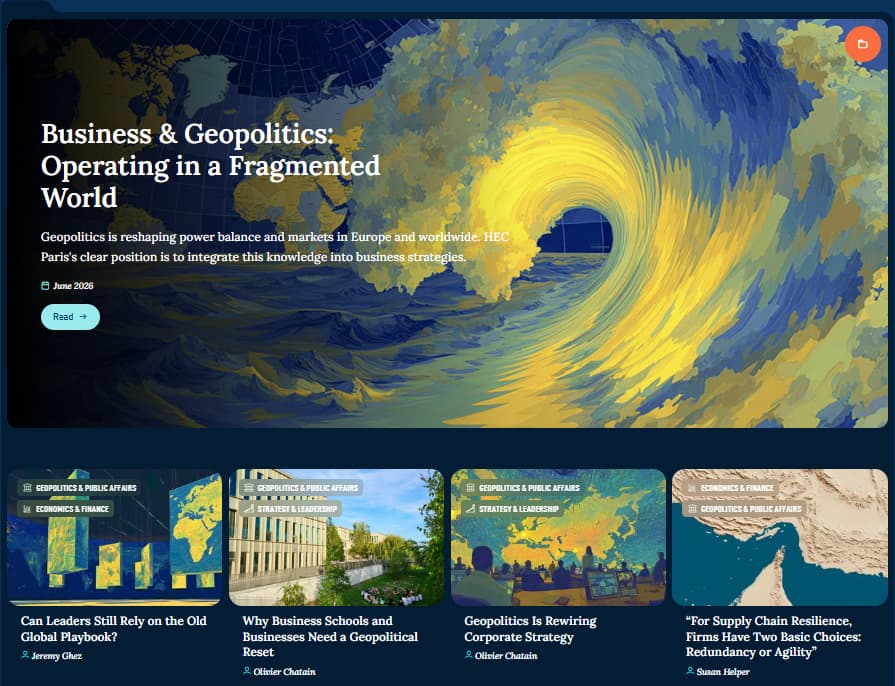
Shattered or Reshaping? HEC Paris Explores How Firms Can Navigate a Fractured Global Order
As geopolitical tensions reshape trade, technology and global value chains, companies are being forced to rethink how they assess risk and make strategic decisions. At the second edition of Shattered or Reshaping? Firms in a Fractured Global Order, HEC Paris and IRSEM brought together scholars, policymakers and business leaders to examine what this new environment means for business, Europe and the future of globalization.
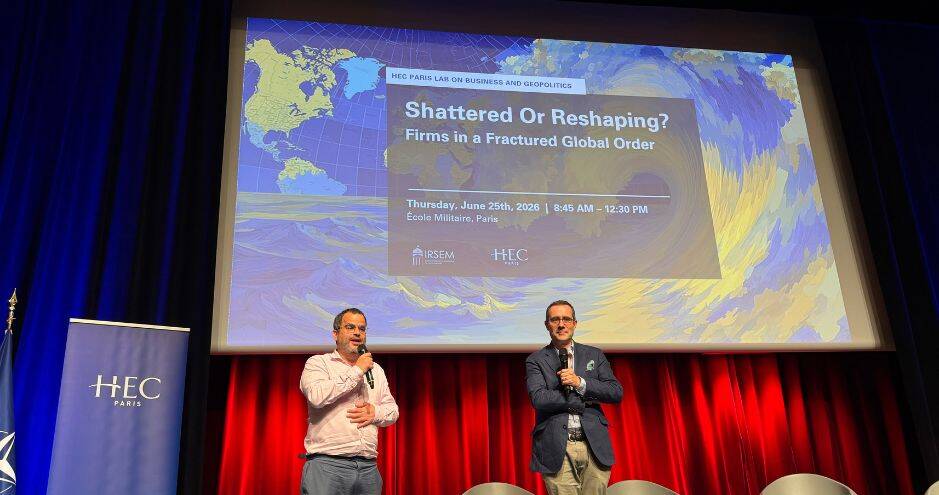
Seeking answers to these pressing questions, HEC Paris and the French Institute for Strategic Research (IRSEM) convened leading academics, policymakers and business leaders on June 25 at the École Militaire in Paris for the second edition of Shattered or Reshaping? Firms in a Fractured Global Order. The conference was organized by Olivier Chatain and Jeremy Ghez (HEC Paris) together with Paul Charon (IRSEM).
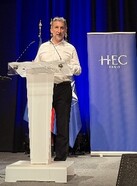
Opening the event, Eloïc Peyrache, Dean of HEC Paris, argued that companies can no longer be treated simply as economic actors. Businesses shape supply chains, technological ecosystems and information flows, making them central players in today's geopolitical landscape.
"If the world is on fire, there will be no business. But if there is no business, the world will be on fire."
His remarks set the tone for a day dedicated not only to understanding how geopolitics affects business, but also how businesses increasingly shape geopolitical dynamics.
Business and Geopolitics Are Becoming Inseparable
One message resonated throughout the conference: geopolitical risk has become an integral part of corporate strategy. Rather than treating it as an external variable, firms are increasingly embedding geopolitical considerations into investment decisions, supply chains and long-term planning.
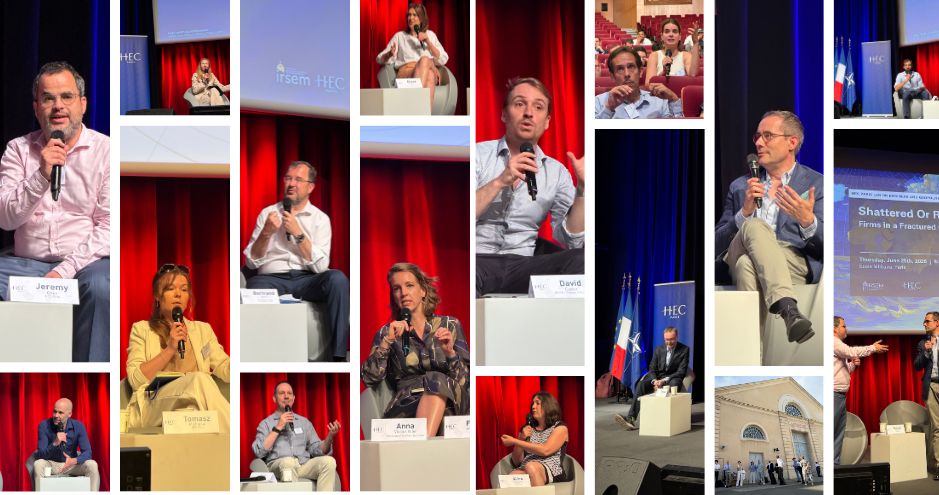
For Bertrand Badré, CEO and Founder of Blue like an Orange Sustainable Capital and former Managing Director and CFO of the World Bank, geopolitical risk itself is nothing new. What has fundamentally changed is the unprecedented degree of interdependence between economies, supply chains and financial markets. In today's world, local political events can rapidly trigger global economic consequences, exposing vulnerabilities that remained largely invisible during decades of globalization.
That does not necessarily mean globalization is coming to an end. Elvire Fabry, Director of the Trade and Economic Security Programme at the Jacques Delors Institute, argued that what we are witnessing is less a process of deglobalization than a profound reorganization of globalization. While strategic rivalry between the United States and China is accelerating fragmentation, dependence on Chinese manufacturing and innovation continues to deepen, creating a far more complex landscape for governments and businesses alike.
Understanding this new landscape also requires better analytical tools. Michael A. Witt, Professor of International Business and Strategy at King's Business School, cautioned against simplistic narratives of fragmentation and argued that researchers must improve both the concepts and the data used to assess geopolitical change. While no one can predict every geopolitical shock, he suggested, scholars can still help organizations understand the broader "climate" in which these events emerge.
The discussion naturally turned to Europe's position in this evolving order. Jeremy Ghez, Professor at HEC Paris, argued that the European Union retains significant leverage through its commitment to rules-based trade and its capacity to build partnerships with other middle powers. At the same time, he suggested that Europe will need to recover a stronger sense of urgency if it hopes to remain a credible geopolitical actor.
Political dynamics also featured prominently in the debate. David Cadier, Research Fellow at IRSEM and Visiting Professor at the College of Europe, explored how the rise of populism is reshaping diplomacy itself. As foreign policy increasingly becomes an extension of domestic political competition, businesses face an international environment where political volatility has become a strategic variable in its own right.
From Geopolitical Risk to Geostrategy
If the diagnosis was clear, the second major theme of the conference focused on how companies are responding.
Drawing on the example of global undersea cable infrastructure, Olivier Chatain, Professor of Strategy at HEC Paris, illustrated how major technology companies are redesigning critical infrastructure to privilege resilience over efficiency. New cable routes deliberately avoid geopolitical chokepoints—even at significantly higher cost—demonstrating how geopolitical considerations are increasingly embedded directly into investment decisions.
For Famke Krumbmüller, Partner at EY-Parthenon, this transformation is also visible inside companies. Many organizations still approach geopolitical events as isolated crises, yet an increasing number are beginning to recognize that today's environment requires permanent geopolitical capabilities rather than temporary crisis committees. Developing what she described as a true "geostrategy" is becoming essential for firms operating internationally.
Governments, too, are redefining their relationship with business. Anna Vlasiuk Nibe, Assistant Professor at the University of Southern Denmark, explained how investment screening and other economic security instruments have rapidly moved from exceptional measures to mainstream policy tools. Firms now operate in an environment where governments intervene more actively in markets in pursuit of strategic objectives, fundamentally changing the rules under which international business develops.
Building Resilience Together
While geopolitical uncertainty is unlikely to disappear, several speakers argued that resilience should not be understood solely as a matter of corporate risk management.
Aline Gatignon, Associate Professor of Strategy at HEC Paris, emphasized that firms cannot build resilience in isolation. Instead, they must increasingly work alongside governments, local communities and civil society organizations to strengthen the institutional foundations that allow economies to adapt to disruption. Rather than simply reacting to crises, companies have an opportunity to help shape the ecosystems in which they operate.
By the end of the conference, one message had clearly emerged: firms are increasingly shaping the geopolitical environment in which they operate. Through their supply chains, technological infrastructure, investment decisions and partnerships, they have become influential actors in their own right.
By bringing together researchers, policymakers and business leaders this conference demonstrated HEC Paris' ambition to foster dialogue at the intersection of business and geopolitics. As geopolitical uncertainty becomes a defining feature of the global economy, the ability to understand and navigate the intersection of business and geopolitics is becoming a defining leadership capability.
More on Dare Special Feature: Business & Geopolitics: Operating in a Fragmented World