
From Engineering to Leadership: Jean Naimeh on a Growth Mindset
“In the EMBA, everyone shares the same mindset of wanting to push themselves further. That’s what makes the friendships different. You build strong connections with people from different fields, united by a common ambition to constantly evolve.”
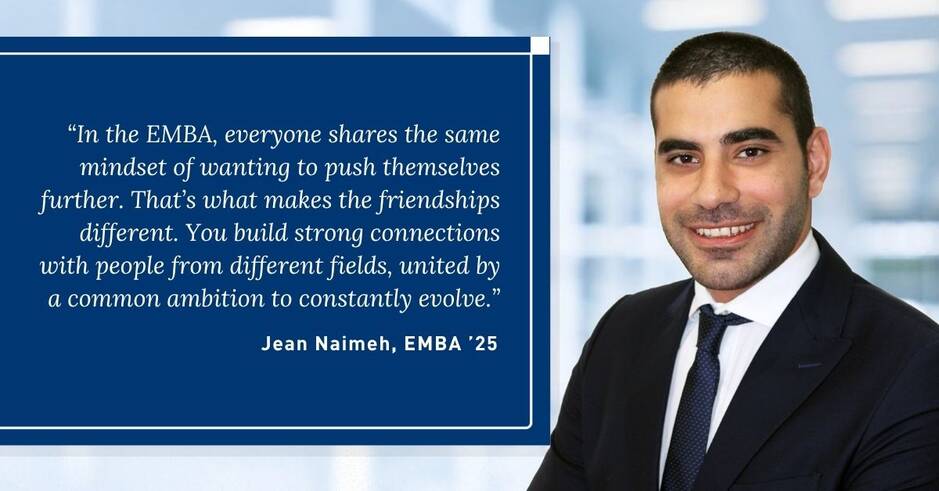
Trained as an aeronautical engineer, recently graduated EMBA alumnus Jean Naimeh began his professional journey at Renault, where he spent seven years managing a team of software architects. He later moved into consulting, joining PwC and rising to Senior Manager in the last four years.
Throughout his career, Jean relied on the analytical approach he developed as an engineer. “Engineering is not only about the technical side,” he says. “It’s about how you think… how you go from point A to point B.”
As he progressed in his role, however, he realized there were areas he wanted to strengthen. “All the things linked to the business side, financial side… how to run a company was missing in my profile,” he says. Filling those gaps became one of the main reasons he decided to pursue an Executive MBA.
Joining the HEC Paris EMBA
Pursuing an EMBA alongside a demanding career is no small feat. For Jean, timing and format were key. He postponed his admission by two years when he joined PwC, recognizing that “learning two things at the same time… was close to impossible.” The flexibility to defer his start date, combined with the program’s block format, allowed him to take on the EMBA at the right moment in his career and make the most of the experience.
HEC Paris stood out for two reasons: reputation and network. In his view, both are essential at senior levels. “Professional opportunities are made from people you meet… not just applying to a job.” This network has proven valuable as he moved into an international role. “The HEC name helps a lot… especially in France,” he adds candidly.
Beyond the classroom
For Jean, one of the biggest surprises of the EMBA was how much learning happened outside the classroom. “In an Executive MBA, you learn from the school and professors, but you learn as much from your cohort,” he says.
Coming from different industries and backgrounds, participants brought experiences that often became part of the lesson itself. Engineers, consultants, finance professionals and entrepreneurs all approached challenges differently, creating discussions that continued long after class had ended. “I would say I learnt 50% from HEC, 50% from my cohort,” he reflects.
More than that, the experience fostered lasting connections. “It’s like being back to school… but you build friends who share the same mindset,” he says. For Jean, being surrounded by friends who were equally invested in learning and challenging themselves became one of the best parts of the experience.
Putting Learning into Practice
He found that many of the lessons from the EMBA could be applied almost immediately at work. Leadership, people management and finance all became more relevant as his responsibilities grew.
Finance was one area that became increasingly relevant as Jean's career progressed. While it hadn't been a major part of his day-to-day responsibilities before the EMBA, the program gave him a stronger grounding in the subject. “Before, I didn't use any financial knowledge,” he says. “Now, I know what people are talking about.” The timing proved useful when he recently moved into PwC's deals business unit, where financial concepts are part of everyday conversations.
The EMBA also gave him the chance to step outside his usual professional environment. Through his specialization, he explored entrepreneurship for the first time, learning how startups are launched, funded, and scaled. “I wasn't in contact with this environment, so it was really eye-opening,” he shares.
Learning directly from founders was one of the highlights. Some had successfully exited their companies, while others spoke openly about ventures that had failed. “It's always important to learn from people who succeed, but also from people who fail,” he adds.
Progress, Not Change
Looking back, Jean sees the EMBA as an accelerator rather than a transformation. “You don't change, you progress,” he says. “You learn what is useful for you and you build on it.” The program helped him strengthen areas he had little exposure to before, from finance to leadership, while exposing him to new industries, perspectives, and opportunities. Shortly after graduation, he took on a new challenge as a Director in PwC's aerospace and defense practice in Riyadh.
His advice to anyone considering an EMBA is simple: don't wait if you see the value. For Jean, the EMBA works best when participants arrive ready to learn from one another as well as from the faculty. “A lot of the modules are not just about getting information from classes,” he says. “It's also about what you can provide to the group and being ready to share what you know.”