
How Radisha Silva broke her own ceiling
Trust gets you in the room. It does not make you indispensable once the room gets more technical than you are. Radisha Silva, VP at J.P. Morgan in Geneva, saw that gap coming and went back to school to close it.
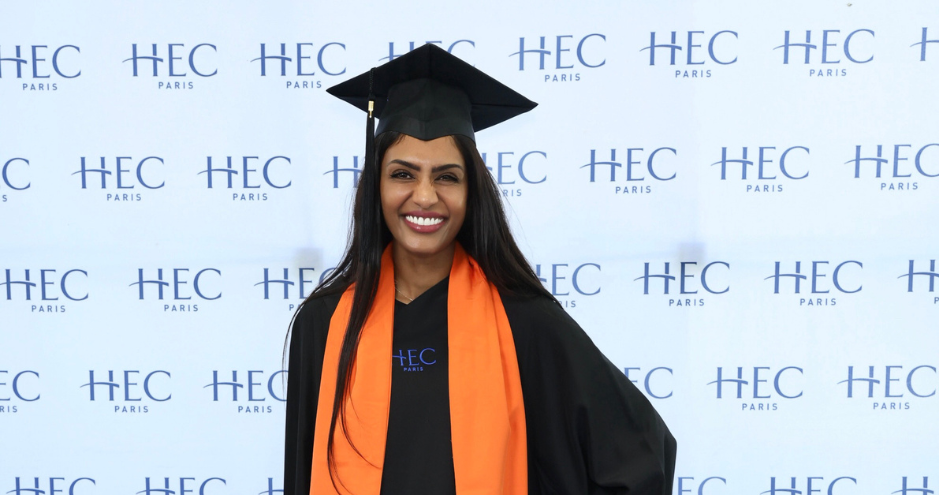
Geneva private banking runs on relationships. Radisha Silva, born and raised in Switzerland to Sri Lankan parents, built hers early. Six months into her internship in Private Banking & Investment Advisory at Rothschild & Co, the CEO offered her a full-time analyst role before she had finished her bachelor’s at EHL. That first role showed her the gap between theory and practice firsthand: business school gives you complete information and one correct answer. This is something you never get from a client.
“In practice, you always have incomplete information, time pressure, and clients with emotions and history,” she explains. When you handle concrete situations for an actual person, she says, things become much easier to understand. The first chapter in her career was all about the people, and relationships, something she keeps nurturing.
She quickly realized that beyond purely technical skills, the discipline to listen well enough to ask the question a client actually needed asked — not the one that would sound clever — was the real differentiator. She even recalls a line her mentor, the Rothschild & Co CEO, would repeat: “We have two ears and one mouth so we can listen twice as much as we speak.”
That instinct carried her into the next chapter of her career. She later transitioned to a Banker Associate role at Rothschild & Co, working directly with the CEO to advise a portfolio of sophisticated clients: top executives and entrepreneurs with a strong finance background who had, for the most part, spent decades managing their own wealth. “Most of them are making their own calls, trusting their own judgment. Letting someone else drive what they have built over the years can be very difficult psychologically.” What these clients expected of her was about to become a question she had to answer for herself.
The ceiling
Radisha names it without flinching. “I find that today there is really an increasing number of sophisticated clients,” she says. “You can be a very warm, trustworthy person, but if you do not have the analytical depth, it becomes at some point a ceiling in your career.” Her clients, she adds, notice fast: “They can immediately sense the difference between someone who is just managing their relationship versus someone who can truly advise them on complex situations.”
It was crystal clear to her: the further she advanced in her career, the more technical her clients became, and the more technical her advice had to be. “Emotional intelligence opens the relationship”, she states, “but it does not, on its own, sustain it,” especially with a client who has run a trading book or built a balance sheet. Before HEC Paris, Radisha says, she could not claim to have both: relationship and technical expertise.
That realization led her to join the Executive Master in Finance (EMIF) at HEC Paris in 2024. While managing market-savvy clients at Rothschild & Co and completing her degree, she received an offer from J.P. Morgan as Banker, VP, to cover the same type of clients (executives, entrepreneurs, and business owners), with a particular focus on commodity trading executives. Recognizing a similar knowledge gap in this new field, she also enrolled in a Diploma of Advanced Studies in Commodity Trading at the University of Geneva, which she completed in July 2026.
The habit she came for
Radisha had no vocation of being an executant. “The biggest blind spot I see with sophisticated clients is that they have a way of doing things, and they just want you to execute, but we have much more to offer”, she explains. But to get there, she needs to build that trust that will seal the relationship. “This is where HEC Paris makes a difference because at the end of the day, what matters to them is that you have a very solid background and a reputation.”
What the Executive Master in Finance gave her first was discipline. Her thesis, on oil futures markets, left her with a reflex she now uses on clients directly: distrust the headline until you have checked it against the structure. A futures contract fixes today the price of oil to be delivered months from now, and comparing the front-month contract to longer-dated ones shows how the market is actually pricing an event: as temporary, or as lasting.
When the US-Iran conflict first disrupted the Strait of Hormuz, she watched exactly that divergence in real time for her thesis. “In the early weeks, the front-month spiked much harder than the 12-month," she says. “The curve was telling you: this is noise, not structural risk.” But the conflict did not pass quickly. As insurers pulled coverage, tankers rerouted away from the strait, and the closure stretched on for months, what had looked like a passing shock started to look permanent. "That's when you knew the market had stopped calling it noise," she says. "It was now clearly a risk."
It is a small methodological shift, but with a direct consequence. It gives her a way to ask a client a sharper question when volatility hits, and to keep asking it as a situation evolves: is this still noise, or has it become risk?
The same instinct extends to her clients themselves. The real difference between an advisor and a financial leader, she says, is the willingness to name a problem the client has not identified yet, even at the risk of being wrong. “What he wants is not just someone who solves the problem he stated. It is someone who identifies the problem he isn’t even aware of.”
She had come to HEC Paris for the framework. What she got alongside it was something she had not budgeted for. “I learned as much from the people I was studying with as in the classroom,” she says. Her cohort was made of senior executives who, within weeks, built a strong group dynamic almost immediately, helping each other prepare, rehearse, and push back. She recalls:
"You didn't feel like you were on this journey by yourself, just going to a classroom and increasing your intellectual knowledge. You felt the whole thing: the networking, the encouragement from people who understood exactly what you were juggling."
The moment she returns to most is the feedback. In group work and presentations, her peers gave her feedback no manager ever had, direct, sometimes uncomfortable, but always meant to help her improve. “I got some of the most honest feedback I’ve had in my entire life,” she says, “and it reshapes the way I lead conversations today.” It is an unusual return on a finance degree: she went in for the technical depth and came out with a different way of listening to a room.
It also unsettled an assumption she had carried since the start of her career. Watching classmates make real moves across industries, she stopped thinking of “financial leader” as a job title tied to one sector. “It’s a mindset,” she says, “the analytical rigor, the way you frame problems, the discipline around risk. Those skills travel.” In the end, the ceiling she came to HEC Paris to dismantle turned out not to be the only one she found.
A seat already earned
Radisha moved to J.P. Morgan eight months ago, while finishing the EMIF’s final thesis chapter. She is careful about what the credential bought her. “There’s a big difference between knowing you can do the job and being able to demonstrate the intellectual framework behind your decisions,” she says, in front of colleagues she calls some of the sharpest she has worked alongside, and to clients who expect both. One of her greatest takeaways she got from her degree was the standing to walk into a room and hold her position in it, “with confidence, but not arrogance”, while still operating, in her words, in an environment where there is always someone smarter in the room, often more than one.
The same recalibration shows up in how she now handles a stalled negotiation. Her instinct, when two sides cannot find common ground, is no longer to keep pushing the original solution. “Very often when you rethink the problem, you find another route that has no link with the first one,” she says, describing a recent client case that was going nowhere until she abandoned the initial framing entirely and found a different solution altogether. The client got there, so did she. The mechanism is the one she names as the real takeaway from the program’s case method: when a deal stalls, the fix is rarely more pressure on the same approach. It is a different question.
The race, not the sprint
The year that produced both credentials: EMIF and the commodity trading diploma, alongside a move to a new bank, cost her, by her own account, time with friends and family she would have liked to see more. But she remains unsentimental about the trade.
What looks from the outside like overload, she describes as something closer to a thrill. “I love being challenged like that," she says. “It's the same feeling as when I drive on an F1 track.” She means it literally: juggling a thesis, a second diploma, and a new role at the same time is like holding several variables in your head at once on a circuit, when to accelerate, when to brake, how to take the turn, all at very high speed. “There's no room for hesitation,” she says. “The key is being extremely focused, extremely concentrated. If you lose that for a second, you go straight into the wall.” Two degrees and a new role, run in parallel, demanded exactly that: no room for anything but focus.

During these last months, she also had to compromise on cooking. Her parents, recently retired, cooked for her throughout the year and left meals in her kitchen so dinner was waiting when she came home. It seems like a small detail, but that’s what made the pace sustainable.
What she is watching now
Asked what she wants to understand next, Radisha goes straight to the topic that might disrupt more than one sector: artificial intelligence. She wants to know how AI will redefine financial advisory work, and specifically what a financial leader will still bring to the table once the technical layer is automated. “The leaders who figure that out early will probably define what the profession looks like in twenty years,” she says. “I want to be part of those people.” It is the same logic that has run through the rest of her career: do not wait for the ceiling to become visible, go find the next one first.
The Executive Master in Finance (EMIF) is the credential Radisha built this shift on.
Also read: Helen Arrey, alumna of the program, on Reinventing her Finance Career.