


 Economics & Finance
 Sustainability & Society

As 2026 unfolds with record-breaking heatwaves in Southern Europe and growing water stress in North Africa, climate resilience is now an economic and security imperative.
While adaptation gaps widen in the Global North, some of the most effective solutions are coming from the Global South. In the middle of this climate crisis, we are witnessing a reversal of innovation flows.
From Nairobi to Valencia, extreme events are exposing the limits of current systems. While attention remains focused on mitigation, the real frontier lies in adaptation.
As Fernando J. Díaz López, Executive Director of the HEC Paris Climate & Earth Center and Lead author for the IPCC Seventh Assessment Report, shows that the Global South is not only coping with the brunt of climate risk—it is also quietly leading a wave of innovation that can transform resilience worldwide.
This “climate resilience transition” marks a shift: these solutions are not just public goods, but scalable business models with global potential. Unlocking them will require investment, reverse technology transfer, and supportive policies.
- Less than 5% of global climate finance targets adaptation—despite evidence that resilience investments yield 10X return.
- Global South ventures like Ushahidi (Kenya) and Cropin (India) are exporting resilience tech to Europe and North America.
- The private market for climate adaptation could reach $1.4 trillion/year by 2030, yet remains vastly underdeveloped.
- Development institutions must now shift focus from project-by-project aid to full ecosystem-building for resilience hubs.
Climate Resilience: A Market and Moral Imperative
With each flood, heatwave, and fire, societies are forced to confront an increasingly volatile reality. Yet less than 5% of global climate finance goes to adaptation. This is above all a missed investment opportunity, and a stark reminder of how misaligned our policies remain. Studies show adaptation measures such as early warning systems and resilient infrastructure offer a tenfold return in net socio-economic benefits.
Adaptation is now an investment opportunity. But capturing this opportunity means looking beyond conventional mitigation-heavy portfolios. A vibrant market for climate resilience is emerging—especially in the Global South.
The Global South Steps Up as an Innovation Engine
In Africa, Asia, and Latin America, startups and entrepreneurs are developing solutions with massive potential. In Kenya, the digital platform Ushahidi crowd-sources real-time data to support disaster response. In India, Cropin is using AI to support regenerative agriculture. In Mexico, Gravalock develops permeable surfaces that combat urban flooding.
These solutions have been deployed in extreme weather events in Europe and North America. And they are gaining traction with multilateral funders, government buyers, and private clients. In 2023 alone, Global South adaptation startups raised nearly $30 billion in venture capital.
When Reverse Innovation Saves Lives in the Global North
The 2024 floods in Nairobi killed nearly 300 people—but the toll could have been far worse without crowd-sourcing rapid-response systems and nature-based interventions designed locally. Months later, the ‘DANA’ flash floods in Valencia caused even greater economic losses—yet, it lacked comparable digital crowdsourcing platforms. Ironically, the same satellite and sensors technology used in Nairobi had originally been funded by European institutions – combined with the use of Kenya-based Ushahidi platform allowed real-time crisis mapping and fast responses. This would have been reverse innovation at work.
For investors, this signals a paradigm shift: value chains for adaptation solutions may flow both ways. The Global South has become a source of innovation in its own right
Unlocking the Business Case for Adaptation Solutions
Climate adaptation is increasingly quantifiable. Recent estimates suggest global demand for resilience solutions—across agriculture, water, infrastructure and cities—will exceed $1.4 trillion annually by 2030. Consumers, governments, and corporates alike are seeking ways to anticipate, absorb, and adapt to climate shocks.
Private actors are starting to take note. DFIs like Proparco and the InterAmerican Development Bank are piloting performance-based mechanisms and sustainability-linked loans. Venture funds are entering the adaptation space. But vast segments remain invisible to capital markets due to data gaps, valuation blind spots, and policy uncertainty.
To bridge this, DFIs and investors must work together to create verifiable markets. This includes supporting intermediaries, investing in common indicators, and experimenting with pay-for-impact models.
Building Ecosystems, Not Just Projects: A New Mandate for DFIs
Unlocking the climate resilience market requires moving beyond project-level interventions. It demands investment in ecosystems: accelerators, incubators, testbeds, and public procurement mechanisms that allow climate ventures to scale.
Programs like UNDP’s Adaptation Fund Climate Innovation Accelerator and the HEC Paris Challenge+ Africa are pointing the way. In Dakar and Abidjan, ventures like Jokalante and Limawa are combining ecosystem building, business innovation with local resilience goals.
For DFIs and institutional investors, the message is clear: if we want climate resilience to scale, we must fund and strengthen the infrastructure and ecosystems of innovation—not just isolated success stories.

The program helps creators of innovative projects with high growth potential
Strengthening DFIs and DAAs in the climate resilience marketplace
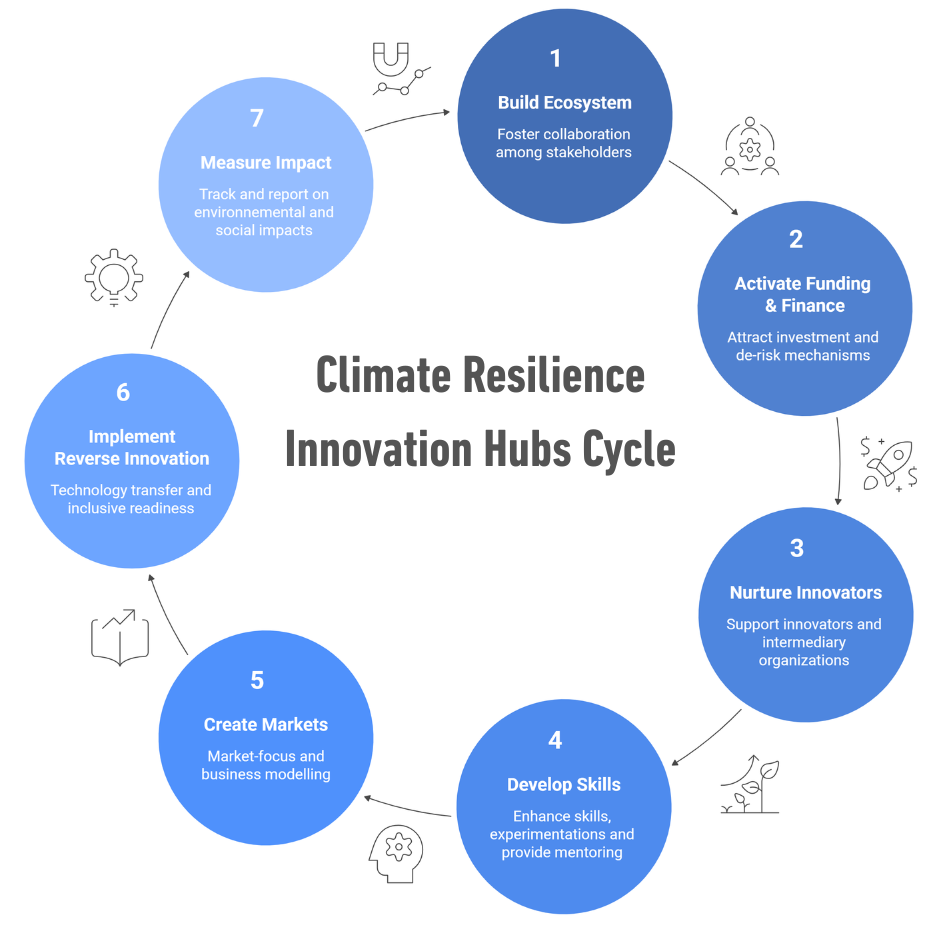
To seize the opportunity for significant private sector engagement, a systemic approach to Global South climate resilience hubs could be adopted.
The following recommendations are proposed to support actionable programming:
- Focus on ecosystem building, shared infrastructures/facilities, testbeds and sandboxes – and involve multiple-stakeholders from the outset.
- Continue the focus on finance and funding (including non-dilutive funding), attracting larger amounts of blended finance and de-risking mechanisms.
- Systematically detect and nurture innovators in thematic areas, but also provide support to intermediary organisations (ESOs, ISOs).
- Pay special attention to skills development, experimentation, learning and novel mentoring programs, adopting a systemic lens.
- Dare to create markets, e.g. use procurement schemes (e.g. climate services), provide access to relational networks (in the global north), and support business modelling.
- Include reverse innovation within (soft and hard) tech transfer and business development approaches, including twining and ‘test-before paying’ schemes.
- Require impact measurements (GHG, environmental/social impacts, gender), in addition to emerging VRM certifications.
Adaptation Can’t Wait—And Neither Can We
In a world marked by cascading climate shocks, budget constraints, and rising inequality, the question has shifted from whether we can afford to invest in resilience—to whether we can afford not to.. The solutions exist, the markets are emerging, and the innovation is already underway—often in places we have not looked closely enough.
What is needed now is the political and financial courage to scale them. If recent crises have shown anything, it is that resilience built anywhere strengthens stability everywhere. The real risk, today, is not moving too fast—but moving too late
Sources
- Trabacchi, C. DFIs’ key role in climate-change resilience | AFD - Proparco. Private Sector & Development#43, 2025
- UNEP, Adaptation Gap Report 2024: Come hell and high water — As fires and floods hit the poor hardest, it is time for the world to step up adaptation actions. . 2024, United Nations Environment Programme: Nairobi.
- Watkiss, P. and K. England, Adaptation finance and the private sector: opportunities and challenges for developing countries. 2025, Zurich Climate Resilience Alliance.: London. p. 72
- Brandon, C., et al., Strengthening the investment case for climate adaptation: A triple dividend approach., in WRI Working Paper. 2025, World Resources Institute: Washington.
- Lacambra, C., et al., Private Markets for Climate Resilience: Global Report. 2020.
- Collins, L., The Unavoidable Opportunity: Investing in the Growing Market for Climate Resilience Solutions, in Discussion Paper. 2024, Global Adaptation & Resilience Investment Working Group: New York. p. 25.






 Geopolitics & Public Affairs


 Strategy & Leadership