
A Leadership Signature, You Don’t Copy It, You Refine It
When Indra Nooyi, then CEO of PepsiCo, was told to walk into a job interview in a sari — “and if they don’t hire you for who you are, that’s their loss” — she didn’t know it yet, but she was getting one of the most important leadership lessons of her life.
Not about strategy or execution. About radical alignment: between who you are, the story you carry, your values, and the organizational challenges ahead. That thread, the Leadership Signature, is at the heart of the approach HEC Paris Executive Education has been building out over the past several years.
For decades, HEC Paris faculty have been digging into questions that now sit squarely at the top of every executive’s agenda: purpose, organizational transformation, situational complexity, team inclusion, resilience. Building on that intellectual capital, a group of professors involved in the executive programs — Emmanuel Coblence, Julien Jourdan, Catherine Tanneau — worked under the direction of Barbara Stöttinger, Dean of Executive Education, Andrea Masini, Dean of Faculty and Research, and Éloïc Peyrache, Dean of HEC Paris, to develop what the school now calls its “Leadership Signature.”
No off-the-shelf recipe, no generic skills catalogue: the Signature is a structured method to help each executive find and own their leadership style, one that genuinely fits their personality, their organization’s culture, and the demands of their specific business context. It rests on five academic pillars - self-awareness, leadership paradoxes, situational intelligence, purpose-based leadership, and leading major transformations - and is designed for a wide range of profiles: emerging leaders, senior managers, C-suite executives.
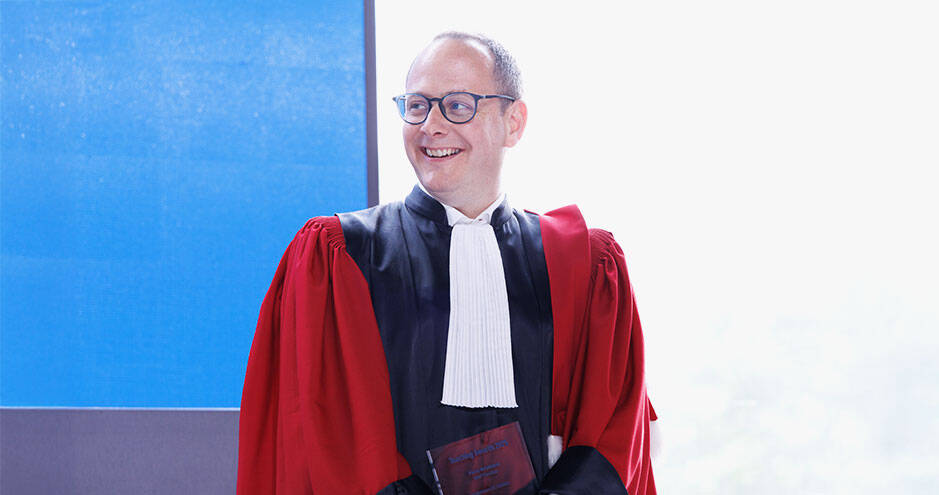
Emmanuel Coblence, Associate Professor of Management and Human Resources and Academic Director of the Leadership programs at ExEd, sits down to explain what it really means to craft a leadership signature.
The leadership literature has never been so abundant, or so contradictory. Distributed leadership, human-centered leadership, AI-driven leadership, emotional resilience, inclusion… How does an executive find their own mark in the middle of all that noise without losing the plot?
Emmanuel Coblence: That’s precisely where our responsibility lies. The sheer volume of research, frameworks, and competing theories has exploded over the past fifteen years or so. Some approaches complement each other; others flat-out contradict one another. And that makes it genuinely hard for a senior manager to work out what kind of leader they want to be, or what kind of leadership they actually want to practice.
What we do at HEC runs counter to the prescriptive approach that tells you, “leadership is primarily about this trait, this dimension.”
We want to open things up, to show that there are many ways of being seen as a leader in professional and organizational life, and to help each participant find and shape their own style. The important thing is that this style has to fit three things: the personality, values, and key principles of the person - which vary from one individual to the next; the culture of the organization they’re working in; and the specific business situation they’re facing. These three dimensions are what we call the signature.
People often talk about “models” and “frameworks” in leadership development. Where does the Leadership Signature sit in that distinction, and why does it matter for how you teach?
E.C.: A model is only worth something when it serves action. At Executive Education, we're not training researchers: we work with managers and executives who already have serious experience under their belts, and who come looking to sharpen their practice, to measure their leadership against that of peers from entirely different industries and backgrounds.
What I know is this: you can learn leadership, but reading a book about it won't get you there. The intellectual stimulus is necessary, but it's not enough. That's why we work according to the principle Herminia Ibarra put her finger on:
Act your way into thinking, rather than think your way into acting.
Leadership development comes through experimentation, through action. Think of it like going to the gym: you're building a muscle memory, developing reflexes and habits, stretching your capacity to act so you can lead with a broader, more varied repertoire - and feel genuinely at ease in situations that used to throw you off. Running a meeting differently, delegating more, shifting register with your team or your own boss: that's where real learning happens.
Our approach, then, is one of stimulation through multiple frameworks, which we put in front of participants and invite them to pick their priorities, turn those into concrete experiments, and then draw their own conclusions. Not the other way round.
And that also shows up in how the faculty works. HEC's leadership team is not a lineup of great individual professors who happen to share a timetable, which is sometimes what you get at competing schools.
We co-design programs, co-facilitate sessions, write cases together on the different pillars of the Signature.
That internal dynamic has helped build a real collective identity around leadership at HEC: an approach broad enough to stay open, and precise enough to stand out.
Five pillars make up the Signature: self-awareness, paradoxes, situational intelligence, purpose-based leadership, and transformation. Why these five and not others?
E.C. : Three reasons. The first is that these themes are rooted in the school's own academic history. Situational intelligence, for instance, goes back to a body of research and teaching that has been alive at HEC for over twenty years - started by Michel Fiol, carried forward by Catherine Tanneau, and backed today by a whole team. These aren't new furrows: we've been plowing them for decades.
The second reason is that these themes are in direct conversation with the most current cutting-edge academic research. Purpose-based leadership sits at the center of the work coming out of the Society & Organizations Chair and Rodolphe Durand's teams over the past ten years. These are living subjects — generating new publications, shifting, evolving every year.
The third reason, and this one matters practically, is their cross-sector universality. Whatever the organizational culture, the industry, the geography, or the function of our participants, these five pillars hold up as fundamentals of leadership development. The question of adaptive leadership in the face of technological and societal upheaval; the question of steering AI-driven transformations: these come to us straight from our participants
How does the Signature actually translate into a concrete method, rather than just a pedagogical promise?
E.C.: Our approach is necessarily experiential, collaborative, and grounded in individual development. It runs on a constant back-and-forth between theory and practice: workshops, peer-to-peer coaching, simulations, role plays, case studies, individual development grids. Every participant leaves with concrete tools — templates to work on their adaptive behaviors, their purpose-based leadership axes, their change management strategies — and a set of experiments to run back in their own work environment.
Our programs are also blended: five online courses map to the five pillars of the Signature, letting each participant get their intellectual grounding before the face-to-face sessions. That way, every minute of in-person time goes straight into collective learning and exchange.
It's a format that suits Executive Education audiences particularly well — people who aren't coming to HEC for a traditional top-down classroom experience.
We're also building an AI Leadership Mentor: a tool trained on HEC's approach that lets participants keep developing once the program is over. This won't be a generic tool that spits out off-the-shelf advice: it's been fed the Signature and takes each participant's specific personality into account. An introvert doesn't need the same recommendations as an extravert.
You can't change a personality; but you can stretch, build out the behaviors and competencies that complement or balance what you naturally bring to the table.
The Move-to-Action protocol sits at the heart of your pedagogical architecture. Yet we know that many executives who go through training understand the concepts perfectly well, and still struggle to change how they actually work. Why is that last step so hard to take?
E.C.: Because changing your habits means throwing yourself off balance. Our participants have built the success of their careers on proven competencies, routines, reflexes, habits — asking them to change some of those is no small thing.
Move-to-Action is about identifying concrete experiments to run within their sphere of responsibility, with a clear cadence.
HEC's faculty role isn't comparable to that of consultants or coaches: we're not walking alongside them every day. But we give the push, we provide the rigorous academic framework, and we create the conditions for them to actually want to change and to learn from what they try.
Some continue exchanging with our faculty after the program, through what we call "leadership conversations" - personalized exchanges to fine-tune their direction and account for the realities of their specific context.
The AI Leadership Mentor we're developing will add another layer to this: refining their experiments, giving them responses that match their personality and preferred behaviors, grounded in the Signature.
The ambition is a genuine continuum — before, during, and after the program.
A 2024 McKinsey survey found that 55% of CEOs reported mental health difficulties in the previous year — a jump of 24 percentage points in a single year. Executive loneliness seems to be getting worse. Beyond the tools and protocols, what role does peer work play in your setup?
E.C. : It's probably one of the best reasons to sign up for a leadership program at HEC. Executive loneliness isn't new - it's been a feature of power and responsibility for as long as organizations have existed. But what our programs can actually do is crack it open. Through the encounter with the academic team, and through what the German philosopher Hartmut Rosa calls the "crackling" - that electricity that builds in a classroom between participants who share the same dilemmas - executives discover they're not alone.
We also work on what I call the executive's Supporting Cast, built around three complementary roles: Mentors, who guide the thinking and ask the right questions; Mirrors, the peers or collaborators you formally give permission to tell you the truth about how you lead; and Sponsors, the senior leaders who provide cover and resources. Knowing how to build a solid, varied MMS network - Mentors, Mirrors, Sponsors - is one of the most concrete competencies our participants develop.
The Signature speaks to everyone from the emerging leader to the confirmed C-level executive. That's a pretty wide net. How do you cast it that broadly without the approach losing its bite?
E.C.: The five pillars can be taken as a whole - what we call the "Full Signature" - or targeted individually, based on what the moment calls for. A senior manager facing serious technological disruption will find their priority in Adaptive Leadership. An executive whose company is building out a strong purpose will get more from the Purpose-Based Leadership module. A manager making the shift from a hierarchical role to a cross-functional one will get the most from Orchestrating Transformation.
We cover the same themes, but not with the same tools or content: the seniority of participants fundamentally changes the nature of the cases, the discussions, and the workshops.
Get people in a room who share the same stakes, the same difficulties, the same needs, and a comparable level of seniority, and you get that crackling. That's the pedagogical promise of leadership programs in the age of AI.
To close: is shaping your signature also about making peace with the fact that you can’t be everything to everyone?
E.C.: Of course. Shaping your signature means giving things up. You can't be the ideal leader in every situation. The work is finding the ones where the fit comes more naturally: where you'll thrive, feel like yourself, be seen as the right person in the right place for the right project. That also keeps burnout and emotional fragility at bay.
There's no universal leadership style, and there's no miracle leader who can do it all, everywhere, all the time. The match between who I am, what I do, and the situations I face isn't fixed: it shifts over the course of a career. Developing your leadership means knowing the conditions under which your teams can grow - without taking up all the oxygen, without solving every problem - which also means preparing what comes next, for yourself and for the organization. And that, too, is the reflection our programs generate.
References
- Fiol, M., Tanneau, C., Delahaie, P., & Bonnefous, A. M. (2017). L’intelligence situationnelle : 50 situations de management décryptées, 67 fiches concepts. Editions Eyrolles, Paris.
- Durand, R., & Ioannou, I. (2023). How leaders can create a purpose-driven culture. Harvard Business Review, November 7.
Rosa, H., & Endres, W. (2022). Pédagogie de la résonance : Entretiens avec Wolfgang Endres. Le Pommier.