
Leading When the World Stops Following Its Own Rules
Executives want to know what happens next in Iran, in Washington, in the markets. Professor Jeremy Ghez argues that the real skill in a broken world is no longer predicting what happens next, but spotting which of the assumptions that made them successful have stopped working.
The wrong question
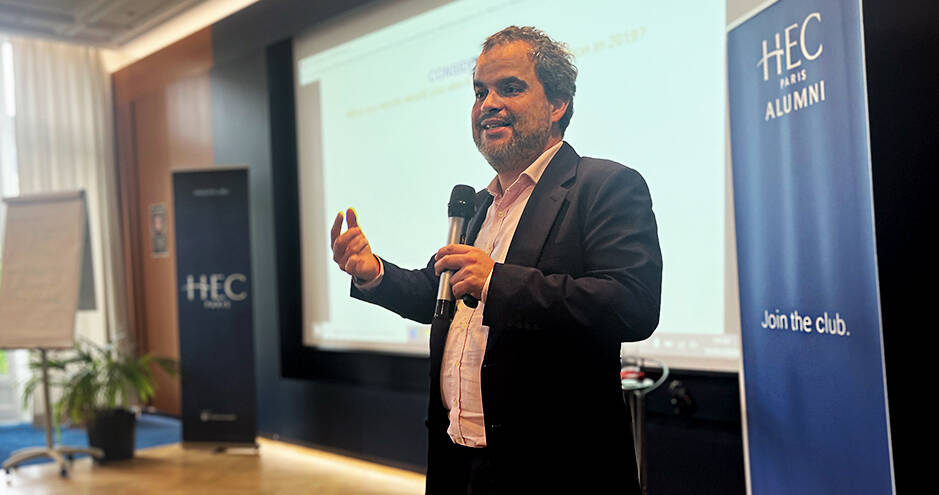
What people want from Jeremy Ghez is almost always a prediction. Who wins the next American election? What happens next in Hormuz? The Professor of Economics and International Relations at HEC Paris answers that he has no clue, and means it. The job, as he sees it, is not to forecast events but to frame the problem, to work out which questions are worth asking in the first place. The demand for a prediction misreads it.
What has changed, he argues, is not the world's supply of risk but the attention paid to it. Colleagues keep telling him he must be busy these days. “I've been busy for 15 years”, he replies. “It's just that you've been paying attention right now”. The risks executives must now price run past finance, past strategy, past conventional market risk. Those still matter. But the list of things that have to be watched keeps growing, until the very discipline at the heart of executive training, the assessment of risk, no longer knows quite where to point. There is no longer a settled set of dangers to measure.
This isn't the world you trained for
The instinct of most decision-makers is to treat the world as a detective novel. “They want a clean, linear story”, Ghez observes. “There's a dead body, and I want to know who the killer is”. The appeal is structural: a beginning, a climax, a conclusion, something that can be held in one hand and acted on.
But the present “is messy and confusing – which, on its own, would be survivable”, Ghez allows. The greater difficulty is that it “contradicts everything we learned in the classroom", in early careers, and culturally, about how the system is supposed to behave – a contradiction sharpest in Europe, whose assumptions ran in nearly the opposite direction.
So the work is no longer detection. "We're not in an Agatha Christie novel", as Ghez puts it. "We're in a Stranger Things episode".
The monster is visible and can even be named; naming it explains nothing. What matters is the step past the label: framing the problem, establishing what is actually happening, asking the questions no one has asked yet. On the evidence of the past decade, “we're not a generation that's going to be blessed with clarity”.
Three assumptions that no longer hold
Each one, Ghez points out, “helped you become who you are today, and that's the worst part”, because the rule that has to go is the one that worked.
Geopolitics: that the game is positive-sum
For four decades, globalization rested on the premise that the world was a positive-sum game. Ghez traces it to Getting to Yes, the 1981 negotiation manual that became a fixture of business and diplomatic training. Its argument was that the purpose of any negotiation is compromise: identify overlapping interests, build on them, and, because every party has a stake in the table holding, generate shared norms and precedent. “We know they're out there”, he says of those shared interests, “because the world is a win-win game”. Scaled up, that logic produced multilateralism and the World Trade Organization, where, in principle, the smallest member could sue the largest.
The competing text is The Art of the Deal, which treats negotiation not as compromise but as a contest to be won. “Because the world is not a win-win game. It's a zero-sum game. What you win, I lose”, Ghez summarises.
The premise drives the tactics: make it personal, use showmanship, make extravagant claims just to see what your red lines are.
What counts is no longer the ability to live together but a sequence of short-term, ad hoc arrangements indifferent to precedent.
The shift the two books capture is a change in what interdependence is for. “I depend on you, you depend on me” once worked as mutual insurance: the very fact that we needed each other was the guarantee that neither would do the other harm. That same dependence is now turned into a lever. The reasoning inverts, in Ghez's words: “You depend on me, so I'm going to make you pay a dear price for that”. Analysts have a name for it, weaponized interdependence, dependence used not to bind rivals together but to inflict costs on them.
The data records the inflection. Trade as a share of world GDP rose from roughly 26 to 27 percent in 1970 to 61 percent by 2008, on the back of liberalization and offshoring. The comparable figure in 1913, during an earlier golden age of globalization, sat below 20 percent. Since 2008 the line has flattened. Read generously, the plateau is an achievement to defend; read otherwise, it is a driver that has run its course, and trade is now examined “with a far more political eye than in the past”.
Politics: that the dividends would be broadly shared
“We legitimately believed everyone would become richer”, Ghez recalls, and that patience has run out. He illustrates the erosion with an unlikely benchmark: Homer Simpson. A single income supports a house, two cars, three children and a spouse at home. For years, it read as an ordinary middle-class life. “People are waking up and saying that's a scam”, he notes. “That's not the life of a middle-class person. That is the life of a rich person”. The gap between the two is politically combustible. It opens space for movements that feed on the discontent, and forces those who still defend the model to concede that “maybe we have to stop talking in terms of free trade” and start talking about self-sufficiency.
The French polling captures the drift. Asked in 2017 whether the state should protect vulnerable people and industries or adapt the economy to global competition, roughly a third chose protection and two-thirds adaptation. By 2022, the same question split the electorate close to evenly. Economists, Ghez notes, relearn their alphabet after each crisis, debating whether a recovery traces a V, a U or an L. The shape now in fashion is the K, with “winners and losers”, and the danger, he warns, is that “the pocket of winners gets smaller and smaller”.
Technology: that everyone relies on the same tools
The pursuit of comparative advantage anywhere on the planet rested on an unspoken premise: that all parties would continue to rely on the same technology indefinitely, and that exclusion from the system supplying it was a credible sanction. Technology enforced good behavior.
That premise is dissolving. As UBS chief economist Paul Donovan argues, new production technologies are “simpler, more digital and more local”, which means, in Ghez's gloss, “I don't need to rely on the rest of the world to do what I need to get done”. The vocabulary of supply chains tracks the retreat almost in real time. Offshoring became reshoring, though the returning plants run on automation and bring back few jobs. Reshoring became nearshoring, then friendshoring: production is sited not where it is cheapest, but where a partner is unlikely to turn the dependency against you.
For Ghez, the decisive marker was the arrival of a competitive Chinese AI model. That, he recalls, “is the moment I started to ask what in the world is happening to that global system”, the last piece blowing apart.
I used to believe in a world where technology would keep us honest. No more.
The hardest two words in business: "so what?"
The analytical work, Ghez argues, is not in reading the world. Senior executives know the Financial Times by heart and their businesses cold. It lies in connecting the two: turning a changing environment into a decision that can be taken on Monday. He calls the move “the two most beautiful words in English: so what?” It is also, he adds, the hardest step there is. Hard because it forces questions most leaders would rather avoid.
- The one Ghez finds executives most reluctant to ask: Do we really have the right talent?
- Where can the business actually operate, now that extraterritorial law can turn a single global brand into a liability?
- What are we doing today that we will still be doing tomorrow?
- And what have we never imagined doing that we will be forced into?
The first question exposes how defensive leaders become about their own people. The second has begun to redraw strategy: the finance executives who impress him most are rethinking the logic of M&A, concluding that a company unable to operate under one brand in a broken world may need a portfolio of them. The last two mark the real divide. One is a question of improvement, refining what the firm already does. The other is a question of creative destruction, forcing it toward what it has never attempted and cannot avoid. Boardrooms, Ghez observes, are drawn to the third and avoid the fourth.
Your playbook isn't wrong, only obsolete
The temptation is to keep running the existing playbook because it has always worked, the way a reliable recipe is repeated because it tastes good. “You'd think in business it might be the same thing”, he remarks. “It's not a question of taste anymore. It just does not work anymore.”
The assumptions now under strain are not abstract or external. They are the ones that produced today's incumbents, which is precisely why they are difficult to abandon. The capability that radical uncertainty rewards is not a sharper forecast but a discipline: the regular regeneration of one's own assumptions, and the willingness to interrogate hardest those that have served best.
That discipline matters all the more because the talk of self-sufficiency and sovereignty promises a cleaner break than the world will deliver. Dependence is not ending.
The global economy, in Ghez's image, “looks like an old couple that can't stand each other, but that can't live without each other either”.
The mistake is to read that as a fixed picture. The world is never to settle on an answer, but to keep asking what you do today that you may not be able to do tomorrow, because somewhere, a partner, a rival, a technology has already decided to do something else.
This article draws on Jeremy Ghez's HEC Paris Executive Education masterclass, "The World is Breaking… So What?" That same question anchors a new program launching in October: not an account of how frightening the world has become, but a working method for reframing the problem and rebuilding a playbook for doing business in it.
|