


 Strategy & Leadership

Companies are still judged by what they produce but increasingly, also by what they stand for. Yet mainstream economics has little to say about purpose at work.
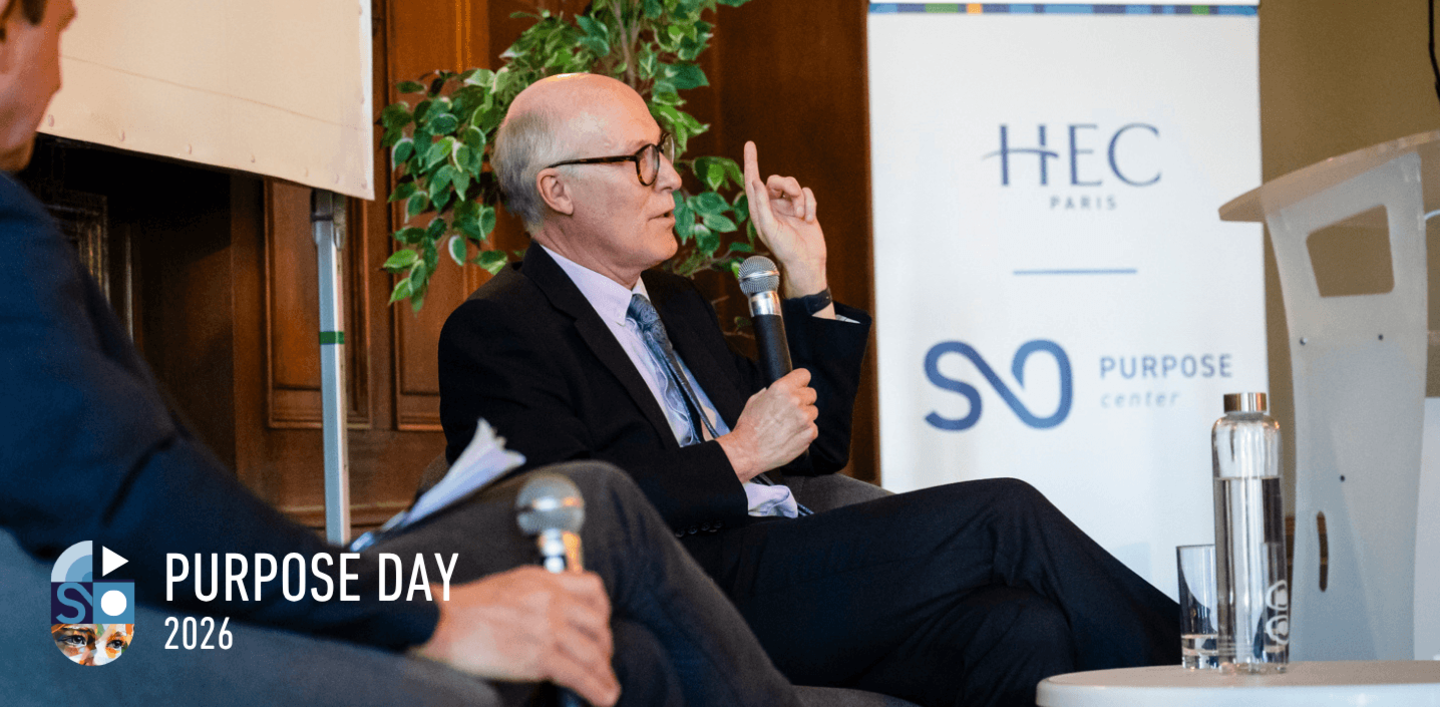
In his keynote at HEC Paris Purpose Day, Professor Tim Besley at London School of Economics argues that this is a blind spot. Drawing on economics, philosophy, and political theory, he proposes a new framework in which firms serve as more than producers of private goods: they also create meaning, foster motivation, and generate “public goods” within the workplace.
If that’s true, then the way we think about productivity, leadership, and regulation may need a fundamental reset.
Rethinking the Firm: Beyond Profit and Efficiency
Traditional economic models focus on efficiency: do firms allocate resources well? Do markets deliver optimal outcomes?
But according to Besley, this framework is incomplete. It largely ignores a central question: what kind of experience does work create for individuals?
There is currently no widely accepted way to integrate purpose into economic analysis. Nor is there a clear measurement framework. While metrics like wages and productivity are well established, concepts like dignity, respect, and meaning remain underexplored.
This gap matters because it leaves out a critical dimension of how economies actually function.
Why Purpose Drives Motivation and Productivity
One of Besley’s key arguments is that workers are not just economic agents — they are motivated agents.
Employees care about the nature of their work, the values it represents, and the impact it has. When these elements align, motivation increases and so does productivity.
This insight challenges the traditional view that incentives are primarily financial. Instead, purpose becomes a source of competitive advantage.
Recent research by HEC Paris Professor Rodolphe Durand helps explain how this happens in practice. Durand and his co-authors have shown that purpose becomes a source of organizational advantage when it is actively discussed and interpreted within teams. Their research finds that employees are more committed when managers engage them in regular conversations about the firm's purpose and connect it to everyday work. Purpose does not drive performance through slogans alone, but through the relationships, trust, and shared understanding that organizations build around it.
Firms that align organizational goals with employee values can unlock higher engagement and performance — not through control, but through meaning.

Discover the CLARITY© model to structure and align leadership around a deep purpose-based management experience.
From Pay to Respect: What Data Reveals
Empirical evidence reinforces this shift. Survey data shows that feeling respected at work is strongly correlated with overall life satisfaction. But surprisingly, income explains very little of this variation.
Instead, the strongest predictors are workplace-specific factors, including:
- Trust in management
- Pride in the organization
- Quality of the work environment
Even occupation and political affiliation have limited explanatory power. This suggests that purpose is not a function of status or salary — but of organizational culture and leadership.
Purpose, Power, and Workplace Equality
To understand purpose more deeply, Besley turns to philosophy.
Drawing on Elizabeth Anderson’s concept of relational equality, he highlights that inequality extends beyond differences in income to encompass power dynamics and hierarchical relationships within organizations.
Workplaces are structured around authority relationships. But when employees are given autonomy and a sense of ownership, motivation increases.
Similarly, Michael Sandel’s idea of contributive justice emphasizes that people want to feel they are contributing to society through their work. Together, these perspectives suggest that purpose emerges when:
- Employees are respected and empowered
- Work is aligned with broader societal goals
- Organizations foster a sense of shared mission
When Firms Become Political Actors
The discussion of purpose ultimately leads to a broader political debate.
As firms take on broader responsibilities — from sustainability to social impact — they increasingly operate in areas traditionally governed by the state.
This raises fundamental questions:
- Should companies define social purpose?
- Or should governments set the rules?
- What happens when political systems fail to deliver?
Besley warns against relying entirely on “private politics” where corporations fill governance gaps. Instead, he argues for strengthening public institutions while recognizing that firms are now inherently political actors.
In this context, purpose is not just a management issue, it is a societal and political challenge.
A Necessary but Unfinished Framework
Does the search for purpose at work “open a can of worms”?
According to Besley, it does. It complicates economic theory, forces engagement with philosophical questions, and raises difficult political trade-offs. As organizations become central to how individuals experience meaning, identity, and contribution, the challenge shifts from whether firms should engage with purpose to how they can do so responsibly.
What is still missing is a coherent framework that integrates economics, philosophy, and politics. Building that framework may be one of the most important challenges for business leaders — and for society — in the years ahead.





 Innovation & Entrepreneurship